Introduction: Walking the Circle of Power
Bagua Zhang (Eight Trigram Palm) stands as one of the three major internal Chinese martial arts, alongside Tai Chi Chuan and Xing Yi Quan. Yet among these three sisters, Bagua Zhang is perhaps the most enigmatic and visually distinctive. Its practitioners walk in circles, their palms held in specific configurations, their bodies spiraling and coiling like dragons in motion. To the uninitiated, it appears almost like a ritual dance; to the knowledgeable observer, it reveals itself as one of the most sophisticated combat and health systems ever devised.
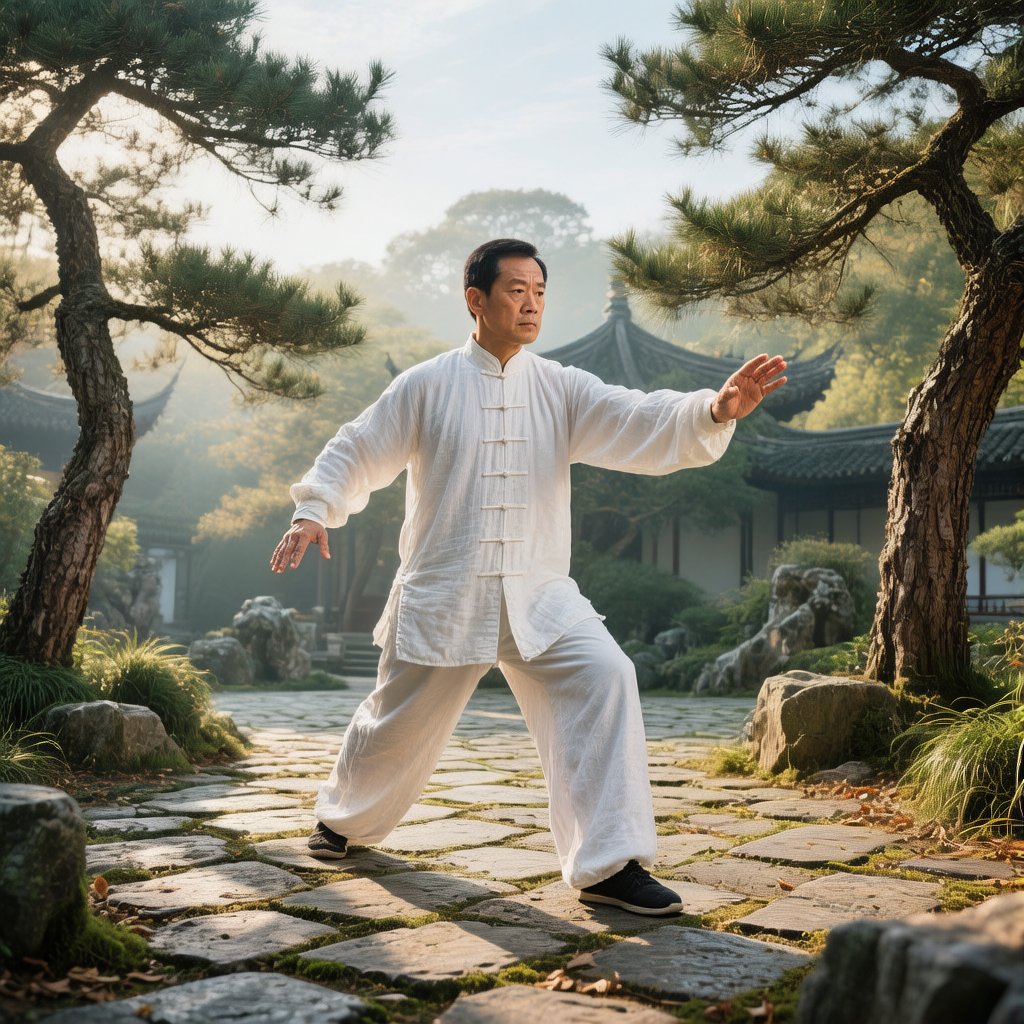
Created in the 19th century by the legendary Dong Haichuan, Bagua Zhang integrates the philosophical wisdom of the I Ching (Book of Changes) with a revolutionary approach to movement that emphasizes constant change, circular evasion, and devastating close-range power. This article explores the art’s philosophical foundations, its unique training methodology, the development of internal power through circular practice, and practical guidance for those seeking to walk the Bagua path.
The Philosophical Foundation: The Eight Trigrams
Bagua Zhang draws its name and conceptual framework from the Eight Trigrams (Ba Gua) of the I Ching. The trigrams are eight three-line symbols composed of broken (Yin) and unbroken (Yang) lines, each representing a fundamental force or principle in nature:
| Trigram | Chinese | Nature | Attribute | Martial Application |
|---|---|---|---|---|
| Qian | 乾 | Heaven | Creative strength | Lion palm — powerful, sweeping strikes |
| Kun | 坤 | Earth | Receptive yielding | Unicorn palm — absorbing, redirecting |
| Zhen | 震 | Thunder | Arousing movement | Dragon palm — sudden, explosive |
| Xun | 巽 | Wind | Gentle penetration | Snake palm — flowing, penetrating |
| Kan | 坎 | Water | Abysmal depth | Bear palm — heavy, overwhelming |
| Li | 離 | Fire | Clarity, attachment | Hawk palm — swift, precise |
| Gen | 艮 | Mountain | Stillness, rest | Ape palm — agile, unpredictable |
| Dui | 兌 | Lake | Joy, openness | Phoenix palm — expansive, enveloping |
The genius of Bagua Zhang lies in its application of the I Ching’s core principle: constant change. Just as the trigrams transform into one another through the movement of Yin and Yang lines, Bagua Zhang techniques flow and transform without pause, never allowing an opponent to find a fixed target. This philosophical grounding gives Bagua Zhang its distinctive character as an art of perpetual transformation.
Dong Haichuan: The Founder and His Legacy
Dong Haichuan (1797-1882) is one of the most remarkable figures in Chinese martial arts history. Born in Wen’an County, Hebei Province, Dong spent years wandering China, studying with Daoist and Buddhist teachers, and allegedly learning circle-walking meditation practices from a Daoist hermit in the mountains. Around 1865, he appeared in Beijing and began teaching the art he called “Zhuan Zhang” (Turning Palm), which later became known as Bagua Zhang.
Dong’s teaching method was revolutionary: rather than teaching a fixed set of forms, he adapted his instruction to each student’s existing martial arts background and physical characteristics. A student with Xing Yi experience would learn a different version of Bagua than one with Shaolin experience. This individualized approach gave rise to the numerous sub-styles of Bagua Zhang that exist today, including the Cheng style, Yin style, Liang style, Gao style, and Jiang style, each emphasizing different aspects of Dong’s original teachings.
The Core Practice: Circle Walking
The foundation of all Bagua Zhang training is circle walking (Ding Shi Ba Gua Zhang). Practitioners walk the circumference of a circle—typically 8 to 12 feet in diameter—while maintaining specific palm positions and body alignments. This seemingly simple practice contains extraordinary depth and develops multiple capabilities simultaneously:
Physical Benefits
- Cardiovascular conditioning: Continuous circle walking provides sustained aerobic exercise that improves heart health and endurance without the joint stress of running or jumping.
- Lower body strength: The characteristic “mud-walking” step (Tang Ni Bu), where the feet glide close to the ground, develops exceptional leg strength and ankle stability.
- Spinal mobility: The constant twisting and turning of the torso while walking the circle creates a comprehensive spinal workout that maintains flexibility and disc health.
- Proprioceptive enhancement: Walking in a circle while maintaining internal awareness challenges the vestibular system and improves balance in ways that linear movement cannot.
Martial Applications
Circle walking develops the ability to move around an opponent rather than meeting force head-on. The circular path creates constant angle changes that make it difficult for an opponent to track the practitioner’s center, while the walking itself generates momentum that can be suddenly redirected into strikes, throws, or joint locks. The principle of “walking to the opponent’s back door” (approaching from behind the opponent’s guard) is a core Bagua strategy that circle walking directly trains.
The Eight Palms: Bagua’s Technical Foundation
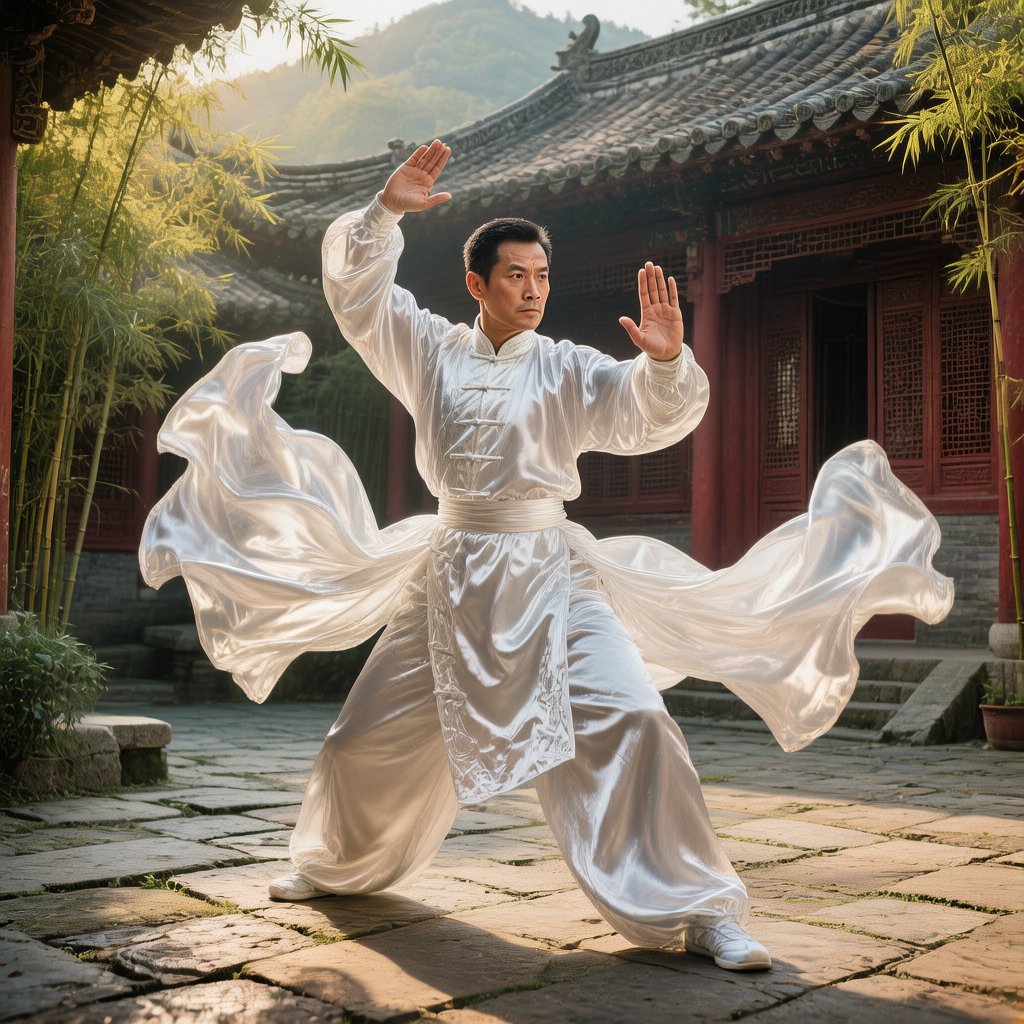
Each of the Eight Trigrams corresponds to a specific palm position and fighting strategy. These are not merely hand shapes but complete body configurations that integrate posture, intention, and movement:
The Mother Palms (Ba Mu Zhang)
The eight “mother palms” are the fundamental static palm positions practiced during circle walking. Each palm position creates a distinct body alignment and energy configuration:
The Lion Palm (Qian Trigram) opens the chest and extends power outward through the entire arm, developing the capacity for wide, sweeping strikes. The Dragon Palm (Zhen Trigram) coils the body like a spring, storing potential energy for sudden explosive release. The Snake Palm (Xun Trigram) elongates the fingers and extends reach, training precision and penetration. Each palm position is a complete qigong exercise that develops specific physical and energetic qualities.
The Palm Changes (Huan Zhang)
The transitions between palm positions—known as “palm changes”—are where Bagua Zhang’s combat applications reside. Each palm change is a flowing sequence that includes strikes, throws, joint locks, and evasion maneuvers. The classical eight palm changes of the Cheng style, for example, contain within their flowing movements dozens of practical combat techniques that can be extracted and practiced individually.
The key principle is that palm changes are never practiced as fixed routines but as adaptive, responsive movements that change according to circumstance. A palm change that flows one way when practicing solo might flow in the opposite direction when responding to a specific attack, embodying the I Ching principle of adapting to change.
Internal Power Development: The Spiral Path
Bagua Zhang’s approach to internal power (Nei Jin) is unique among Chinese martial arts. While Tai Chi develops power through relaxation and Xing Yi develops it through structure, Bagua develops power through spiral movement. Every Bagua technique involves twisting, coiling, and unwinding motions that generate force through the body’s rotational mechanics.
The Three Wrappings (San Guo)
Bagua Zhang’s internal power is organized around three primary wrapping actions:
- Shoulder wrapping (Jian Guo): The shoulders spiral forward and inward, connecting the arms to the spine and creating a unified structure for force transmission.
- Hip wrapping (Kua Guo): The hips rotate in coordination with the shoulders, creating the “cross-body” connection that allows the power of the legs to reach the hands.
- Elbow wrapping (Zhou Guo): The elbows spiral inward toward the body’s center, maintaining structural integrity and protecting the centerline.
When all three wrappings operate simultaneously, the body becomes a single spiraling unit—what Bagua practitioners describe as “the whole body becoming a fist.” This spiral force is qualitatively different from the linear force of external martial arts: it is harder to detect, more difficult to resist, and more damaging upon impact because it introduces rotational forces that disrupt the opponent’s structure.
Open-Close Power (Kai He Jin)
The second dimension of Bagua’s internal power is the alternation between opening (Kai) and closing (He). Opening power expands the body outward—useful for striking, pushing, and creating distance. Closing power contracts the body inward—useful for pulling, trapping, and closing distance. Advanced Bagua practitioners learn to use both simultaneously: one part of the body opens while another closes, creating contradictory forces that overwhelm an opponent’s ability to adapt.
Combat Strategy: The Art of Evasion and Flanking
Bagua Zhang’s combat strategy differs fundamentally from most martial arts. Rather than engaging an opponent directly—standing in front and exchanging techniques—Bagua emphasizes constant movement and positional advantage. The core strategy can be summarized in three principles:
1. Never Be Where the Attack Lands
Bagua practitioners train to move off the line of attack before making contact. Circle walking develops the instinct to step to the opponent’s flank or rear, positions from which the opponent’s weapons are least effective and the practitioner’s are most accessible.
2. Strike While Moving, Move While Striking
In Bagua, there is no separation between movement and technique. Every step is a potential strike, and every strike includes a step. This integration of locomotion and combat action makes Bagua techniques extremely fast, as they eliminate the telegraphic pause between moving and attacking.
3. Control Through Connection
Once contact is made, Bagua practitioners maintain it, using the tactile sensitivity developed through circle walking and partner practice to track the opponent’s center and intentions. Unlike Wing Chun’s “sticky hands,” Bagua’s contact is often at the shoulder, hip, or back—closer to the opponent’s center of mass—enabling throws and takedowns in addition to strikes.
Training Tips: Developing Your Bagua Practice
- Start with Single Palm Circle Walking: Before attempting palm changes or two-person exercises, spend at least three months walking the circle with a single palm position. Focus on maintaining level height, keeping the feet close to the ground, and turning the waist toward the center of the circle.
- Practice Both Directions Equally: Always walk both clockwise and counterclockwise circles. Most people have a dominant direction and tend to neglect the other. Balanced practice prevents muscular imbalances and develops bilateral coordination.
- Develop Your “Mud Walking” Step: The Tang Ni Bu is the foundation of Bagua footwork. Practice it slowly, feeling the entire sole of the foot skim the ground as if walking through mud. This develops the ankle strength and proprioception that enable the swift, deceptive footwork Bagua is known for.
- Study the I Ching: While not strictly necessary for physical practice, understanding the I Ching deepens your comprehension of Bagua’s movement principles. The hexagrams and their transformations provide a conceptual framework for understanding why Bagua techniques work and how to adapt them to changing circumstances.
- Find a Qualified Teacher: Bagua Zhang is extraordinarily difficult to learn correctly from books or videos alone. The internal alignments, spiral pathways, and subtle body mechanics require hands-on correction from an experienced teacher. Invest time in finding a qualified instructor before developing habits that are difficult to correct.
Bagua Zhang and Health: The Medical Dimension
Beyond its martial applications, Bagua Zhang has significant health benefits that are increasingly recognized by medical researchers. The art’s emphasis on spinal rotation makes it particularly effective for maintaining back health and preventing age-related spinal degeneration. A study published in the Journal of Alternative and Complementary Medicine found that Bagua Zhang practice improved spinal mobility and reduced chronic lower back pain in middle-aged practitioners.
The cardiovascular benefits of sustained circle walking have also been documented. Research at the Beijing University of Chinese Medicine demonstrated that 30 minutes of Bagua circle walking produces cardiovascular responses comparable to moderate-intensity aerobic exercise, with the added benefits of improved balance, coordination, and cognitive function.
The meditative aspect of circle walking—maintaining internal awareness while moving continuously—appears to produce neuroplastic changes similar to those observed in mindfulness meditation practitioners. Regular Bagua practice has been associated with improved attention, reduced anxiety, and enhanced emotional regulation.
Conclusion: Embracing the Way of Change
Bagua Zhang offers a unique path within the Chinese martial arts—one that embraces change as the fundamental principle of both combat and life. Its circular movement patterns, spiral force generation, and philosophical grounding in the I Ching provide a comprehensive system for physical development, martial skill, and spiritual cultivation.
In a world that often demands rigidity and fixed positions, Bagua Zhang teaches us to flow, adapt, and transform. As the I Ching reminds us: “The only constant is change.” To walk the Bagua circle is to embody this truth—to practice, with every step, the art of harmonious transformation that lies at the heart of Chinese wisdom.