Introduction: The Cradle of Chinese Martial Arts
Shaolin Kung Fu is not merely a martial art—it is a cultural institution, a spiritual practice, and a symbol of Chinese civilization that has endured for over fifteen centuries. Born in the halls of the Shaolin Temple on Mount Song in Henan Province, this tradition represents the most comprehensive and influential system of Chinese martial arts ever developed. From its humble beginnings as a form of exercise for meditating monks to its current status as a globally recognized cultural phenomenon, Shaolin Kung Fu has continuously evolved while maintaining its essential character.
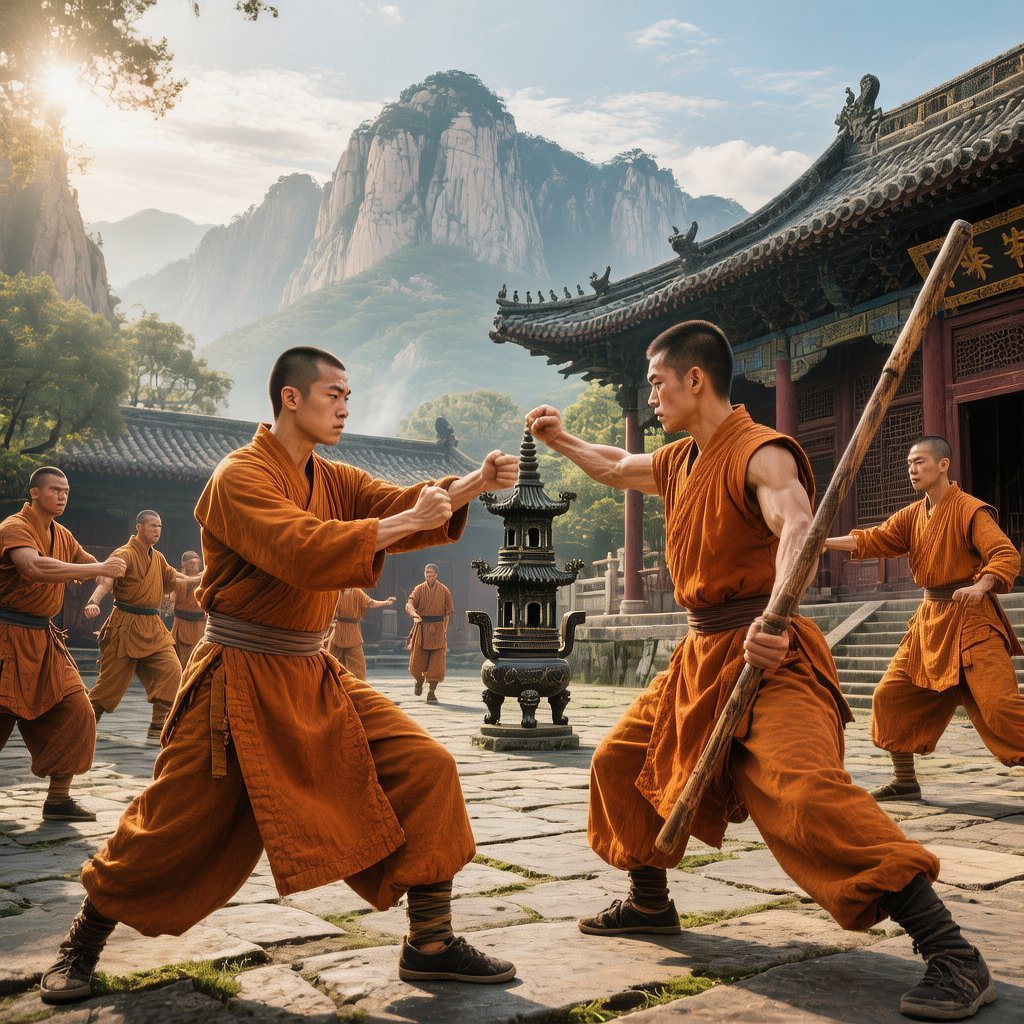
Today, Shaolin Kung Fu is practiced by millions across every continent, featured in countless films and television shows, and studied by historians, anthropologists, and sports scientists alike. This article traces the remarkable journey of Shaolin Kung Fu from temple tradition to global phenomenon, examining the historical, philosophical, and practical dimensions that have made it one of the world’s most enduring and influential martial arts.
The Historical Foundation: Monks, Emperors, and Warriors
The Shaolin Temple was founded in 495 CE during the Northern Wei Dynasty, originally as a center for Buddhist translation and meditation. According to tradition, the Indian monk Bodhidharma (Da Mo in Chinese) arrived at the temple around 527 CE and found the monks too weak from prolonged sitting meditation to maintain their practice. He introduced a series of exercises known as the Yi Jin Jing (Muscle-Tendon Change Classic) and Xi Sui Jing (Marrow Washing Classic) to strengthen their bodies and invigorate their spirits.
While historians debate the historical accuracy of the Bodhidharma legend, archaeological evidence confirms that Shaolin monks were practicing martial arts by the early Tang Dynasty (618-907 CE). The most famous episode in Shaolin military history occurred when thirteen monk-warriors helped Li Shimin (later Emperor Taizong of Tang) defeat the rival warlord Wang Shichong. In gratitude, the emperor granted the temple extensive lands and official recognition, establishing the Shaolin Temple’s dual identity as both a religious institution and a center of martial excellence.
The Evolution Through Dynasties
Throughout the Song (960-1279), Yuan (1271-1368), and Ming (1368-1644) Dynasties, the Shaolin Temple continued to develop its martial arts curriculum, absorbing techniques from military veterans, lay practitioners, and visiting martial artists. The Ming Dynasty represents the golden age of Shaolin Kung Fu, when the temple’s fighting monks were renowned throughout China and frequently called upon to defend the nation’s coastal regions against Japanese pirates (Wokou).
The Qing Dynasty (1644-1912) brought severe challenges. The Manchu government, suspicious of the Shaolin Temple’s martial capabilities and its potential as a center for Han Chinese resistance, repeatedly suppressed the temple. During this period, many Shaolin masters fled to southern China, spreading Shaolin martial arts throughout the Guangdong and Fujian provinces and contributing to the development of numerous southern Chinese martial arts styles.
The Shaolin System: A Complete Martial Arts Curriculum
What distinguishes Shaolin Kung Fu from most other martial arts is the extraordinary breadth and depth of its curriculum. The traditional Shaolin system encompasses hundreds of forms (taolu), weapons routines, conditioning methods, and internal cultivation practices. This comprehensiveness reflects the temple’s unique position as a repository for martial knowledge gathered over centuries from across China.
The Five Animal Styles
Perhaps the most iconic aspect of Shaolin Kung Fu is the Five Animal system, which categorizes fighting strategies and physical attributes according to the characteristics of five animals:
- Tiger (Hu): Emphasizes power, ferocity, and bone-strengthening exercises. Tiger techniques use strong, aggressive movements and focus on developing the tendons and bones. The tiger’s spirit is one of fearless direct confrontation.
- Crane (He): Emphasizes grace, balance, and precision. Crane techniques feature sweeping arm movements, one-legged stances, and precise strikes to vital points. The crane represents patience and strategic timing.
- Leopard (Bao): Emphasizes speed, agility, and explosive power. Leopard techniques use rapid, angular movements and the “leopard fist” (half-closed hand striking with the knuckles). The leopard embodies lightning-fast action.
- Snake (She): Emphasizes flexibility, fluidity, and precision targeting. Snake techniques use whipping movements, finger strikes, and rhythmic undulation. The snake represents rhythmic, penetrating energy.
- Dragon (Long): Emphasizes internal power, wisdom, and spiritual cultivation. Dragon techniques feature circular, sweeping movements and cultivate Qi (vital energy). The dragon represents the integration of all the other animals’ qualities.
Weapons Training
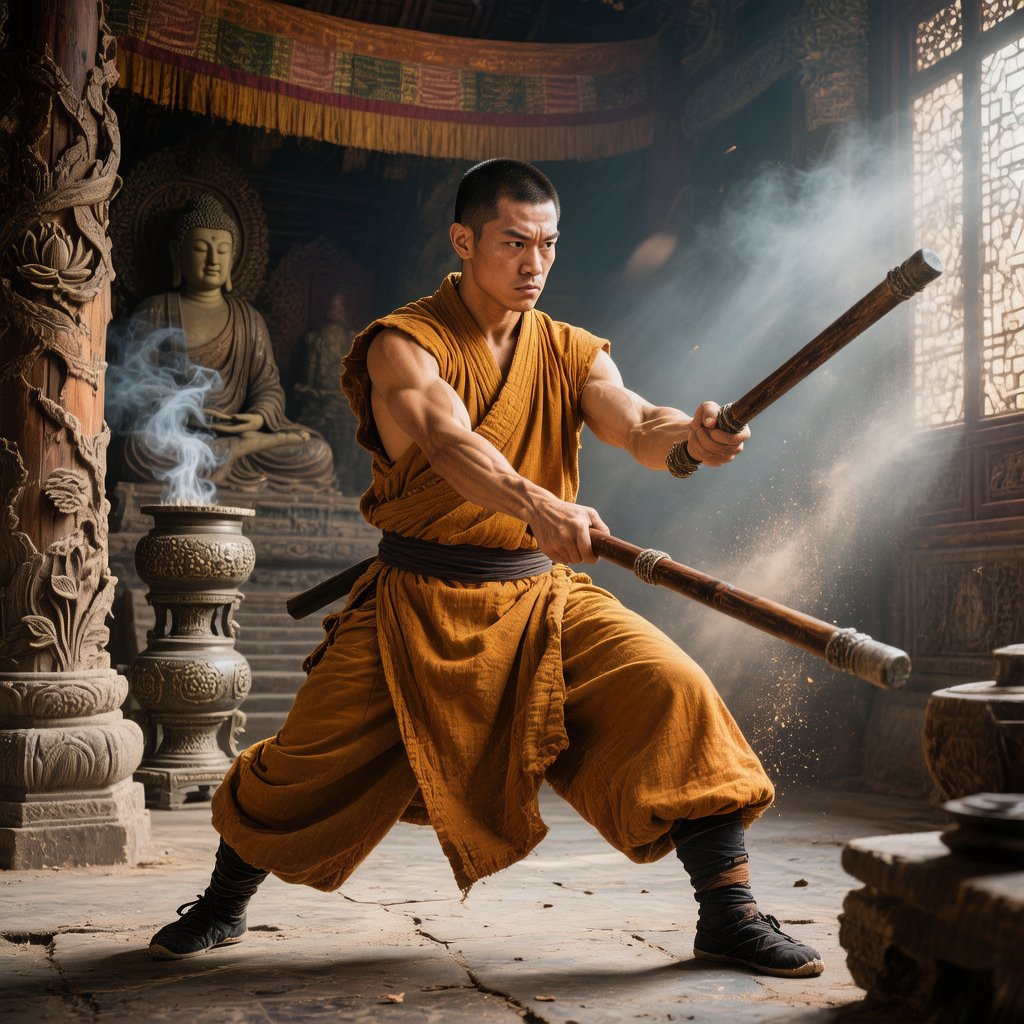
Shaolin Kung Fu maintains one of the most extensive weapons curricula in the martial arts world. The traditional Eighteen Weapons of Shaolin include:
| Category | Weapons |
|---|---|
| Long Weapons | Staff (Gun), Spear (Qiang), Long-handled Spade (Yue) |
| Short Weapons | Straight Sword (Jian), Broad Sword (Dao), Twin Hooks (Shuang Gou) |
| Flexible Weapons | Three-Section Staff (San Jie Gun), Chain Whip (Bian), Rope Dart (Sheng Biao) |
| Paired Weapons | Twin Broadswords (Shuang Dao), Twin Rods (Shuang Gun), Double Daggers (Shuang Bi Shou) |
Each weapon develops specific physical attributes and combat principles. The staff teaches long-range control and full-body coordination. The sword cultivates precision and fluid footwork. Flexible weapons train timing and spatial awareness. Together, they create a well-rounded martial artist capable of adapting to any combat scenario.
The Iron Body: Shaolin Conditioning Methods
Shaolin Kung Fu is renowned for its extraordinary conditioning methods, collectively known as Iron Body training. These practices develop the ability to withstand and deliver powerful impacts through systematic desensitization and tissue strengthening.
Iron Palm (Tie Zhang)
Iron Palm training involves progressively striking harder surfaces—from bags of mung beans to bags of iron shot—while applying herbal liniments (Dit Da Jow) to promote healing and tissue conditioning. Over months and years, the practitioner’s hands develop the ability to deliver devastating strikes without injury. Scientific examination reveals that Iron Palm practitioners develop increased bone density in the hands and thickened periosteum (the membrane covering bones), similar to the adaptations seen in professional boxers’ knuckles.
Iron Shirt (Tie Bu Shan)
Iron Shirt training conditions the torso to withstand powerful blows through breathing exercises, muscle tension techniques, and systematic impact conditioning. Practitioners learn to use specific breathing patterns and muscular engagement to create a “pressure shield” that distributes impact force across the entire body rather than concentrating it at the point of contact. Modern sports science recognizes this as a form of “anticipatory postural adjustment”—pre-activating core musculature to stabilize the trunk against external forces.
Iron Head (Tie Tou Gong)
Perhaps the most visually impressive of Shaolin conditioning methods, Iron Head training involves gradually conditioning the skull to withstand and deliver head-butts. This practice relies on progressive adaptation: light tapping builds to harder impacts over years of training, with the skull’s cranial bones thickening in response. This is a demonstration art—modern practitioners perform it primarily for shows, as the risks of repeated head impact are well-documented.
Philosophy: Chan Buddhism and the Martial Way
Shaolin Kung Fu cannot be understood apart from Chan Buddhism (known as Zen in Japanese). The Shaolin Temple’s founding purpose was Buddhist practice, and the martial arts developed as a means of supporting that practice—not replacing it. The Shaolin maxim “Martial arts and Chan as one” (Wu Chan Yi Ti) encapsulates this integration.
Chan Buddhism emphasizes direct experience over textual study, awakening over intellectual understanding. The physical practice of Kung Fu serves as a form of moving meditation—each form, each technique, each breath is an opportunity to cultivate present-moment awareness. The famous Shaolin practice of “one breath, one movement” synchronizes physical action with meditative attention, creating a state that modern psychology would recognize as flow—complete absorption in the present activity.
The Chan influence also manifests in Shaolin Kung Fu’s ethical framework. The temple’s precepts prohibit the use of martial skills for aggression, requiring that they be employed only in self-defense or the protection of others. The concept of compassionate action (karuna) extends to combat: a Shaolin practitioner should seek to neutralize a threat with minimal harm, using force only as a last resort.
From Temple to Screen: The Global Popularization of Shaolin Kung Fu
The modern global popularity of Shaolin Kung Fu can be traced to several key developments:
The Jet Li Era
The 1982 film The Shaolin Temple, starring a young Jet Li, sparked a massive surge of interest in Shaolin Kung Fu both within China and internationally. The film’s depiction of temple life and spectacular martial arts sequences inspired a generation of practitioners and led to a tourism boom at the actual Shaolin Temple, which has become one of China’s most visited cultural sites.
The Performance Troupe Phenomenon
Shaolin performance troupes have toured the world since the 1990s, dazzling audiences with demonstrations of Iron Body skills, weapon forms, and acrobatic techniques. While these performances represent only a fraction of the traditional Shaolin curriculum—the more spectacular conditioning arts rather than the subtle internal practices—they have been enormously effective in generating global interest and enrollment in Shaolin schools worldwide.
Digital Age Dissemination
The internet has democratized access to Shaolin Kung Fu instruction. Online platforms now offer courses taught by genuine Shaolin monks and lineage holders, making previously inaccessible training available to anyone with an internet connection. Social media has amplified this effect, with Shaolin practitioners accumulating millions of followers and generating unprecedented interest in traditional Chinese martial arts.
Training Tips: Beginning Your Shaolin Journey
- Build Your Foundation with Stance Training: Shaolin Kung Fu begins with stance training (Zhan Zhuang and Ma Bu). Hold the horse stance for progressively longer durations, building from 30 seconds to 5 minutes. This develops the leg strength, structural alignment, and mental discipline that form the foundation of all Shaolin techniques.
- Master One Animal Before Studying Others: Rather than attempting to learn all five animal styles simultaneously, choose one that resonates with your physical attributes and temperament, and study it deeply for at least two years. Understanding one animal thoroughly gives you a framework for learning the others more effectively.
- Invest in Flexibility: Shaolin Kung Fu demands exceptional flexibility. Dedicate at least 20 minutes daily to stretching, focusing on the hips, shoulders, and spine. The classic Shaolin stretching routine includes both static holds and dynamic movements that prepare the body for the art’s wide range of motion requirements.
- Study Weapons After Establishing Empty-Hand Fundamentals: Weapons extend the body’s capabilities and develop attributes that empty-hand training alone cannot. However, begin weapons training only after developing solid empty-hand fundamentals—typically after two to three years of consistent practice.
- Visit the Shaolin Temple if Possible: Training at the source offers an irreplaceable experience. Several programs at the Shaolin Temple and surrounding schools accept international students for periods ranging from one week to several years. The immersive environment accelerates learning and deepens understanding of the cultural context.
The Future of Shaolin Kung Fu
Shaolin Kung Fu faces both opportunities and challenges in the 21st century. On one hand, global interest continues to grow, with new schools opening across Asia, Europe, the Americas, and Africa. The Chinese government has recognized Shaolin Kung Fu as an important element of intangible cultural heritage, providing funding and institutional support for its preservation and transmission.
On the other hand, concerns about commercialization and authenticity persist. The proliferation of “Shaolin” schools that teach only performance-oriented routines, the debasement of traditional conditioning methods for tourist demonstrations, and the tension between preserving ancient practices and adapting to modern pedagogical standards all represent significant challenges.
The most thoughtful Shaolin masters recognize that the tradition has always been dynamic—absorbing new techniques, adapting to changing circumstances, and evolving while maintaining its essential character. The key is ensuring that this evolution remains grounded in the philosophical and practical principles that have sustained Shaolin Kung Fu for over fifteen hundred years.
Conclusion: A Living Tradition
Shaolin Kung Fu stands as a testament to the power of disciplined practice, philosophical depth, and cultural continuity. From the meditation halls of a 6th-century Buddhist temple to the training centers of 21st-century cities around the world, its journey reflects both the enduring appeal of martial arts cultivation and the remarkable capacity of Chinese culture to produce systems of knowledge that transcend their original context.
Whether you are drawn to Shaolin Kung Fu for self-defense, physical fitness, spiritual growth, or cultural appreciation, the tradition offers a path of lifelong learning and continuous self-improvement. As the Shaolin saying goes: “A thousand-mile journey begins beneath one’s feet.” The first step on the Shaolin path is simply to begin—and to continue, with patience, persistence, and an open heart.