Introduction: The Martial Art That Changed the World
Wing Chun stands as one of the most influential Chinese martial arts in modern history. Popularized globally by the legendary Bruce Lee and his teacher Ip Man, Wing Chun has transcended its origins in southern China to become a worldwide phenomenon practiced by millions. Yet beneath its deceptively simple forms lies an extraordinarily sophisticated combat system built on scientific principles of biomechanics, physics, and human physiology.
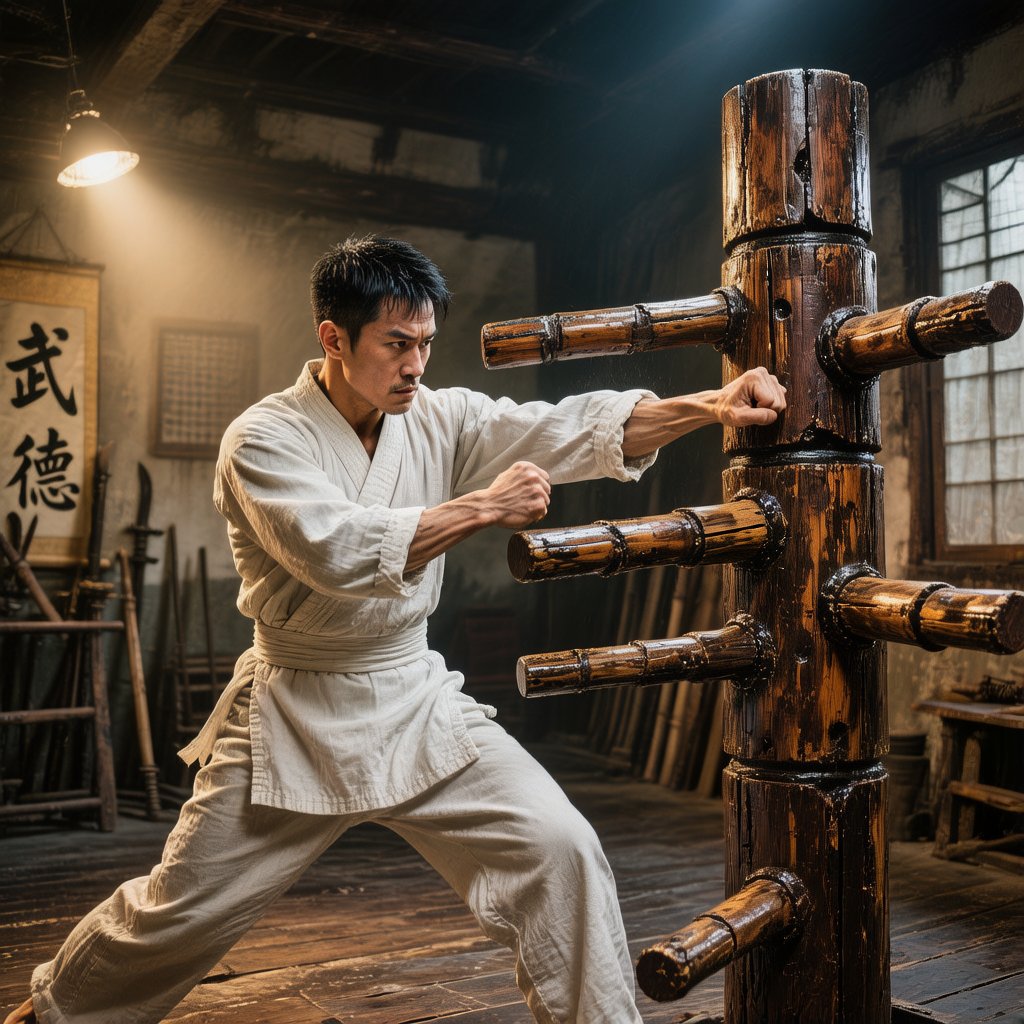
Unlike many martial arts that emphasize wide, flowing movements and high kicks, Wing Chun specializes in close-range combat, prioritizing efficiency, directness, and simultaneous attack and defense. This article explores the science behind Wing Chun’s techniques, its practical applications in self-defense, and how its principles can enhance understanding of combat mechanics across all martial disciplines.
Historical Origins: From Shaolin to the Streets of Foshan
Wing Chun’s origins are steeped in legend and oral tradition. The most widely accepted account credits a Buddhist nun named Ng Mui, one of the Five Elders who survived the destruction of the Shaolin Temple during the Qing Dynasty. Observing a crane and a snake in combat, Ng Mui synthesized their movement principles into a compact, efficient fighting system. She taught this system to a young woman named Yim Wing Chun, who used it to defeat a local warlord who had been harassing her.
While the historical accuracy of this origin story remains debated among scholars, the principles it describes—efficiency over brute force, sensitivity over aggression, and directness over complexity—are verifiably embedded in every aspect of Wing Chun practice. The art passed through several generations of practitioners in the Red Boat opera troupe before reaching the Ip Man lineage that would eventually introduce Wing Chun to the world.
The Core Principles: Wing Chun’s Scientific Foundation
1. Centerline Theory: The Geometric Heart of Wing Chun
The centerline is Wing Chun’s most fundamental concept. It refers to an imaginary vertical line running down the center of the body, along which the most vital targets are located: the eyes, nose, throat, solar plexus, and groin. Wing Chun strategy revolves around controlling this line—protecting one’s own centerline while attacking the opponent’s.
From a geometric perspective, the centerline represents the shortest distance between two points. Every Wing Chun strike travels along or near this line, ensuring maximum speed and minimum telegraphing. The centerline principle also governs defensive structure: the characteristic Wing Chun guard position, with hands held along the vertical centerline, creates a physical barrier that protects the most vulnerable targets while maintaining the shortest path to the opponent’s center.
Biomechanical analysis confirms that centerline-based striking generates superior force transfer compared to wide, looping attacks. When a punch travels straight from the center, the kinetic chain from the feet through the hips, shoulders, and fist operates at maximum efficiency, with minimal energy lost to lateral deviation.
2. Economy of Motion: The Principle of Minimum Effort
Wing Chun’s second defining principle is economy of motion—the commitment to achieving maximum effect with minimum movement. This principle manifests in several ways:
- Simultaneous attack and defense: Rather than blocking and then counterattacking as separate actions, Wing Chun trains practitioners to defend and attack in the same motion. A tan sao (palm-up hand) deflects an incoming strike while the opposite hand simultaneously punches forward.
- Shortest path targeting: Wing Chun strikes travel in straight lines whenever possible, avoiding the wide, circular movements found in many other martial arts. This reduces reaction time and eliminates the telegraphic wind-ups that experienced fighters can read and exploit.
- Chain punching: The Wing Chun straight punch (characterized by the vertical fist) is designed for rapid, continuous delivery. Chain punching generates a relentless barrage that overwhelms an opponent’s defensive capacity through sheer speed and frequency.
3. Chi Sao: The Science of Tactile Sensitivity
Chi Sao (sticky hands) is Wing Chun’s unique training method and perhaps its most scientifically sophisticated component. Through continuous contact with a training partner’s arms, practitioners develop an extraordinary level of tactile sensitivity—what neuroscientists would call proprioceptive awareness—that enables them to feel an opponent’s intentions and respond instantly.
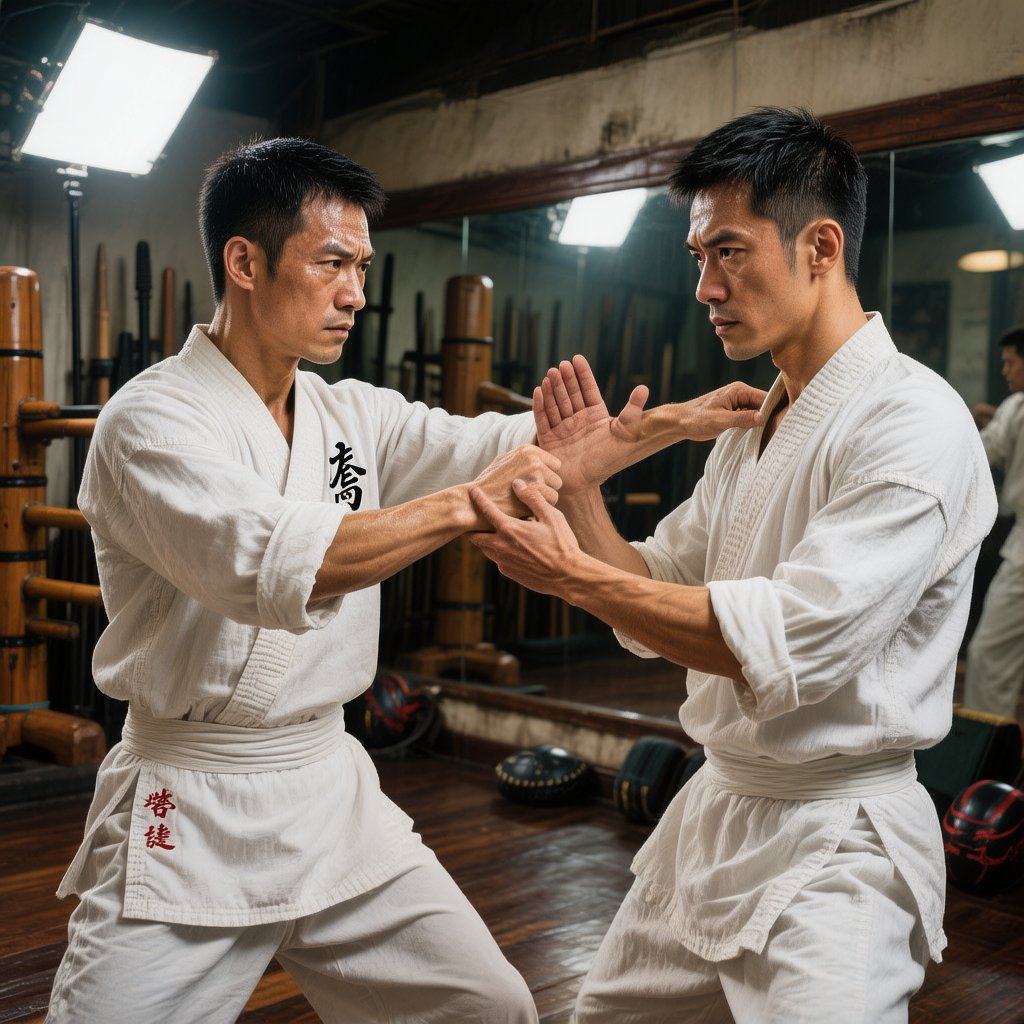
Chi Sao works because the human somatosensory cortex can process tactile information faster than the visual cortex can process visual information. By maintaining contact with an opponent’s arms, a Wing Chun practitioner bypasses the slower visual processing pathway and gains a direct, real-time read on the opponent’s force direction, magnitude, and intent. Research in motor learning has demonstrated that experienced Chi Sao practitioners can detect changes in force direction within 50-100 milliseconds—significantly faster than the 200-250 milliseconds required for visual reaction.
The Three Forms: A Progressive Training System
Wing Chun’s empty-hand curriculum consists of three forms, each building upon the previous one in a carefully structured progression:
Siu Nim Tao (小念頭) — The Little Idea
The first and most fundamental form, Siu Nim Tao, contains the entire Wing Chun system in embryonic form. Practiced stationary and slowly, it develops the basic hand positions, arm structures, and mental focus that form the foundation of all subsequent training. The name “Little Idea” reflects its emphasis on cultivating the correct intention (Yi) before executing technique—teaching practitioners that every movement begins in the mind before it manifests in the body.
Chum Kiu (尋橋) — Seeking the Bridge
The second form introduces movement—stepping, turning, and kicking—while maintaining the structural principles established in Siu Nim Tao. “Seeking the Bridge” refers to the concept of establishing contact (the “bridge”) with an opponent’s limbs, creating the tactile connection necessary for Chi Sao sensitivity. Chum Kiu teaches practitioners to move their entire body as a coordinated unit, generating power through proper body alignment and weight transfer rather than muscular strength.
Biu Ji (鏟指) — Thrusting Fingers
The third and most advanced form addresses emergency situations and recovery techniques. Biu Ji teaches practitioners how to respond when the structure breaks down—when an opponent has breached the centerline or disrupted the defensive framework. It includes specialized finger strikes, elbow techniques, and circular recovery movements. Traditionally, Biu Ji was kept secret within the Wing Chun lineage, taught only to trusted senior students.
The Wooden Dummy: Wing Chun’s Silent Partner
The Muk Yan Jong (wooden dummy) is perhaps the most iconic training apparatus in all of Chinese martial arts. Consisting of a cylindrical wooden trunk with three arms and a leg, the dummy serves as an invaluable training tool that develops precision, structural integrity, and flow.
The wooden dummy form consists of 108 movements (in the Ip Man lineage) that teach practitioners to move around an opponent’s structure, maintain correct angles and distances, and deliver strikes with proper alignment. Unlike partner training, the dummy provides consistent, unyielding feedback—if your structure is incorrect, the dummy will not accommodate you, and you will feel the error in your own body.
Practical Self-Defense Applications
Wing Chun’s practical effectiveness stems from its focus on realistic combat scenarios rather than sport or demonstration. Here are key applications:
Close-Quarters Defense Against Grabbing Attacks
When grabbed by the wrist or lapel, Wing Chun practitioners use the principle of “facing the center”—turning toward the grab to maintain centerline alignment—while simultaneously striking. The tan sao and pak sao (slapping hand) techniques allow practitioners to release grabs and counter-attack in a single beat, exploiting the momentary vulnerability created when an attacker commits to grabbing.
Defense Against Multiple Punchers
While no martial art can guarantee victory against multiple attackers, Wing Chun’s emphasis on close-range efficiency and simultaneous attack-defense provides practical advantages. The centerline theory ensures that practitioners position themselves so only one attacker can engage at a time, while chain punching creates a rapid offensive barrage that can overwhelm individual opponents.
Anti-Ground Fighting Strategies
Wing Chun prioritizes staying on the feet, using low kicks (primarily to the knees and shins) and structure-based takedown defense. The art’s emphasis on maintaining a strong, rooted stance through correct skeletal alignment makes practitioners difficult to take down, and the sensitivity developed through Chi Sao enables early detection of takedown attempts.
Training Tips: Building Wing Chun Skill
- Master Siu Nim Tao First: Do not rush to learn advanced forms. Spend at least six months focusing exclusively on Siu Nim Tao, practicing it slowly with full attention to structure and intention. The quality of your first form determines the quality of everything that follows.
- Invest in Chi Sao: Find a consistent training partner and practice Chi Sao at least three times per week. Start with single-hand Chi Sao (dan chi) before progressing to double-hand (sheung chi). Focus on sensitivity, not speed—speed comes naturally when sensitivity is developed.
- Train the Wooden Dummy with Intention: The dummy is not a punching bag. Every contact should be precise and structurally correct. Move slowly through the dummy form initially, feeling the correct angle and alignment for each technique.
- Develop Your Horse: The Wing Chun stance (Yee Gee Kim Yeung Ma) is the foundation of all power generation. Practice standing in the stance for increasing durations, focusing on the alignment of your knees, hips, and spine.
- Test Under Pressure: Find opportunities to test your skills in realistic, resisted scenarios—whether through controlled sparring, self-defense classes, or competitive formats. Wing Chun that has never been tested under pressure is only theory.
Wing Chun in the Modern World
Wing Chun’s influence extends far beyond traditional martial arts schools. Law enforcement agencies in several countries have adopted Wing Chun principles for close-quarters combat training, particularly the simultaneous attack-defense concept and the emphasis on controlling the centerline in confined spaces. Military close-combat instructors have incorporated Wing Chun’s trapping and straight-blast techniques into their curricula.
The art has also found unexpected applications in sports. Mixed martial arts fighters have incorporated Wing Chun’s trapping hands and straight punching into their stand-up games, while some boxers have studied Wing Chun to improve their inside fighting and defensive hand positioning. The principles of economy of motion and tactile sensitivity have proven valuable across combat disciplines.
Common Misconceptions About Wing Chun
| Misconception | Reality |
|---|---|
| Wing Chun is only for small people | Wing Chun’s principles work for practitioners of all sizes; structure and timing matter more than strength |
| Wing Chun doesn’t work in real fights | Properly trained Wing Chun has proven effective in self-defense; like any art, effectiveness depends on training quality |
| You don’t need physical conditioning | While Wing Chun doesn’t require extreme athleticism, conditioning enhances speed, endurance, and structural integrity |
| Wing Chun is only about hand techniques | Wing Chun includes kicking (to the lower body), elbow strikes, knee techniques, and takedown defense |
| All Wing Chun lineages are the same | Significant differences exist between lineages in forms, training methods, and fighting strategies |
Conclusion: The Art of Intelligent Combat
Wing Chun represents a unique approach to martial arts—one that prioritizes intelligence over aggression, efficiency over effort, and sensitivity over strength. Its scientific foundation, built on the principles of centerline control, economy of motion, and tactile sensitivity, offers practitioners not just a fighting system but a framework for understanding the physics and psychology of human combat.
Whether you are a seasoned martial artist looking to deepen your understanding of close-range combat, a beginner seeking an effective self-defense system, or simply someone interested in the science of human movement, Wing Chun offers a rich, rewarding path of study. As Ip Man famously said: “The way of Wing Chun is not to fight force with force, but to use the opponent’s force against them.” In this principle lies not only a combat strategy but a philosophy of life.