Introduction: The Direct Path of Intention and Form
Xing Yi Quan (Form-Intention Fist) is the most aggressively direct of China’s three great internal martial arts. Where Tai Chi yields and redirects, where Bagua circles and evades, Xing Yi charges straight through. Its strategy is deceptively simple: develop overwhelming structural power, commit fully to the attack, and destroy the opponent’s center before they can mount a defense. This aggressive simplicity belies extraordinary sophistication—Xing Yi’s power generation system, built on the Five Elements theory, represents one of the most efficient and devastating combat methodologies ever created.
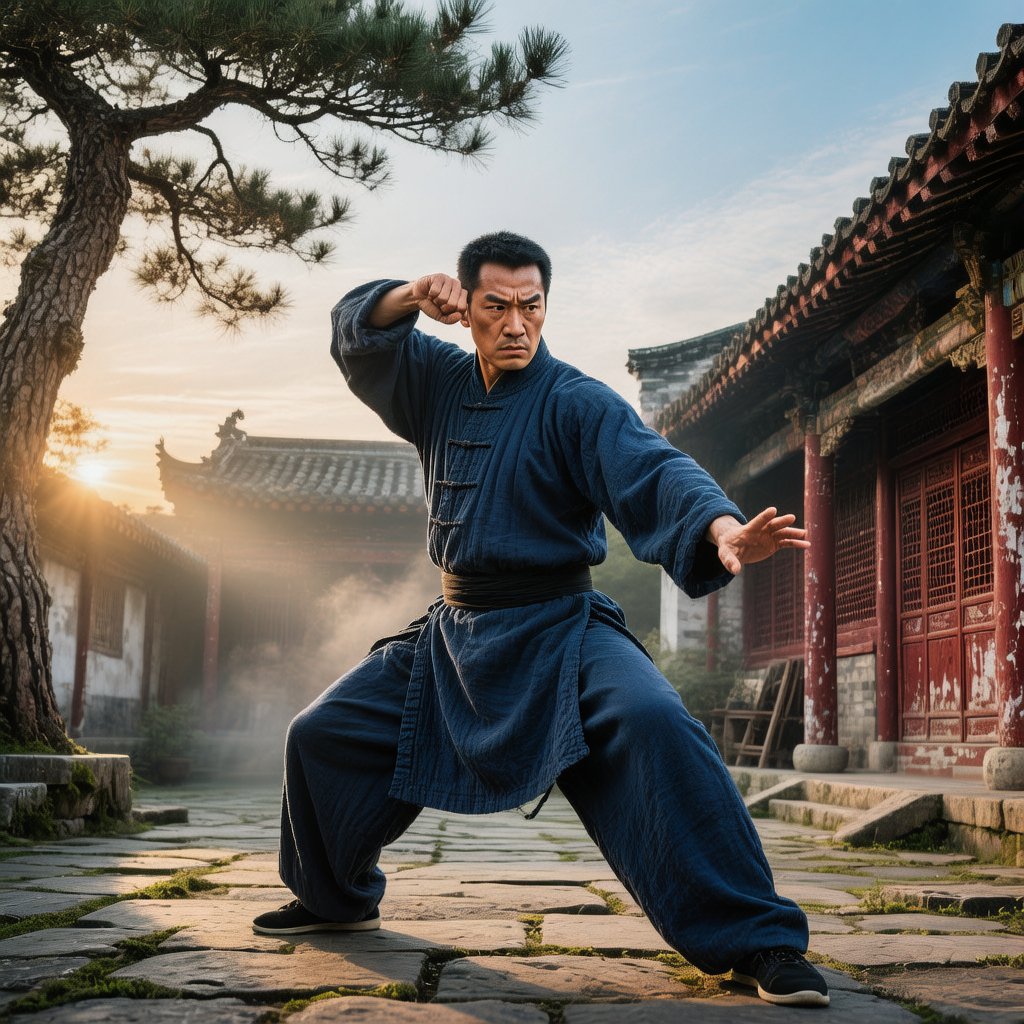
Created by the legendary general Yue Fei in the 12th century (according to tradition) and systematized by Ji Jike in the 17th century, Xing Yi Quan has earned the respect of martial artists worldwide for its combat effectiveness and its elegant theoretical framework. This article explores the Five Elements system that lies at the heart of Xing Yi, examines its combat strategy in detail, and provides practical training guidance for practitioners at all levels.
Historical Origins: From Battlefield to Practice Hall
Xing Yi Quan’s origins are intimately connected with military combat. The legendary founder, General Yue Fei (1103-1142), was one of China’s most celebrated military leaders, renowned for his spear technique and his ability to train ordinary soldiers into elite warriors. According to the Xing Yi oral tradition, Yue Fei created the art by distilling the most effective spear fighting techniques into empty-hand methods that could be quickly taught to infantrymen.
The historical lineage becomes more clearly documented with Ji Jike (also known as Ji Longfeng), a 17th-century martial artist from Shanxi Province who is credited with systematizing Xing Yi Quan into its current form. Ji was renowned for his spear technique—his nickname was “Divine Spear Ji”—and the influence of spear methodology is still visible in Xing Yi’s footwork, body mechanics, and tactical approach.
The art passed through several generations of the Dai family in Shanxi before reaching Li Luoneng (also known as Li Nengran), a remarkable teacher who trained many of the most famous Xing Yi masters of the 19th century, including Guo Yunshen, Che Yizhai, and Song Shirong. Guo Yunshen’s famous “half-step Beng Quan” (crushing fist) was said to be so powerful that he could defeat any opponent with a single technique—a testament to Xing Yi’s emphasis on devastating single-strike power.
The Five Elements: The Core of Xing Yi Quan
At the heart of Xing Yi Quan lies the Wu Xing (Five Elements) system, derived from traditional Chinese cosmology. The five elements—Metal, Water, Wood, Fire, and Earth—each correspond to a fundamental fist technique, a specific type of force, and a combat strategy. More importantly, they exist in two cyclical relationships: creation (Sheng) and destruction (Ke), which provide a dynamic framework for understanding combat interactions.
Metal — Pi Quan (Splitting Fist)
Pi Quan is the first and most fundamental of the five element fists. It represents Metal—the element of cutting, sharpness, and downward force. The technique delivers an axe-like strike that splits downward through the opponent’s guard, using the edge of the palm or the forearm.
The power of Pi Quan comes from the coordinated dropping of the body’s weight through the spine and into the striking hand. It is not a swing but a split—the force travels straight down along the vertical axis, driven by the whole body’s structural alignment. When executed correctly, Pi Quan generates force that is difficult to block because it comes from above with the full weight of the body behind it, and it naturally opens the opponent’s guard for follow-up techniques.
Combat strategy: Attack the opponent’s guard directly with overwhelming downward force. Pi Quan is the sledgehammer that breaks through the door.
Water — Zuan Quan (Drilling Fist)
Zuan Quan represents Water—the element that flows upward, seeking every opening. The technique delivers a rising punch that drills upward from below, typically targeting the chin, throat, or solar plexus. The fist rotates as it rises, generating a corkscrew force that penetrates rather than pushes.
Zuan Quan’s power comes from the upward surge of the legs combined with the rotation of the waist and the screwing action of the fist. Like water finding its way through the smallest crack, Zuan Quan exploits any gap in the opponent’s defense, slipping between their arms to reach vital targets. The upward trajectory also makes it an excellent counter to Pi Quan, as the rising force neutralizes the downward split.
Combat strategy: Exploit openings with rising, penetrating force. Zuan Quan is the stream that finds the crack in the mountain.
Wood — Beng Quan (Crushing Fist)
Beng Quan represents Wood—the element of relentless forward growth. The technique delivers a straight, driving punch that extends outward like a tree trunk pushing through soil. Beng Quan is perhaps the most characteristic Xing Yi technique, embodying the art’s philosophy of overwhelming forward momentum.
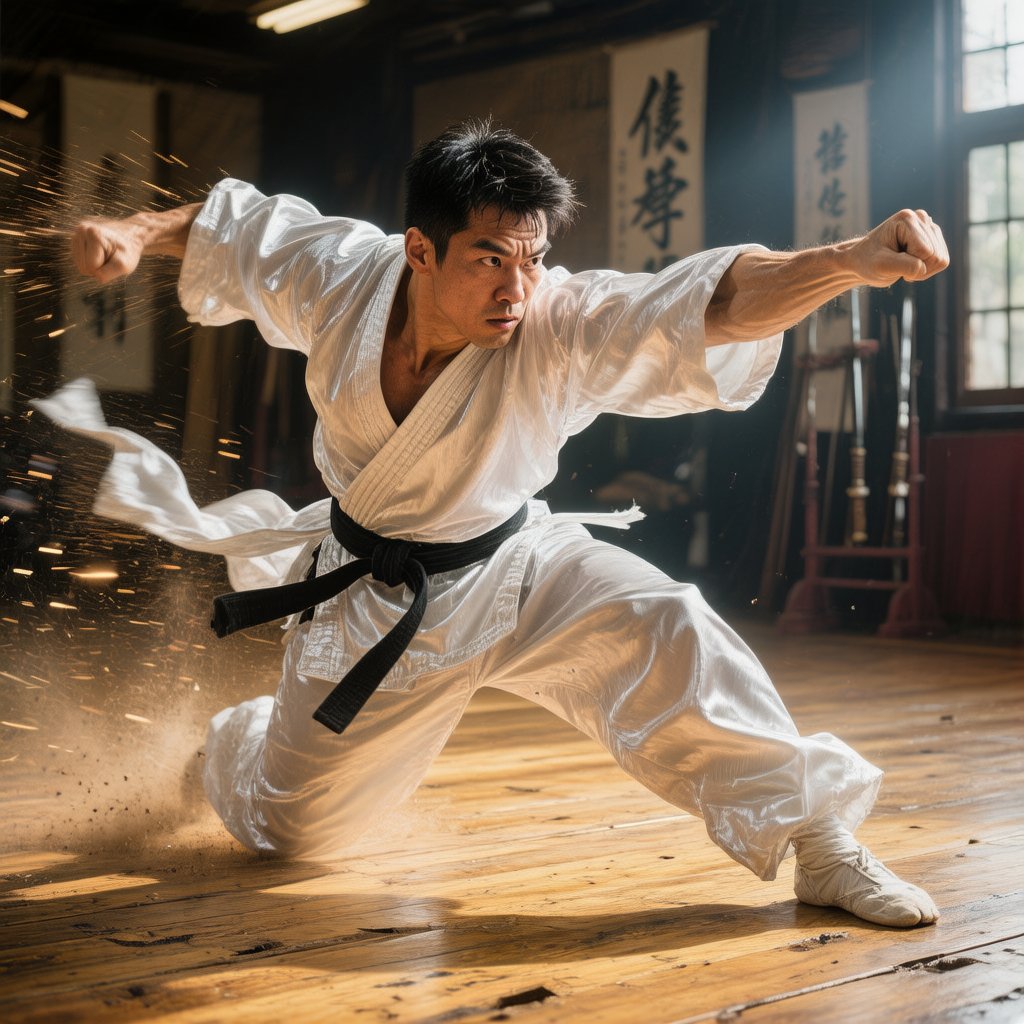
The power of Beng Quan comes from the integration of the entire body’s forward movement. The rear leg drives, the waist rotates, the shoulder extends, and the fist drives forward—all in one coordinated pulse. Guo Yunshen’s famous “half-step Beng Quan” used a specific footwork pattern that allowed him to close distance and deliver devastating power in a single step, overwhelming opponents before they could react.
Combat strategy: Overwhelm with relentless forward force. Beng Quan is the tree that cannot be stopped from growing.
Fire — Pao Quan (Pounding Fist)
Pao Quan represents Fire—the element of explosive, rising force. The technique delivers a simultaneous upward and forward strike, typically with one hand rising to deflect or absorb while the other fires forward like a cannonball. The name “Pounding Fist” reflects the explosive, concussive nature of the strike.
Pao Quan’s power comes from the explosive expansion of the chest combined with the forward drive of the legs. The rising hand creates a “roof” that protects the head while the punching hand fires from beneath it. This two-handed coordination makes Pao Quan both an attack and a defense, embodying the Xing Yi principle of “protecting yourself while destroying the opponent.”
Combat strategy: Explode through the opponent’s attack while simultaneously striking. Pao Quan is the fire that cannot be contained.
Earth — Heng Quan (Crossing Fist)
Heng Quan represents Earth—the element of stability, centrality, and horizontal force. The technique delivers a horizontal or slightly curved strike that crosses the centerline, typically using a horizontal fist or palm that sweeps across the opponent’s guard. Heng Quan is considered the “mother” of the other four elements because it represents the balanced, centered state from which all other forces arise.
The power of Heng Quan comes from the rotational force of the waist combined with the horizontal expansion of the arms. It is a sweeping, enveloping force that controls the centerline and creates openings for the other element fists. Because it moves horizontally, Heng Quan is particularly effective against opponents who are committed to a vertical attack—it simply sweeps their force aside.
Combat strategy: Control the center with horizontal force. Heng Quan is the earth that grounds all other elements.
The Creation and Destruction Cycles
What elevates Xing Yi’s Five Elements system from a collection of techniques to a comprehensive combat theory is the interplay between the creation cycle (Sheng cycle) and the destruction cycle (Ke cycle):
Creation Cycle (Sheng)
Metal creates Water (condensation), Water creates Wood (nourishment), Wood creates Fire (fuel), Fire creates Earth (ash), Earth creates Metal (minerals). In combat terms, each element fist naturally flows into and supports the next:
- Pi Quan (Metal) sets up Zuan Quan (Water) — the downward split creates a natural opening for the rising drill
- Zuan Quan (Water) sets up Beng Quan (Wood) — the rising strike creates momentum for the crushing forward drive
- Beng Quan (Wood) sets up Pao Quan (Fire) — the forward momentum generates the explosive energy for the pounding strike
- Pao Quan (Fire) sets up Heng Quan (Earth) — the explosive expansion settles into the grounded crossing force
- Heng Quan (Earth) sets up Pi Quan (Metal) — the horizontal control creates the position for the downward split
Destruction Cycle (Ke)
Metal destroys Wood (cutting), Wood destroys Earth (roots breaking soil), Earth destroys Water (damming), Water destroys Fire (extinguishing), Fire destroys Metal (melting). In combat terms, each element fist defeats a specific other:
- Pi Quan (Metal) defeats Beng Quan (Wood) — the downward split crushes the forward thrust
- Beng Quan (Wood) defeats Heng Quan (Earth) — the crushing force overwhelms the horizontal sweep
- Heng Quan (Earth) defeats Zuan Quan (Water) — the horizontal force dams the rising drill
- Zuan Quan (Water) defeats Pao Quan (Fire) — the rising drill extinguishes the explosive pound
- Pao Quan (Fire) defeats Pi Quan (Metal) — the explosive strike melts the downward split
This cyclical framework provides Xing Yi practitioners with a dynamic decision-making tool: if the opponent uses Pi Quan, respond with Pao Quan; if they switch to Heng Quan, counter with Beng Quan. The theory ensures that there is always a response, always a counter—creating an infinite tactical game of elemental chess.
San Ti Shi: The Trinity Stance
Before learning any of the Five Element fists, Xing Yi practitioners must master San Ti Shi (Trinity Posture), the fundamental standing method that develops the structural integrity and internal connection required for all Xing Yi techniques. San Ti Shi is not merely a stance but a complete body-alignment practice that integrates the three external harmonies (hands and feet, elbows and knees, shoulders and hips) and the three internal harmonies (heart and intention, intention and Qi, Qi and power).
In San Ti Shi, the practitioner stands with the majority of weight on the rear leg, the front hand extended at throat height, and the rear hand guarding the chest. This configuration creates a “ready to explode” posture, like a coiled spring, with all the body’s structural connections properly aligned for instantaneous power generation. The stance is typically held for extended periods—beginners start with 5 minutes and gradually build to 30 minutes or more—as a form of standing meditation that builds both physical structure and mental focus.
The Twelve Animals: Expanding the Five Elements
Beyond the Five Elements, Xing Yi Quan includes twelve animal forms that expand the elemental techniques into specific combat strategies:
| Animal | Chinese | Primary Attribute | Key Technique |
|---|---|---|---|
| Dragon | Long | Spinal power and transformation | Coiling, rising strikes |
| Tiger | Hu | Fierce, bone-breaking power | Pouncing, clawing attacks |
| Monkey | Hou | Agility and deception | Quick, evasive footwork |
| Horse | Ma | Charging, crushing momentum | Full-body ramming power |
| Rooster | Ji | Upright fighting spirit | Kneeing, precise pecking strikes |
| Hawk | Yao | Speed and precision | Diving, penetrating attacks |
| Swallow | Yan | Lightness and speed | Skimming, low-to-ground attacks |
| Snake | She | Flexibility and threading | Slipping through defenses |
| Tai Bird | Tai | Steady, balanced power | Stable, centered strikes |
| Eagle | Ying | Grasping and tearing power | Locking, ripping techniques |
| Bear | Xiong | Heavy, overwhelming force | Shoulder and back strikes |
| Crane | He | Graceful, precise strikes | One-legged balance, beak strikes |
Each animal form is built upon the Five Elements foundation. The Dragon uses the rising power of Zuan Quan; the Tiger uses the downward force of Pi Quan; the Horse embodies the forward momentum of Beng Quan. Understanding the elements allows practitioners to see the animals not as separate techniques but as expressions of fundamental principles adapted to specific combat scenarios.
Combat Strategy: The Xing Yi Approach to Fighting
Xing Yi Quan’s combat philosophy can be summarized in a single principle: “Attack the attack” (Ying Dang). Unlike arts that emphasize defense and counterattack, Xing Yi trains practitioners to meet aggression with overwhelming aggression—to strike the opponent’s attack with a more powerful attack of their own.
The Principle of “One Step, One Strike”
Xing Yi’s most distinctive combat principle is the integration of footwork and striking. Every step is a strike, and every strike includes a step. The goal is to close distance and deliver fight-ending power in a single, committed action. This principle reflects Xing Yi’s military origins—on the battlefield, there is no room for prolonged exchanges; a single decisive action determines the outcome.
The Three Postures of Combat
- Yi (Intention): Before physical contact, the practitioner’s intention is already committed to the attack. The mind leads the body, and the opponent feels the threat before any movement occurs.
- Qi (Energy): At the moment of engagement, the practitioner’s energy surges forward, driving through the opponent’s defense like a battering ram.
- Li (Power): At the point of impact, the practitioner’s structural power is fully expressed, delivering maximum force through proper alignment and body unity.
Training Tips: Building Xing Yi Skill
- Invest Heavily in San Ti Shi: Stand in San Ti Shi for at least 15 minutes daily. This is not optional—it is the foundation upon which all Xing Yi power is built. Pay attention to the alignment of your rear hand, the extension of your front hand, and the connection between your feet and the ground.
- Practice the Five Elements in Both Directions: Train each element fist moving forward and backward, left and right. Combat does not always allow forward movement, and you must be able to generate power in any direction.
- Drill the Creation and Destruction Cycles: Practice the five elements in sequence, both creation and destruction orders, until the transitions become instinctive. This trains the ability to flow from one technique to the next without hesitation.
- Develop Explosive Power (Fa Jin): Xing Yi’s power is not sustained—it is explosive. Practice each element fist with maximum commitment, focusing on the moment of power release rather than endurance. Quality of each repetition matters more than quantity.
- Spar with Xing Yi Principles: When sparring, resist the temptation to become defensive. Practice meeting your partner’s attacks with your own attacks, using the “attack the attack” principle. Start slowly and gradually increase intensity as your timing and structure improve.
Xing Yi and the Other Internal Arts
The relationship between Xing Yi, Tai Chi, and Bagua is often described using the metaphor of a family: Xing Yi is the eldest brother—direct, powerful, and aggressive; Bagua is the middle sister—circular, adaptable, and evasive; Tai Chi is the youngest sibling—yielding, sensitive, and transformative. Each art develops different but complementary capabilities.
Many practitioners study all three internal arts, as they were traditionally taught together in the “internal arts alliance” promoted by masters like Sun Lutang, who was a lineage holder in all three systems. Sun’s synthesis—known as Sun Style Tai Chi—integrates Xing Yi’s stepping method, Bagua’s leg techniques, and Tai Chi’s body method into a single comprehensive system.
Conclusion: The Power of Direct Intention
Xing Yi Quan teaches a profound lesson that extends far beyond martial arts: the power of direct, committed intention. In a world that often rewards hesitation, overthinking, and half-measures, Xing Yi reminds us that true power comes from clarity of purpose and unwavering commitment to action.
The Five Elements system provides not just a combat methodology but a framework for understanding how different types of force interact, support, and overcome one another. Whether you are a martial artist seeking to develop devastating striking power, a strategist looking for a model of competitive dynamics, or simply someone who wants to cultivate the quality of decisive action, Xing Yi Quan offers a path of deep and rewarding study.
As the Xing Yi classics state: “When the intention moves, the form follows; when the form arrives, the power is already there.” This is the essence of Xing Yi—the inseparable unity of mind and body, intention and action, that transforms the practitioner into a living expression of the Five Elements’ dynamic power.