Bruce Lee transformed martial arts globally, breaking down barriers between Eastern and Western cultures and creating a legacy that continues to influence martial arts, film, and philosophy decades after his untimely death. His revolutionary approach to martial arts, combined with his charismatic screen presence and philosophical depth, created a cultural phenomenon that transcended the boundaries of fighting and entertainment. Bruce Lee was not merely a martial artist or an actor but a philosopher who used physical expression as a medium for communicating profound truths about human potential and self-expression.
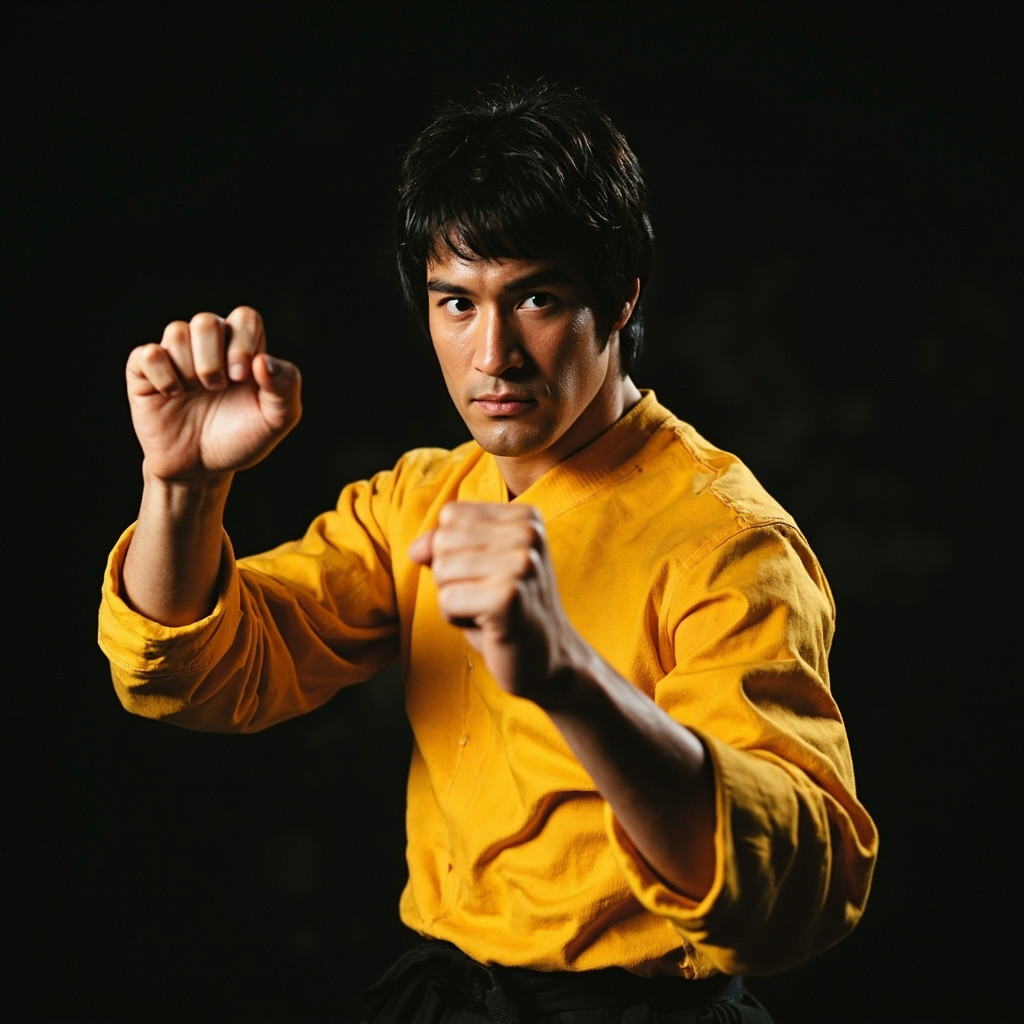
Born in San Francisco in 1940 during his father’s American tour, Bruce Lee grew up in British Hong Kong where he began his martial arts training at age 13 after getting into street fights. He studied Wing Chun under Master Ip Man, one of the most famous Chinese martial arts teachers, and absorbed the fundamental principles that would later inform his own philosophy. His early exposure to both Chinese and Western cultures gave him a unique perspective that would enable him to bridge these worlds in ways no one had done before. After returning to the United States for college, he began teaching martial arts and developing his own system, which he called Jeet Kune Do or the Way of the Intercepting Fist.
Early Life and Training
Bruce Lee’s early life in Hong Kong shaped his character and martial arts philosophy. Growing up in a performing arts family, his father was a famous Cantonese opera star, Bruce was exposed to the entertainment world from childhood, appearing in several films as a child actor. His first martial arts teacher, Ip Man, was a master of Wing Chun, a close-range fighting system that emphasizes efficiency and directness. Bruce trained obsessively, often practicing techniques hundreds of times until they became second nature. His natural athletic ability and competitive spirit drove him to excel, and he began teaching other students while still a teenager. His famous street fights during this period, while sometimes exaggerated in popular accounts, did occur and contributed to his practical understanding of combat. When his parents sent him to the United States at age 18 to pursue a safer life, he took with him a deep foundation in Chinese martial arts and an unquenchable desire to understand the essence of combat.
Philosophy: Jeet Kune Do
Bruce Lee’s martial philosophy, Jeet Kune Do, rejected rigid forms and styles in favor of practical effectiveness and personal expression. The philosophy is often summarized in his famous instruction to be water, my friend, meaning that martial artists should adapt to any situation rather than forcing situations to fit predetermined techniques. Jeet Kune Do is not a style but an approach to martial arts that emphasizes efficiency, directness, and simplicity. Lee believed that traditional martial arts had become too stylized and distant from practical combat, arguing that formal techniques should be discarded when they prove ineffective. He encouraged students to absorb what is useful, reject what is useless, and add what is specifically your own, a philosophy that extended beyond martial arts to encompass all areas of life. His writings and recorded lectures on martial philosophy continue to influence martial artists and thinkers across disciplines.
Film Career and Cultural Impact
Bruce Lee’s film career, though brief, revolutionized action cinema and changed the way Chinese people were portrayed in Western media. His first major Hollywood role as Kato in The Green Hornet television series introduced American audiences to his incredible physical abilities, but racial stereotypes limited his opportunities in the American film industry. Frustrated by these limitations, he returned to Hong Kong, where he made a series of films that broke box office records across Asia. The Big Boss, Fist of Fury, and Way of the Dragon established him as a superstar, showcasing his incredible speed, power, and charisma. Enter the Dragon, his first Hollywood-produced film, became a global phenomenon upon its release, grossing over 400 million dollars worldwide and establishing martial arts films as a major genre in international cinema. His untimely death in 1973, just days before Enter the Dragon’s release, turned him into a legendary figure whose potential remained forever unfulfilled.
Training Methods and Physical Conditioning
Bruce Lee’s training methods were legendary for their intensity and innovation. He developed a comprehensive fitness regimen that included running, jumping rope, weight training, and specialized martial arts conditioning. His approach to strength training was ahead of its time, emphasizing functional strength and endurance over pure muscle size. He invented several training devices, including a specialized punching bag and a kicking machine, that allowed him to develop extraordinary speed and power. His famous one-inch punch, which could send a person flying from almost no distance, demonstrated the incredible force he could generate through proper body mechanics and timing. His training philosophy emphasized quality over quantity, believing that intense, focused practice produced better results than long hours of unfocused training. His dedication to physical excellence inspired generations of martial artists and athletes to approach training with greater scientific understanding and personal commitment.
Conclusion
Bruce Lee showed that martial arts transcend physical technique to become vehicles for personal growth and philosophical understanding. His message of self-expression, adaptability, and continuous improvement continues to inspire millions around the world. Though his life was cut short, his impact on martial arts, cinema, and popular culture remains immeasurable, and his legacy as the most influential martial artist of the modern era remains unchallenged.
Bruce Lee Controversies and Criticisms
Despite his legendary status, Bruce Lee faced criticism during his career and has been the subject of ongoing debates about his martial arts legacy. Some traditional martial artists criticized him for abandoning classical forms and disrespecting established traditions. Questions have been raised about his actual fighting record, as few documented full-contact fights exist from his career. The claim that he could deliver a one-inch punch with devastating force has been verified by witnesses and film footage, but some of his more extraordinary feats may be exaggerated. His portrayal of Chinese culture in films faced criticism from some quarters for reinforcing stereotypes even as it broke others. These controversies do not diminish his achievements but rather reflect the complexity of his legacy and the passionate responses he continues to evoke decades after his death.
Bruce Lee Family Legacy
The Lee family has continued Bruce legacy in various ways since his death. His daughter Shannon Lee has worked to preserve and promote her father philosophical teachings through the Bruce Lee Foundation and various media projects. His son Brandon Lee was building a promising acting career before his tragic death on the set of The Crow in 1993, a loss that echoed his father premature passing. Linda Lee Cadwell, Bruce widow, has written books about their life together and managed his legacy through careful control of his image and intellectual property. The Bruce Lee Foundation maintains his childhood home in Hong Kong as a museum and educational center, ensuring that future generations can learn about his life and philosophy. The family efforts have kept Bruce Lee legacy alive and relevant, introducing his teachings to new generations who discover his work through films, books, and documentaries.
Bruce Lee Enduring Influence on Modern Martial Arts
Bruce Lee influence on modern martial arts remains profound and continues to shape how martial arts are practiced and taught today. Mixed martial arts or MMA, which has become one of the world fastest-growing sports, follows principles remarkably similar to Jeet Kune Do philosophy of combining effective techniques from multiple sources rather than adhering to a single style. Many of the training methods Bruce Lee pioneered, including the use of focus mitts, heavy bags, and specialized conditioning equipment, are now standard in martial arts gyms worldwide. His emphasis on physical fitness and cross-training influenced not only martial artists but athletes in many sports. The concept of using martial arts for self-expression and personal growth rather than just combat effectiveness has become mainstream, with millions of people practicing martial arts for fitness, confidence, and personal development rather than fighting. Bruce Lee vision of martial arts as a path to self-discovery continues to inspire practitioners around the world.