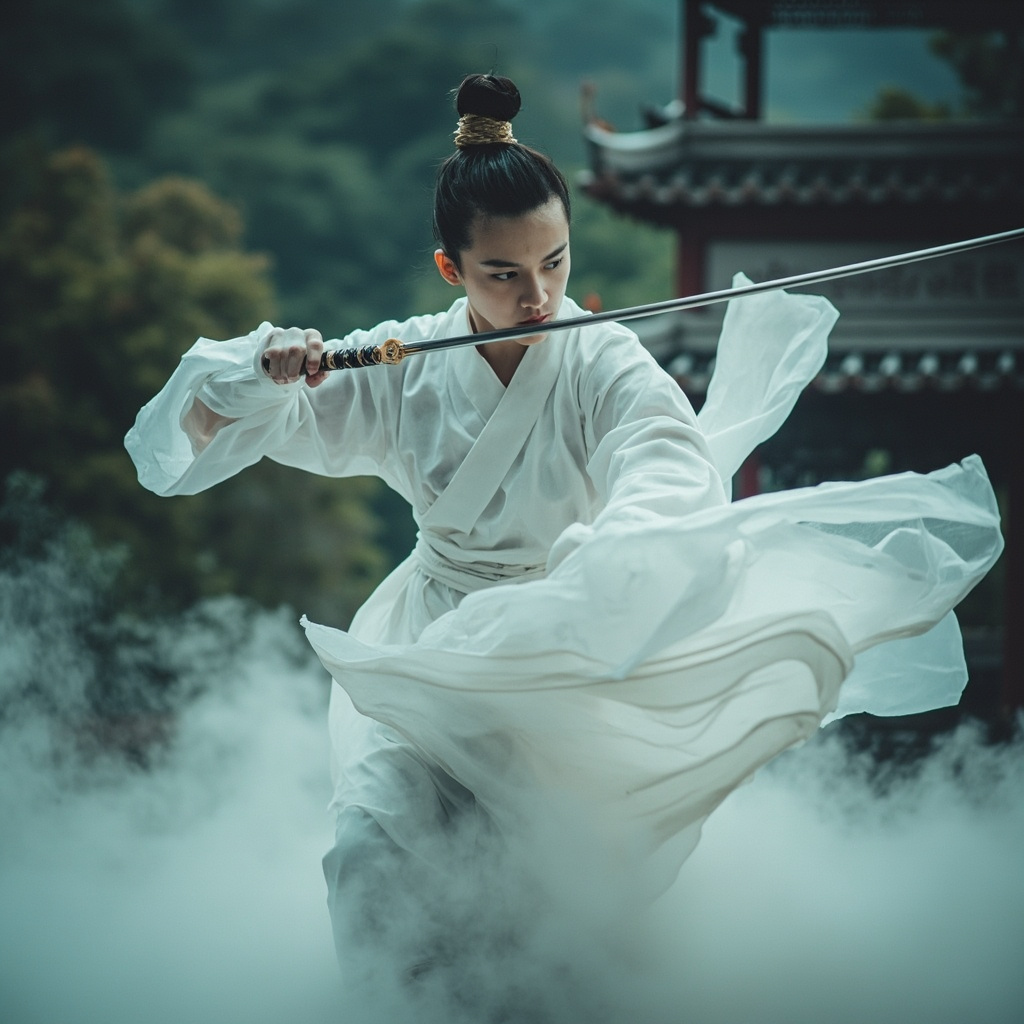
# Chinese Sword Jian Training: The Art of the Straight Blade
The jian stands as one of the most elegant and revered weapons in the rich tapestry of Chinese martial arts. Unlike the broader dao or the spear, the straight double-edged blade represents a philosophy of balanced precision, refined technique, and deep cultural significance. Chinese sword jian training encompasses not merely physical movements but an entire discipline that shapes both body and mind, connecting practitioners to centuries of martial tradition. Whether you are a complete beginner drawn to the graceful forms of this ancient weapon or an experienced martial artist seeking to deepen your understanding, the journey of learning jian sword offers profound rewards. This comprehensive guide explores the essential elements of jian martial arts, from foundational techniques to advanced practices, providing you with the knowledge needed to begin or enhance your training in this distinguished martial art.
## Understanding the Jian Sword: History and Significance in Chinese Martial Arts
The jian sword traces its origins back over two thousand years to China’s Zhou Dynasty, evolving from bronze weapons into the sophisticated steel blades that define classical Chinese swordsmanship. Historical records and archaeological discoveries reveal that the jian was not merely a weapon but a symbol of status, virtue, and martial excellence. Scholars, officials, and warriors alike prized the jian as an extension of one’s character, believing that proper sword training cultivated discipline, respect, and inner strength.
In traditional Chinese culture, the jian earned the title of “the gentleman of weapons” due to its sophisticated nature and the intellectual approach required for mastery. Unlike more straightforward combat weapons, the jian demands nuanced control, precise timing, and a deep understanding of energy dynamics. This philosophy extends into modern jian martial arts, where practitioners continue to honor these ancient traditions while adapting techniques for contemporary training methods.
The sword itself typically measures between 70 and 80 centimeters in length, featuring a double-edged blade that narrows to a sharp point. The blade’s geometry allows for both cutting and thrusting movements, making it extraordinarily versatile in combat applications. Traditional jian swords are characterized by their balance, with the center of gravity positioned close to the guard, enabling rapid transitions between techniques and maintaining precise control throughout forms and drills.
Understanding this historical and cultural context enriches your jian training immeasurably. When you learn jian sword movements, you are participating in a living tradition that connects you to countless practitioners across generations who have dedicated themselves to this elegant art.
[IMAGE: Traditional Chinese jian sword displaying its elegant double-edged blade and ornate guard]
## Essential Stances and Footwork in Jian Training
Mastering proper stances and footwork forms the foundation of all effective jian martial arts practice. Without solid structural foundations, even the most technically refined blade work will lack power, stability, and efficiency. Chinese swordsmanship emphasizes root-like stability, allowing practitioners to generate explosive power while maintaining the ability to flow seamlessly between positions.
The fundamental stance in jian training is the bow stance, or gong jian bu, which provides a strong, balanced foundation. From this position, the front foot points forward while the back foot sits at approximately 45 degrees, creating a stable triangle with the ground. The knees remain slightly bent, the torso upright, and weight distributed with approximately 60 percent on the front leg. This stance allows for dynamic movement while maintaining structural integrity against an opponent’s force.
The empty stance, or xu bu, presents another essential posture where the back leg bears most of the weight while the front leg extends forward with the heel on the ground and toes raised. This stance teaches practitioners to shift weight dynamically, a skill crucial for both defensive maneuvers and offensive power generation. Transitioning smoothly between bow and empty stances develops the leg strength and body awareness necessary for advanced jian techniques.
Cat stance, or lou bu, offers a more evasive positioning where weight rests primarily on the back leg with the front leg drawn back and angled outward. This stance facilitates quick sidestepping movements and defensive retreats while maintaining readiness to counterattack. Practicing these fundamental stances daily, holding each position for progressively longer durations, builds the muscular endurance and proprioceptive awareness that inform all subsequent training.
[IMAGE: Martial artist demonstrating proper bow stance and empty stance transitions in jian training]
## Core Jian Techniques Every Practitioner Must Master
Chinese swordsmanship encompasses a comprehensive vocabulary of jian techniques that practitioners must internalize through dedicated drilling and form practice. These fundamental movements combine into increasingly complex sequences, eventually flowing together in the traditional solo and partner forms that preserve this martial knowledge. Understanding and practicing these core techniques forms the technical backbone of effective jian training.
The basic cutting families include vertical, horizontal, and diagonal cuts, each serving distinct tactical purposes. The vertical cut, or pi, delivers powerful downward strikes that utilize the blade’s mass and the practitioner’s body weight. Horizontal cuts, or sao, sweep across at waist or head height, controlling space and deflecting incoming attacks. Diagonal cuts combine elements of both, offering versatile responses to various angles of attack and defense.
Thrusting techniques distinguish the jian from single-edged weapons, requiring practitioners to develop precise point control and penetrating power. The direct thrust extends the arm while rotating the wrist to align the blade’s edge appropriately for the situation. Curved thrusts, or ci, follow circular trajectories that can bypass defenses while maintaining structural connection with the opponent. These jian techniques must be practiced extensively to develop the muscle memory necessary for reflexive execution under pressure.
Wrist articulation plays a critical role in jian martial arts, distinguishing skilled practitioners from beginners. The blade should never remain static in the hand; constant subtle movement maintains readiness and creates deceptive feints. Twisting the wrist at different points during cuts and thrusts adjusts blade alignment, adds power, and controls the edge presentation for optimal cutting efficiency. Combined with appropriate body mechanics, these wrist techniques generate surprising power from the slender blade.
## The Mental and Spiritual Dimensions of Chinese Swordsmanship
Beyond physical technique, authentic jian training cultivates mental discipline, emotional balance, and spiritual awareness. Traditional Chinese martial arts philosophy recognizes that true mastery emerges from the harmonious development of both external skill and internal cultivation. Practitioners who neglect this dimension find their progress plateauing, while those who embrace the mental aspects discover depths of ability that transcend mere physical capability.
The concept of yi, or intention, plays a foundational role in Chinese swordsmanship. Where many Western martial arts emphasize external form and measurable performance metrics, jian training prioritizes the alignment of mind and body. When practicing forms or drills, practitioners learn to direct their attention with precision, visualizing techniques before executing them and maintaining awareness throughout each movement. This focused intention transforms mechanical repetition into meaningful practice that accelerates skill development.
Breath control represents another essential element of jian martial arts. Traditional training emphasizes coordinated breathing that matches the rhythm of movement, with exhalation accompanying the execution of techniques and inhalation supporting recovery and preparation. This breathing pattern promotes relaxation during performance, reduces tension that would impede technique, and builds the diaphragmatic strength that supports sustained training sessions.
The cultivation of sang, or spirit, completes the internal trinity alongside yi and breath. Through consistent practice, practitioners develop qualities that extend beyond the training hall into daily life: confidence, composure under pressure, respect for tradition, and appreciation for beauty in movement. These attitudinal developments represent the ultimate purpose of traditional jian training, making the sword a tool for personal growth rather than merely a means of combat.
## Choosing the Right Jian Sword for Your Training
Selecting an appropriate training sword significantly impacts your jian martial arts development. The market offers numerous options ranging from decorative display pieces to purpose-built training weapons, and understanding the differences helps ensure you acquire a tool suitable for your training goals and skill level. Making informed equipment choices prevents frustration and potential injury while supporting proper technique development.
Training jian swords generally fall into three categories: wood swords for beginning practitioners, unsharpened steel training swords, and sharps for advanced practitioners with proper supervision. Beginners should start with wooden jian, which allow full-speed practice without injury risk while developing the fundamental coordination and control that physical jian techniques demand. Quality wooden swords are typically made from hardwoods like teak or beech, offering appropriate weight and balance characteristics.
As practitioners advance, steel training swords provide more authentic feel and weight distribution that prepares them for eventual sharp weapon work. When selecting steel jian, examine the blade’s geometry, balance point, and overall construction quality. A proper training jian should have a double-edged blade with distal taper, appropriate flex for safety, and a functional guard that protects the hand. Avoid swords with excessively heavy pommels or poorly centered balance points, as these compromise technique development.
For practitioners interested in traditional forms and cutting practice, sharp steel jian eventually become necessary. However, sharp weapon training requires experienced supervision, appropriate safety protocols, and controlled environments. Never practice with sharps until you have developed solid fundamentals with training weapons and received guidance from qualified instructors familiar with sharp weapon protocols.
## Creating an Effective Jian Training Program
Developing a structured training program accelerates progress while preventing injury and burnout. Effective Chinese sword jian training balances multiple elements including conditioning, technique drilling, form practice, and conditioning work. Understanding how to combine these elements creates sustainable improvement over months and years of dedicated practice.
Physical conditioning supports all martial training, and jian practitioners benefit particularly from exercises that develop grip strength, shoulder stability, and core strength. Regular practice of push-ups, planks, and grip training builds the muscular endurance necessary for extended form practice. Flexibility work, especially for hips and shoulders, enables the full range of motion that traditional jian techniques require. Dedicate at least fifteen minutes daily to supplemental conditioning that supports your sword work.
Technique drilling should comprise a significant portion of your training time, especially as a beginner. Rather than practicing complex forms immediately, break jian techniques into component parts and drill each element with focused attention. Practice individual cuts dozens or hundreds of times with proper form before combining them into sequences. This systematic approach builds reliable technique that forms will later integrate into fluid movement patterns.
Traditional forms represent the synthesized expression of jian martial arts, combining techniques, stances, and transitions into complete artistic sequences. Practitioners should dedicate substantial training time to form practice, progressively refining movements as skill develops. Solo forms like Taiji Jian and basic Wudang Jian sequences offer excellent starting points, while partner forms introduce application context that pure solo practice cannot provide.
## Common Mistakes to Avoid in Jian Martial Arts
Learning from others’ errors accelerates your development and helps you sidestep frustrating plateaus in your jian training. Experienced instructors consistently observe certain patterns that impede beginner progress and limit advanced practitioners’ refinement. Understanding these common mistakes allows you to recognize and correct them in your own practice.
Grip errors represent perhaps the most prevalent issue among jian practitioners. Excessive grip tension restricts wrist mobility, preventing the articulation necessary for effective blade control. Conversely, insufficient grip allows the sword to shift unpredictably during technique execution. The ideal grip maintains relaxed fingers with the thumb lightly supporting the handle, allowing the wrist complete freedom of movement while maintaining secure control. Practice grip awareness drills, periodically releasing and regaining grip to develop adaptive tension control.
Poor body mechanics undermine technique power and efficiency. Many beginners rely excessively on arm strength, neglecting the leg drive, hip rotation, and shoulder positioning that generate true power in jian martial arts. When cutting, the movement should originate from the legs, transfer through the hips, express through the torso rotation, and finally manifest through the arm and wrist. Analyzing your techniques from multiple angles helps identify mechanical inefficiencies that may not be apparent during practice.
Rushing through fundamentals frustrates long-term progress. The temptation to learn advanced forms before mastering basic techniques leads to reinforced errors that become increasingly difficult to correct. Respect the training process, understanding that solid fundamentals create the foundation for everything that follows. Spend ample time with basic cuts, stances, and transitions before progressing to complex sequences, and periodically return to fundamental drills throughout your training career.
Neglecting the internal dimensions of jian training limits your ultimate potential. Practitioners who focus exclusively on external form without cultivating intention, breath awareness, and spirit development find their technique lacks depth and refinement. Even during physical drilling, maintain mental engagement, visualize applications, and coordinate breath with movement. This integrated approach transforms technical practice into true martial training.
[IMAGE: Practitioner demonstrating proper jian grip and wrist articulation techniques]
## Conclusion
Chinese sword jian training offers a profound journey into one of the world’s most refined martial traditions. From the historical significance of the weapon itself to the intricate techniques that define effective practice, the art demands dedication, patience, and wholehearted engagement. Whether your goals involve competitive martial arts performance, traditional form practice, historical reenactment, or simply the pursuit of physical fitness and mental discipline, the jian provides a pathway to developing skills that enrich every aspect of life.
Begin your journey by establishing solid fundamentals: proper stances, basic cuts, appropriate equipment, and balanced training methodology. Seek qualified instruction whenever possible, as the nuanced details that distinguish effective technique from mechanical imitation require experienced observation and feedback. Supplement formal training with supplemental conditioning, historical study, and meditation practice that deepen your connection to this ancient art.
The path of the jian rewards consistent, thoughtful practice over years and decades. Every practitioner begins as a complete beginner, and every master continues learning throughout their lifetime. Approach your training with humility, respect for tradition, and genuine curiosity about the possibilities that disciplined practice reveals. In doing so, you join a lineage of practitioners stretching back through centuries, carrying forward an art that continues to inspire and transform those who dedicate themselves to its mastery.
Begin your jian martial arts journey today, and discover the art of the straight blade that has captivated practitioners for generations.