ARTICLE_TITLE: Chinese Painting: Art Forms, Techniques, and Masterpieces
ARTICLE_BODY:
## Introduction
Chinese painting, one of the oldest continuous artistic traditions in the world, blends visual art, poetry, calligraphy, and philosophy into a single expressive medium. From the earliest depictions on ritual bronze vessels to the delicate ink washes on silk scrolls, Chinese painting has evolved into a rich tapestry of styles, techniques, and cultural narratives. This article explores the diverse art forms, core techniques, and celebrated masterpieces that define Chinese painting, offering readers a comprehensive guide to understanding and appreciating this timeless art.
## Historical Evolution of Chinese Painting
The history of Chinese painting stretches back over two millennia. Early periods were dominated by ritualistic themes and depictions of mythic beasts on bronze implements. By the Han dynasty (206 BCE – 220 CE), the first recognizable painting forms appeared on tomb walls, illustrating scenes of daily life and afterlife journeys.
The Six Dynasties period (220–618 CE) saw the emergence of literati painters who began to view painting as an intellectual pursuit rather than a purely decorative craft. The Tang dynasty (618–907 CE) marked a golden age, with court artists producing monumental works that emphasized realism and vibrant color. The Song dynasty (960–1279 CE) shifted focus toward scholarly restraint, giving rise to the meditative landscapes that would later define the literati tradition.
The Yuan, Ming, and Qing dynasties further diversified the aesthetic, integrating Confucian, Taoist, and Buddhist ideas into composition and subject matter. By the 20th century, modern Chinese painters began experimenting with Western techniques, yet they retained the core principles of brushwork, composition, and symbolic meaning that have characterized Chinese painting for centuries.
## Major Schools and Styles
### Literati Painting (Wenrenhua)
Also known as “scholar‑painting,” this style emphasizes personal expression, spontaneity, and the mastery of brush and ink. Artists working in this tradition often paint landscapes, bamboo, and plum blossoms, using bold, expressive strokes to convey inner feelings. The emphasis is on the “spirit” of the subject rather than photographic realism.
### Academic or Court Painting (Gongbi)
In contrast, the Gongbi school focuses on meticulous detail, refined line work, and vivid colors. Developed during the Tang and Song periods, this approach was favored by the imperial court for its ability to depict flora, fauna, and courtly scenes with exquisite precision. Gongbi works often feature luminous pigments on silk, creating a jewel‑like quality.
### Folk and Decorative Styles
Beyond the elite schools, folk traditions flourished across villages, producing vibrant paintings on paper, wood, and clay. These works, often created for festivals, rituals, or domestic decoration, employ bold outlines, bright pigments, and symbolic motifs such as dragons, phoenixes, and lotus blossoms.
## Core Techniques
### Brushwork (Ink, Water, and Loading)
The heart of Chinese painting lies in brushwork. Artists use a variety of brushes—ranging from fine‑pointed to broad‑stroke—each capable of producing distinct line qualities. Ink, mixed with water on an inkstone, yields gradients from deep blacks to faint grays. “Loading” refers to the technique of loading the brush with varying amounts of ink or pigment to control tone and texture.
### Composition (Shan‑shui, Bird‑and‑Flower)
Composition in Chinese painting follows principles derived from Taoist and Confucian thought. In landscape painting (Shan‑shui), artists arrange mountains, water, and mist to create a sense of depth and harmony. The “three distances”—height, depth, and level—guide the placement of elements to achieve spatial illusion. Bird‑and‑flower paintings employ balance, asymmetry, and the principle of “void” (留白) to focus attention on the subject while allowing the viewer’s imagination to fill the empty space.
### Use of Space (留白 – “Void”)
Empty space, or “void,” is not an absence but an active element that conveys stillness, breath, and the ineffable. By leaving areas of the silk or paper unpainted, the artist creates a dialogue between presence and absence, inviting contemplation.
### Color and Pigments
Traditional Chinese pigments are derived from minerals, plants, and shells, producing colors such as azurite blue, malachite green, cinnabar red, and gold. While early works were predominantly monochromatic ink, later periods introduced vivid color palettes, especially in Gongbi works, to highlight detail and symbolism.
## Tools and Materials
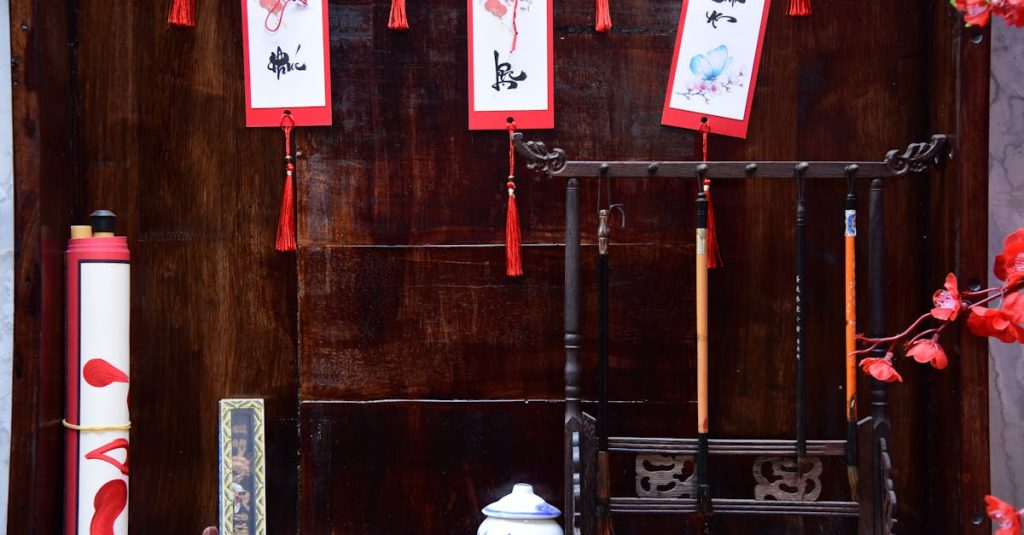
– **Brushes**: Made from animal hair (e.g., goat, weasel, rabbit) bound to bamboo or wood handles. Different hairs provide varying degrees of stiffness and absorption.
– **Ink**: Produced by grinding an ink stick on an inkstone with water. The consistency can be adjusted for thin washes or dense lines.
– **Rice Paper (Xuan paper)**: Known for its absorbency and durability, this paper allows delicate ink diffusion, making it ideal for both calligraphy and painting.
– **Silk**: A smoother surface that retains fine detail and brilliant color. Silk scrolls often require a different loading technique due to its non‑porous nature.
– **Inkstone**: A slab used for grinding ink sticks, providing a consistent texture.
– **Seals**: Red chops bearing the artist’s name or motto, stamped on completed works to signify authenticity and artistic identity.
## Notable Masterpieces and Artists
### Gu Kaizhi – “Admonitions of the Instructress to Court Ladies” (c. 400 CE)
One of the earliest surviving Chinese paintings, this hand scroll demonstrates refined line work and narrative storytelling. Gu Kaizhi’s emphasis on capturing the inner emotions of figures set a precedent for later figure painting.
### Fan Kuan – “Travelers among Mountains and Streams” (c. 1000 CE)
A monumental landscape in the Northern Song tradition, this piece showcases Fan Kuan’s mastery of monumental composition, where towering peaks dominate the foreground, and misty valleys recede into the distance. The painting embodies the Taoist reverence for nature’s grandeur.
### Wang Xizhi – Calligraphic Influence (4th‑5th century)
While primarily celebrated as a calligrapher, Wang Xizhi’s flowing brushwork profoundly influenced the development of painting aesthetics. His “Orchid Pavilion Preface” exemplifies how calligraphic rhythm can be transferred to visual art.
### Wu Guanzhong (1919–2010) – Modern Landscapes
Wu Guanzhong’s works fuse traditional Chinese ink painting with modernist simplicity. His minimalist depictions of mountains and rivers, often rendered in bold black strokes on white paper, highlight the timeless relevance of Chinese painting in contemporary art.
### Qi Baishi (1864–1957) – Insect and Flower Paintings
Qi Baishi is renowned for his lively depictions of insects, shrimp, and botanicals. His use of vibrant color and dynamic brushwork brings a playful realism to the bird‑and‑flower genre, making his pieces beloved worldwide.
### Zhang Daqian (1899–1983) – Splashed‑Ink (Pōu‑mò) Style
Zhang Daqian pioneered the “splashed‑ink” technique, breaking away from conventional brush control to create dramatic, abstract landscapes that echo the energy of nature. His later works, blending traditional motifs with modern abstraction, have fetched record auction prices.
## Themes and Symbolism
Chinese paintings often embed layered meanings beyond their visual appeal. Common motifs include:
– **Mountains and Water**: Represent stability, endurance, and the Taoist concept of the “Way.”
– **Bamboo**: Symbolizes resilience, integrity, and scholarly conduct.
– **Plum Blossom, Orchid, Chrysanthemum, Bamboo**: The “Four Gentlemen,” embodying moral virtues.
– **Dragons and Phoenixes**: Signify power, prosperity, and auspiciousness.
– **Lotus**: Represents purity and spiritual awakening, rising above the mud.
Artists may incorporate poetry onto the scroll, aligning text with image to convey philosophical insights or personal reflections.
## Modern Influence and Global Appreciation
In the 21st century, Chinese painting continues to inspire contemporary artists worldwide. Exhibitions in major museums—such as the Metropolitan Museum of Art, the British Museum, and the Palace Museum—showcase both classical scrolls and modern interpretations. Collectors are increasingly drawn to Chinese paintings for their historical significance, aesthetic beauty, and investment potential.
Digital platforms have also democratized access, allowing enthusiasts to view high‑resolution images, study brush techniques, and even purchase reproductions. Contemporary Chinese artists like Liu Xiaodong and Zeng Fanzhi blend traditional elements with global art discourse, demonstrating the dynamic evolution of Chinese painting.
## Tips for Aspiring Artists
1. **Master Brush Control** – Practice basic strokes repeatedly. A steady hand and consistent ink loading are foundational.
2. **Study Classical Works** – Visit museums or reputable online archives to observe how masters handled composition, ink, and space.
3. **Embrace the Void** – Experiment with leaving areas unpainted; this practice trains the eye to see balance and breath in a composition.
4. **Learn Calligraphy Basics** – Even a rudimentary understanding of Chinese calligraphy can improve line quality and expressive brushwork.
5. **Experiment with Materials** – Try both rice paper and silk to understand how each surface interacts with ink and pigment.
6. **Integrate Symbolism** – Research the cultural meanings of common motifs to embed deeper narratives in your work.
## Conclusion
Chinese painting is far more than a visual art; it is a synthesis of philosophy, literature, and craftsmanship that has endured for over two millennia. From the meticulous Gongbi renderings of court life to the spontaneous ink washes of literati landscapes, each style offers a distinct lens through which to view humanity’s relationship with nature and the cosmos. By exploring the rich history, mastering key techniques, and appreciating celebrated masterpieces, you can gain a profound insight into this enduring artistic tradition. Whether you are a collector, a student of art, or simply a curious reader, the world of Chinese painting invites you to discover beauty, meaning, and inspiration in every brushstroke.