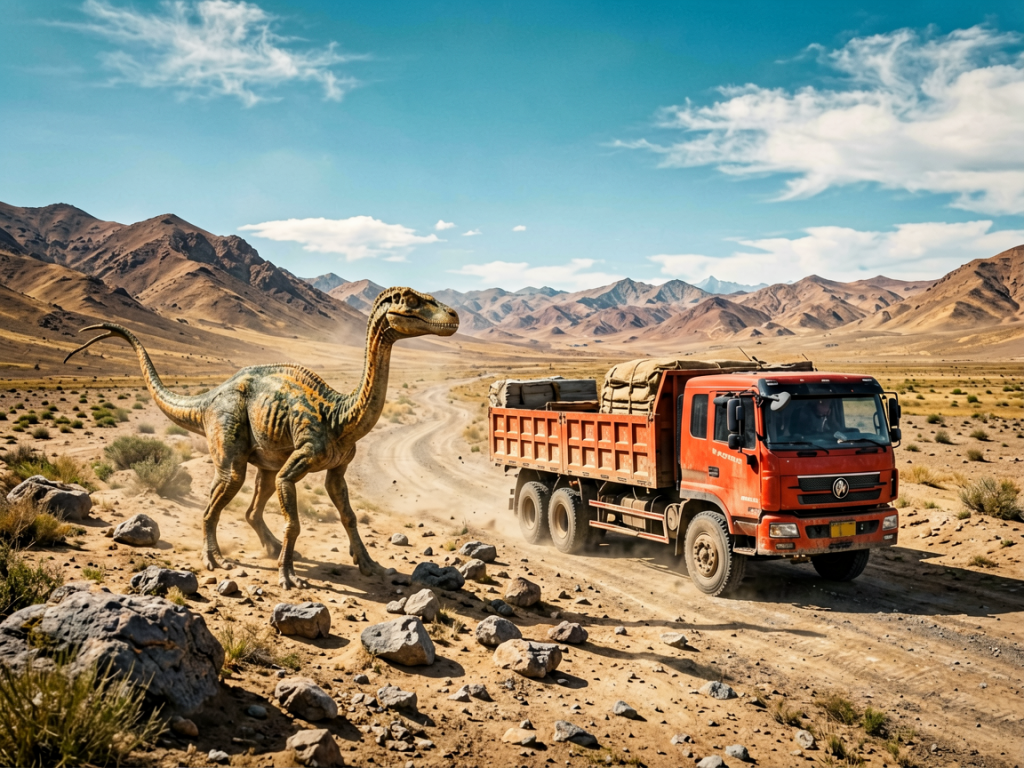
I still remember pulling into Erenhot after a six-hour bus ride from Beijing. The air hit me first. It was dry, hot, and carried that distinct grit of wind-swept sand. I stepped out onto the pavement and immediately squinted at the skyline. It looks like someone dumped a theme park model of a Mongolian palace right next to a Soviet-era industrial zone.
There are yurts everywhere. They’re actually just concrete buildings painted to look like felt tents, but trust me, it works perfectly. I’d come here chasing one thing: dinosaurs. I’ll be honest, I didn’t expect Inner Mongolia to rival the American West for paleontology. But the Gobi Basin is absolutely packed with Mesozoic remains.
Chasing Dinosaurs in the Gobi Dust
The guides at the local museum weren’t just reciting geological dates. They actually cared deeply about the sediment layers. I asked one researcher why the province digs up so much while neighboring regions mostly uncover plain rocks. He laughed and told me the climate basically freeze-dries the bones here. The sand buries them quickly, and the dry air stops them from decaying.
I rented a jeep the next day to drive out past the city limits. The highway just opens into endless flatlands of yellow grass. We stopped near an active dig site that was cordoned off with bright orange safety tape. A paleontologist was carefully brushing loose soil off a massive vertebrae. He let me hold a smaller fragment he’d pulled out earlier. It weighed almost nothing but felt incredibly heavy with age.
Right there, I found myself imagining a fifty-ton creature walking exactly where my boots were sinking into the dirt. Sure, you can buy plastic replicas in souvenir shops back home. But nothing compares to touching something that actually lived here seventy million years ago. The scale of these excavations is genuinely wild.
Private companies actually mine the fossil beds now. I watched workers carefully package a complete duck-bill dinosaur skull into a reinforced wooden crate. The crew marked it with fragile stickers and loaded it onto a flatbed. It felt less like modern science and more like an archaeological heist happening in broad daylight.
I spent three hours just sketching the excavation grid in my notebook. The sheer volume of bone fragments scattered across the slope defies logic. Even the smallest ribs looked intact. I asked the foreman if he ever gets tired of looking at ancient creatures. He shook his head and told me they never talk back. I couldn’t argue with that logic.
The Endless Highway of Russian Trucks
If dinosaurs represent the deep past, the border road is undeniably the loud present. Erenhot sits right on the freight corridor that feeds goods from Moscow straight into northern China. I walked down to the commercial terminal at dusk just to listen. The sound is absolutely deafening. Diesel engines idle constantly, air brakes hiss loudly, and Mongolian drivers shout over crackling walkie-talkies.
I bought a thermos of bitter tea from a street vendor and leaned against a rusted chain-link fence. A massive Kamaz truck rolled past, covered in thin frost despite the summer heat outside. The driver hopped out, cracked his window, and passed me a foil packet of roasted sunflower seeds. We didn’t speak the same language, but we both nodded at the sheer volume of metal passing through this dusty town.
He pointed at the customs building and made a rubbing motion with his thick fingers. Money, he clearly meant. Lots of it. The logistics here are brutal but surprisingly brilliant. Russian diesel, European appliances, and Chinese electronics all shuffle through this checkpoint daily. I learned that Mongolian tugrik changes hands constantly at the border stalls.
Vendors sell everything from heavy-duty car batteries to secondhand winter coats right on the asphalt. I picked up a vintage Soviet enamel mug for exactly thirty yuan. The paint was completely chipped, but it still held heat perfectly. It’s definitely better than most modern travel mugs I’ve tested recently. It’s easy to overlook towns like this on a standard map.
But watching the trucks rumble past the desert gates gave me a whole new perspective on global supply chains. Most people never actually see where their imported goods cross the international line. I spent the entire afternoon photographing license plates from half a dozen different countries. The long-haul drivers sleep in cabs stacked high with instant noodle cups and spare diesel cans. They’re the quiet backbone of this entire region.
Eating Lamb and Drinking Tea on the Edge of Everything
You simply can’t survive on museum tickets and diesel fumes. Dinner in Erenhot is a serious culinary commitment. I found a restaurant tucked inside a complex called the Mongol Empire Cultural Park. The name sounds aggressively touristy, but the food actually respects traditional preparation methods. I sat at a low wooden table with a family of traders who’d just unloaded a shipping container from Zamiin-Uud.
They warmly invited me to share fresh lamb skewers and pour myself a bowl of salty milk tea. The meat was incredibly tender. It wasn’t gamey at all, just rich and smoky from the charcoal grill. I tried dipping it into a chili paste that tasted exactly like fermented tomatoes and cumin. It woke up my palate instantly. The host kept refilling my cup until the copper pot was nearly empty.
He explained over broken English that hospitality matters far more than quick profit here. I could easily believe it. Afterward, we strolled across a plaza paved with smooth river stones. The architecture is strangely specific to this crossroads. You’ll find marble arches that look like they belong in Rome, sitting right next to neon signs advertising dental clinics and internet cafes.
It’s a jarring visual mix, but it fits the border vibe completely. Nothing here feels artificially forced. It just grew organically from decades of nomadic movement and industrial demand. I’m no expert on urban design, but places like this teach you how cultures blend when you stop trying to separate them. The Chinese, Mongolian, and Russian influences don’t fight each other here.
They just coexist peacefully under the same harsh sky. You order a plate of hand-pulled noodles and nobody questions why they taste slightly different than versions served in Lanzhou. They simply do. The flavors shift subtly depending on whose kitchen is cooking them. It’s a quiet reminder that borders are mostly lines on paper.
Why This Weird Border Town Stuck With Me
I’ve lived in northern China for eight years now. I’ve eaten street food in busy Chengdu alleys, hiked terraced hills in remote Yunnan villages, and argued about ancient philosophy in Beijing teahouses. Erenhot doesn’t fit neatly into any travel brochure category. It’s dusty, loud, and utterly unpolished. And that’s exactly why it stays with you.
Most tourists skip straight through to Zhangjiajie or the famous Great Wall sections. They completely miss the grit that actually holds the country together. Here, you watch prehistoric bones get carefully cataloged right beside modern shipping containers. You hear engines from factories that haven’t been invented yet mixing with wind howling across empty steppe.
It’s strange, absolutely. But it’s also refreshingly real. I packed my Soviet mug and a bag of dried beef jerky at the morning station. The train ride back south takes roughly twelve grueling hours. I spent most of the journey staring out the window as the landscape slowly turned lush and green again. I easily could’ve visited ten other cities that same month.
None of them would’ve given me that same quiet hum in my chest. Erenhot doesn’t try to impress anyone. It just exists fully and unapologetically on the edge of everything. If you ever find yourself driving north past the ring roads and shopping malls, follow the dust trail. You’ll find a place that remembers the ancient world while aggressively marching toward the future.