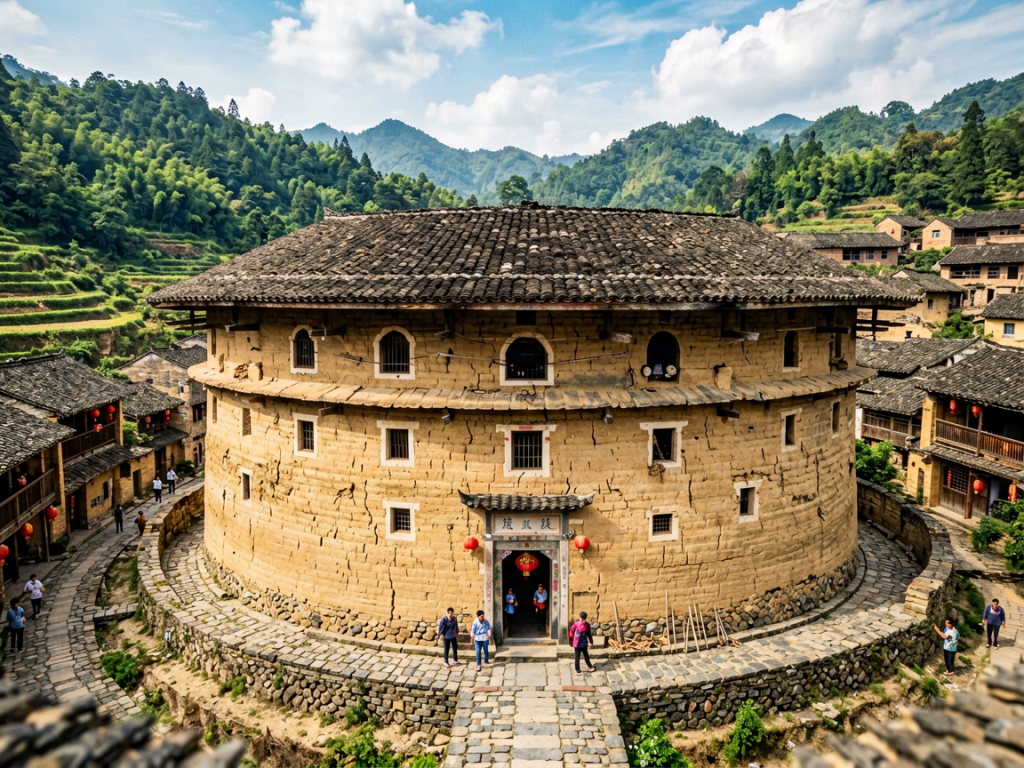
I still remember the first time I saw a Tulou. I was standing on a dusty ridge in Nanjing County, squinting against the morning mist. Below me, in a valley that felt like it belonged to a different century, sat a massive circular structure made entirely of rammed earth.
It looked less like a building and more like a giant, ancient pancake that had fallen out of the sky. It was beige, imposing, and utterly silent except for the distant sound of a rooster crowing. I knew they were famous. Everyone knows the Terracotta Warriors. Everyone knows the Great Wall. But this? This was different.
Here’s the thing about Fujian Tulou. They’re not just old houses. They’re social experiments written in clay and timber. And honestly, they’re the most overlooked UNESCO World Heritage site in China. You’d think millions would flock there, but most tourists stick to the shiny skyscrapers of Shanghai or the historic hutongs of Beijing. They miss out on something truly magical.
Living inside a fortress made of mud
I spent three days living in the Chengqilou Tulou in Yongding. It’s one of the largest residential earthen buildings in the world. When I walked through the main gate, I felt like I was stepping into a movie set. But then I heard a dog barking. And saw an old woman washing vegetables in a communal courtyard.
That’s when it hit me. People still live here. Not as tourists, not as actors, but as real folks going about their daily lives. The air smelled of dried chili peppers, wood smoke, and damp earth. It wasn’t polished for your Instagram feed. It was raw, functional, and deeply human.
The walls are three meters thick. I leaned against one in the hallway. It felt solid as rock, though it’s just dirt, rice glue, bamboo strips, and brown sugar mixed together. That’s right, brown sugar. The Hakka people who built these discovered that adding sugar to the mud mixture made it harder and more resistant to rot. It sounds weird, right? But it works. The structure has stood for over 400 years without collapsing.
I asked my host, Uncle Lin, how he liked living in such a confined space. He laughed and told me he didn’t mind. “We watch each other,” he said. “No secrets. No thieves. It’s safe.” I wasn’t sure I wanted that level of transparency for my own life, but I couldn’t deny the sense of community. In those hallways, you bump into your neighbors every time you go to the kitchen. You learn their rhythms. You become part of the family, even if you’re just visiting.
Why did they build them like this?
To understand the Tulou, you have to understand history. The Hakka people are migrants. They moved south from central China centuries ago to escape wars and famine. When they arrived in Fujian, they weren’t welcomed with open arms by the local populations. There was tension. Lots of it.
So, they built fortresses. These circular or square structures were designed for defense. The ground floor had no windows. It was used for storing grain and keeping livestock. The second floor stored food. The third and fourth floors were for sleeping. By the time you got to the top, you had a bird’s-eye view of the surrounding landscape. If bandits attacked, the Hakka could defend themselves easily. They had arrows slit in the roof and boiling water ready to pour down on invaders.
But it wasn’t just about war. It was about equality. Inside a Tulou, everyone had roughly the same amount of space. No matter how rich or poor your branch of the family was, your room size was determined by the layout, not your bank account. This was radical. I’ve seen palaces in Beijing where the difference between the emperor’s quarters and the servants’ halls is night and day. Here, the rich and the poor lived under the same roof, sharing the same courtyard and the same well.
I stood in the central courtyard of Chengqilou. It was huge. Like a football field, but round. In the middle stood the ancestral hall. This is the heart of the community. During festivals, the whole clan would gather there to worship their ancestors. It’s a powerful reminder of where they came from. For a people who lost their original homeland long ago, this shared space is their anchor.
The food tastes better when you eat it in silence
You haven’t really experienced Fujian until you’ve eaten Hakka cuisine in a Tulou. It’s hearty, salty, and incredibly flavorful. We had a dinner prepared by Uncle Lin’s wife in one of the ground-floor rooms. The table was low, and we sat on wooden stools. The lighting was dim, provided by a single bulb hanging from a bamboo beam.
We ate meatballs. Not the tiny ones you get in soup back home. These were fist-sized, made of pork and shrimp, and packed with flavor. Then there was the fermented tofu. I’ll be honest, I was skeptical at first. It looked like gray slime. But Uncle Lin insisted. “Try it,” he said. “It goes well with rice.” I took a bite. It was pungent, creamy, and addictive. I ended up eating three bowls of rice just to wash it down.
We also drank rice wine. It was strong. I forgot how much I love cheap, strong alcohol until I was sitting in that ancient hall, chatting with strangers who became friends. The wine warmed me up, but the conversation warmed me more. We talked about nothing and everything. His grandchildren, my job in Shanghai, the weather, the price of pork.
It’s strange how food breaks down barriers. In a modern restaurant, everyone is on their phones. Here, there’s nowhere else to look but at the person across the table. You’re forced to connect. And it’s beautiful.
Why is it so hard to get there?
This is the catch. The Fujian Tulou are in a remote part of the province. Getting there takes time. Most people fly into Xiamen, which is a nice coastal city, but it’s hours away from the hills of Nanjing and Yongding. From Xiamen, you have to take a train to Zhangzhou or Longyan, and then a bus. The roads are winding. If you’re prone to motion sickness, bring your meds.
I remember sitting in the back of a rattling minibus for four hours, watching the landscape change from urban sprawl to lush green terraces. My stomach was doing flips, but my eyes were wide open. Every turn revealed another valley, another cluster of Tulou peeking out from the mist. It was worth every bump in the road.
But here’s the irony. Because it’s hard to get there, fewer people go. And that keeps it special. If they built a direct high-speed rail line next to every Tulou, it would be overrun. Like Wuzhen or Fenghuang, it would become a commercialized tourist trap filled with souvenir shops selling mass-produced plastic swords. The inconvenience is actually a feature, not a bug. It filters out the casual tourists and leaves room for those who really want to see it.
I met another traveler at a guesthouse. She’s from Berlin. She’d been traveling in China for six months and hadn’t seen a single Tulou. “I heard they’re amazing,” she said. “But I didn’t know where to start.” I gave her my itinerary. We swapped numbers. Now, whenever we meet, we compare notes on the best local dishes we’ve found.
Is it fading away?
There’s a bittersweet reality to all this. The young people are leaving. The children go to school in the towns. The graduates move to Guangzhou or Shenzhen for jobs. They don’t come back to live in the mud houses. The population is aging. The average age in Chengqilou is probably over sixty.
Uncle Lin told me his son lives in Xiamen. He visits once a year during Chinese New Year. That’s it. The Tulou is becoming a museum of sorts, even while people still live in it. It’s a ghost town in the making, but a living one. The echoes of footsteps in the corridors will eventually fade. The cooking smells will disappear. The communal laughter will quiet down.
This is why I’m passionate about telling you to go now. Not later. Now. Because in twenty years, these places might be empty shells. Or worse, they might be renovated beyond recognition to suit modern tastes. The soul of the Tulou is in its authenticity. It’s in the cracks in the walls and the peeling paint. It’s in the way the light hits the dust motes in the afternoon sun.
I don’t want to be dramatic. But some things are fragile. You can’t replicate this experience. You can’t buy it online. You have to walk through that gate. You have to smell that mix of wood smoke and old dirt. You have to feel the weight of history pressing against your back.
What to pack and how to behave
If you decide to make the trip, leave your luxury expectations at the door. The guesthouses are basic. You might not have hot water 24/7. The beds are simple. But that’s part of the charm. Don’t expect five-star service. Expect hospitality.
Bring comfortable shoes. The floors are uneven stone and wood. Wear layers. The mornings are chilly, but the afternoons can be humid. And bring an open mind. This isn’t a resort. It’s a real place where real people live. Be respectful. Ask before you take photos of locals. Buy things from the local vendors. Support the economy that keeps these structures alive.
I learned a lot from just watching. I watched a group of elderly men playing chess in the courtyard. I watched women hanging laundry from the upper balconies, the colorful clothes fluttering like flags. I watched kids running around with sticks, pretending they were soldiers defending their fortress. Life goes on. Simple, slow, and steady.
When I left, I felt lighter. Like I’d shed some of the stress I’d carried from the city. The Tulou doesn’t ask anything of you. It just stands there, solid and enduring. It reminds you that you don’t need much to be happy. A roof over your head. Food on the table. People around you.
China has so many layers. You have the hyper-modern side that dazzles you with its speed and scale. And then you have these hidden pockets of tradition that ground you. The Tulou is one of those pockets. It’s quiet. It’s humble. But it’s powerful.
So, go. Take the long bus ride. Eat the strange tofu. Sleep in the big circle. Let the mud walls soak up your stories. And maybe, just maybe, you’ll leave with a little piece of that peace in your heart too. Trust me, it’s worth it.