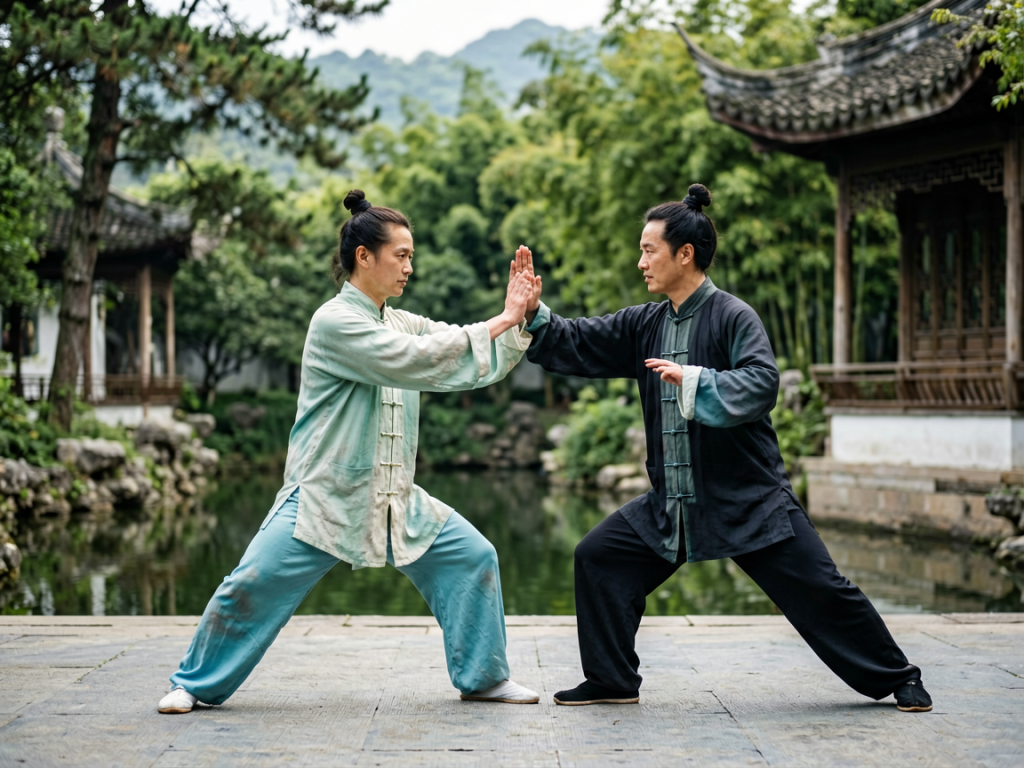
The Illusion of Stillness
I remember my first time watching a serious Push Hands competition. It was in a drafty community center in Chengdu, back in 2016. The air smelled faintly of damp concrete and stale tea.
I sat on a plastic stool, expecting something slow and graceful. I’d seen the videos. You know the ones. Old masters moving like smoke, arms weaving in perfect circles. I expected poetry.
Instead, I got a wrestling match disguised as a dance. And honestly? It terrified me.
Two guys were locked in an embrace. They weren’t moving their feet much. Their upper bodies swayed slightly, like trees in a breeze. To a casual observer, they looked stuck.
But I was wrong. I’m no expert, but I’ve spent eight years watching people move in China. I recognized the tension in their shoulders. It wasn’t relaxation. It was coiled energy.
One guy leaned forward just an inch. The other didn’t retreat. He yielded. And in that split second, the first guy lost his balance completely. He didn’t fall far, maybe two feet, but he hit the floor with a heavy thud.
Cheers erupted. Not the polite applause of a theater. These were guttural shouts from uncles who had been drinking beer since noon.
That moment changed how I see everything. People think Tai Chi is gentle. It is. But it’s also deadly efficient. Push Hands competitions show you exactly why.
Reading the Body, Not Just the Eyes
If you want to understand what’s happening, stop looking at the faces. Look at the hands.
In Western wrestling or Judo, you watch the eyes. They’re tracking the opponent’s intent. In Push Hands, intent is hidden in the contact points. The forearms, the wrists, sometimes even the chest.
I learned this from Master Li, a retired fighter who now teaches in my neighborhood park. He’s tiny, maybe five-foot-five, but he moves like water.
“The skin feels,” he told me once over steamed buns. “The bone directs. The mind empties.”
At first, I thought he was speaking nonsense. But after watching dozens of matches, I started to see it.
When two practitioners touch, they aren’t just pushing. They’re listening. They’re sensing the direction of the other person’s force. It’s called “Ting Jin,” or listening energy.
If you push hard, they don’t push back. They redirect. It’s like trying to push a door that swings open toward you. You lose your momentum. They gain yours.
The magic happens in the timing. A skilled practitioner waits until the opponent is fully committed. Then, just as the force peaks, they add a small nudge in a different direction.
That’s all it takes. The opponent becomes their own enemy. Their own strength throws them off balance.
I saw this clearly last year at a provincial tournament in Xi’an. The crowd was huge. Maybe three hundred people crammed into a gymnasium.
A younger guy, muscular and aggressive, charged at his older opponent. The old man didn’t flinch. He stood still, arms loose.
As the young man lunged, the old man stepped aside. He touched the young man’s shoulder lightly. Just a tap. The young man spun around and fell onto his back.
The referee counted to ten. The old man won by default. He didn’t even break a sweat.
That’s the secret nobody tells you. The fight isn’t about being stronger. It’s about being smarter. Or rather, being less resistant.
The Social Contract of the Mat
There’s another layer to these competitions that you won’t see on TV. It’s social.
In China, martial arts aren’t just sports. They’re a way of testing character. Push Hands is intimate. You have to be close to someone else. Your body touches theirs.
In many cultures, that would be awkward. Here, it’s a conversation.
I’ve watched men argue politics while sparring. I’ve seen business partners test each other’s trust levels. If you betray your partner during the match, you lose respect in the community.
Respect is huge here. The winners don’t gloat. They bow. The losers nod respectfully. There’s no trash talk.
I noticed this pattern early on. In the West, athletes celebrate their dominance. They flex. They shout. In Chinese Push Hands, humility is part of the technique.
If you act arrogant, your posture stiffens. Your energy blocks. You become easy to defeat.
Master Li explained it this way: “Arrogance is heavy. Humility is light. Light things float. Heavy things sink.”
It sounds like philosophy, but it’s biomechanics. When you’re relaxed, your muscles don’t tense up. You react faster. You stay balanced longer.
I tried it once. I went to a local club and asked to try Push Hands with a regular guy named Chen. He runs a taxi service during the day and trains at night.
Chen was nice enough to let me go first. I tried to push him. I used some force. I thought I was doing it right.
He didn’t resist. He just let me push against empty space. I stumbled forward, caught myself, and felt foolish.
Then it was his turn. He placed his hand on my arm. He didn’t push hard. He just guided me backward. I couldn’t stop my own movement.
It was embarrassing, but enlightening. I realized how much effort I was wasting by fighting against the flow.
This lesson applies outside the gym too. I’ve seen it in negotiations, in traffic, even in family disputes. Fighting force with force rarely works. Redirecting it does.
The Hidden Physics of Balance
Let’s talk about the science for a second. I know, I’m not a physicist. But I’ve read enough to understand the basics.
Push Hands relies heavily on the concept of the center of gravity. Everyone has one. It’s usually around your belly button.
If you keep your center low and aligned, you’re stable. If you lean too far forward or backward, you’re unstable.
The goal of the opponent is to disturb your center. They don’t need to knock you down. They just need to make you correct your balance.
Once you start correcting, you’re reactive. You’re playing their game. And reacting is tiring.
I watched a match between two grandmasters recently. They moved so slowly it looked like they were in slow motion. But every shift was calculated.
They were probing for weaknesses. Like a boxer circling the ring, looking for an opening.
One master shifted his weight to his left leg. The other sensed it immediately. He pushed gently on the right side, forcing the first master to step back.
That step back broke his alignment. He was now off-balance. The second master capitalized instantly. A quick twist, and the first master was out.
It took less than three seconds. The crowd gasped. It was beautiful.
You don’t need to be strong to do this. You need to be aware. Awareness is the real weapon.
I used to think strength was muscle. Now I think strength is connection. Connection to your body, to your breath, to your opponent.
When you connect, you feel what’s coming before it happens. That’s the illusion of precognition. It’s not magic. It’s sensitivity.
Why You Should Watch Again
So, why should you care? Why spend an afternoon watching two old men hug each other?
Because it’s a mirror.
Tai Chi Push Hands reflects how we handle conflict in our daily lives. Do we resist? Do we fight back? Or do we yield and redirect?
I’ve found that practicing Push Hands, even casually, makes me calmer. I don’t get angry as easily. I listen better.
It’s not just a sport. It’s a meditation in motion.
If you ever get the chance to attend a competition, go. Sit down. Watch closely. Ignore the speed. Focus on the touch.
You’ll see something profound. Two people communicating without words. Two forces interacting in perfect harmony.
It’s chaotic, yet controlled. Aggressive, yet peaceful. That’s the paradox of Tai Chi.
I’ll be honest, I was skeptical at first. I thought it was just soft exercise. I was wrong.
It’s a deep study of human interaction. And it’s available to anyone willing to learn.
Next time you’re in China, look for the community centers. Listen for the shouting. Find the mats.
Watch the hands, not the faces. And maybe, just maybe, you’ll feel the power of yielding.
Trust me, it’s better than any blockbuster movie. And it’s right there, in the dusty gym next to the noodle shop.