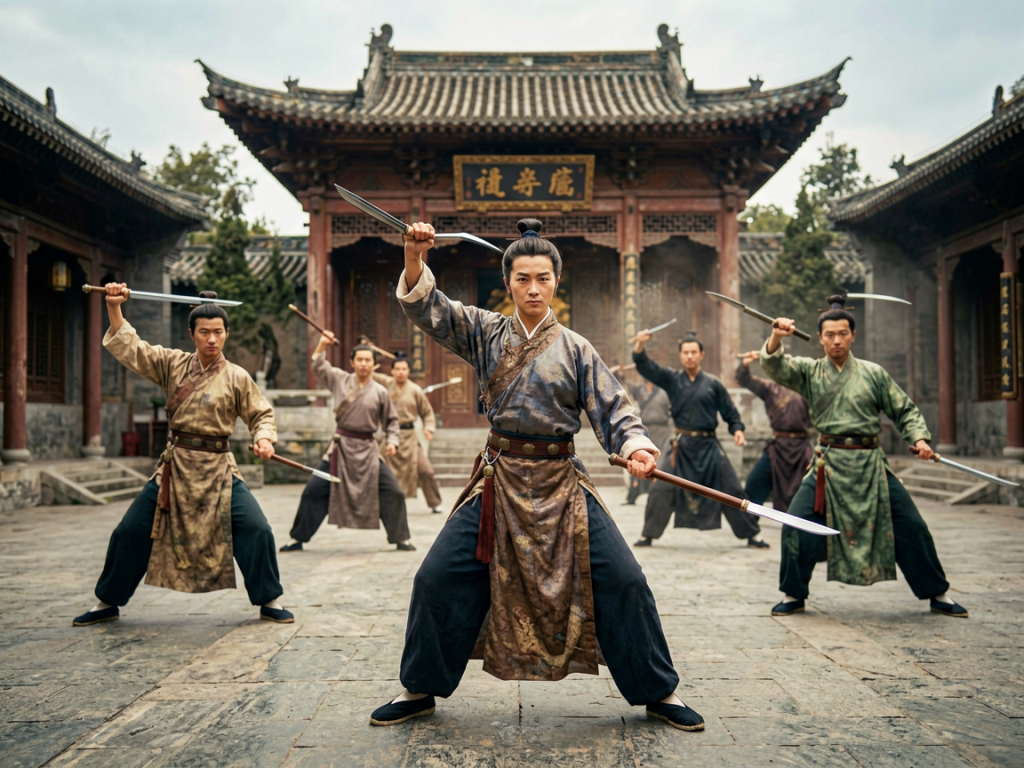
Look, I’ll be honest. When I first walked into that dusty community center in Chengdu last month, I thought I’d walked into the wrong place. I was expecting a high-tech gym with neon lights and spinning bikes. Instead, I found an old man in a white silk tunic swinging a bamboo staff with enough force to split a watermelon. And around him? Dozens of twenty-somethings. Not in armor. Not in cosplay. Just in comfortable track pants and hoodies.
It was weird. It was cool. It was exactly what I didn’t see coming. For years, the narrative has been that traditional Chinese martial arts are dying out, replaced by kickboxing or just scrolling on TikTok. But if you’re in any major Chinese city in 2026, you’ll notice something different. The young folks are getting hungry for something heavier. Something with history in its bones.
Why the Bamboo Staff? It’s Not Just for Movies Anymore
I spent three weeks trying to learn basic movements with a jian (straight sword) and a gun (staff). Let me tell you, it’s humbling. I’m a grown man. I can deadlift more than I should. But holding a four-foot bamboo staff without whipping myself in the face? That’s a different kind of strength.
The thing about traditional weapons training isn’t the combat efficiency. You’re not gonna go into a fight with a sword in 2026. It’s the rhythm. It’s the focus. I remember my first class in the Chunxi district. My instructor, a guy named Lao Li who looks like he’s been carving wood since the Qing Dynasty, kept yelling, “Relax your wrist!”
I couldn’t relax my wrist. I was gripping so hard my knuckles turned white. The staff felt like a dead fish. Every time I tried to swing it, it wobbled. It was embarrassing. But Lao Li didn’t laugh. He just handed me a lighter bamboo stick and said, “You’re fighting the wood. The wood isn’t your enemy.”
Sound interesting? Maybe not yet. But stick with me. This mindset shift is why the trend is catching fire. In a world where everything is instant and digital, holding a weapon requires you to slow down. You have to feel the weight distribution. You have to breathe. It’s meditative in a way that punching a bag never is.
The Anti-Burnout Movement
Here’s the thing about modern life in China. It’s fast. It’s intense. The 996 work culture might be legally restricted now, but the pressure hasn’t gone away. Everyone is tired. Mental fatigue is the new epidemic. And traditional weapons training offers a weird kind of escape.
I met a software engineer named Wei at a training session in Hangzhou. He’s got that thousand-yard stare that programmers get. He told me he started practicing the spear because sitting in a chair for ten hours a day was killing his back and his brain. “When I’m holding the spear,” he said, “I don’t think about code. I think about the tip. I think about balance. It’s the only time my brain shuts up.”
That’s the hook. It’s not about learning to kill. It’s about learning to center yourself. The physical demand is moderate, but the mental load is high. You can’t multitask when you’re handling a two-meter pole. If your mind wanders, you drop the thing. Simple as that.
I’ve seen this trend popping up in unexpected places. It’s not just in traditional martial arts schools. You’ve got yoga studios adding “staff flow” classes. You’ve got corporate team-building events where CEOs are learning to coordinate with a partner using long poles. It’s becoming a status symbol in a weird way. Like, “Yeah, I’m a tech CEO, but I also practice traditional weaponry on weekends.” It’s classy. It’s intellectual.
From Wuxia to Reality: The Pop Culture Shift
We can’t ignore the elephant in the room. Wuxia novels and movies. Everyone knows them. The flying swords, the qi blasts, the immortal masters. For decades, that was the only image we had of Chinese martial arts. It was fantasy. It was beautiful, but it was fake.
But in 2026, the culture is shifting. The young generation is less interested in the magic and more interested in the mechanics. They want to know how the weight feels. They want to understand the physics behind the swing. It’s a more grounded approach.
I watched a group of university students in Shanghai performing a routine with the dao (broadsword). It wasn’t flashy. There were no jumping kicks. Just clean, sharp cuts. The sound of the blade slicing the air was satisfying. It was crisp. One of the girls, a biology major named Lin, told me she started because she was tired of abstract art classes. “I wanted to make something that moves,” she said. “The sword moves with my body. It’s honest.”
I love that word. Honest. Martial arts gear is expensive, sure. A decent quality jian can cost you a few hundred dollars. But it lasts. It’s not fast fashion. It’s an investment in a hobby that you can do when you’re eighty. I saw an old master in a park in Xi’an doing forms with a iron staff. He was probably seventy-five. His movements were slower, but the precision was terrifyingly good. It made me think about my own future. I want to be able to hold a stick like that when I’m old.
Community and Connection in a Digital Age
Here’s the part that surprised me the most. The social aspect. You’d think people would want to train alone. Headphones in, phone on silent, get it over with. But that’s not what’s happening. Traditional weapons training is forcing people to interact.
You can’t practice with a partner if you’re on your phone. You can’t do partner drills if you’re distracted. The training requires eye contact. It requires communication. You have to trust your partner. If you’re holding a padded staff and swinging it at your friend’s chest, you better trust that they’ll pull the strike. That trust builds a bond.
I joined a weekend group in Wuhan. We were a mix of ages. A retired teacher, a graphic designer, a college student, and me, the foreigner who still couldn’t figure out the footwork. We’d train for an hour, then sit around drinking tea and eating steamed buns. The conversations were rich. They weren’t just about martial arts. They were about life. About work. About the stress of the city.
It’s easier than you’d expect to join these groups. Most don’t even require membership fees. You just show up. The culture is welcoming. I was nervous about being the only foreigner, but the locals were eager to help. “Try this,” they’d say, adjusting my grip. “Feel the weight?” It’s a shared experience. It breaks down barriers faster than a language class ever could.
Is It Right for You?
I’m no expert, but I’ll give you my take. If you’re looking for a quick fix, this isn’t it. You won’t lose weight in a week. You won’t look like a movie star overnight. You will look like a person who is learning to hold a stick without looking like an idiot. And that’s okay.
But if you’re feeling disconnected, if you’re tired of the digital noise, if you want to understand a part of Chinese culture that goes deeper than food and festivals, then pick up a staff. Literally. Go find a local instructor. Ask for a beginner class. It’s cheaper than therapy, and you get better posture.
I’m still not good. I still trip over my own feet. I still swing too hard. But last week, I managed to hold a stance for ten seconds without shaking. Lao Li nodded at me. Just a small nod. But it felt like a victory. It felt like I was part of something old and enduring.
The comeback isn’t just about weapons. It’s about reconnecting with the physical world. With history. With each other. In 2026, that’s a pretty powerful thing. So, are you ready to pick up the stick? Or are you just gonna keep scrolling?