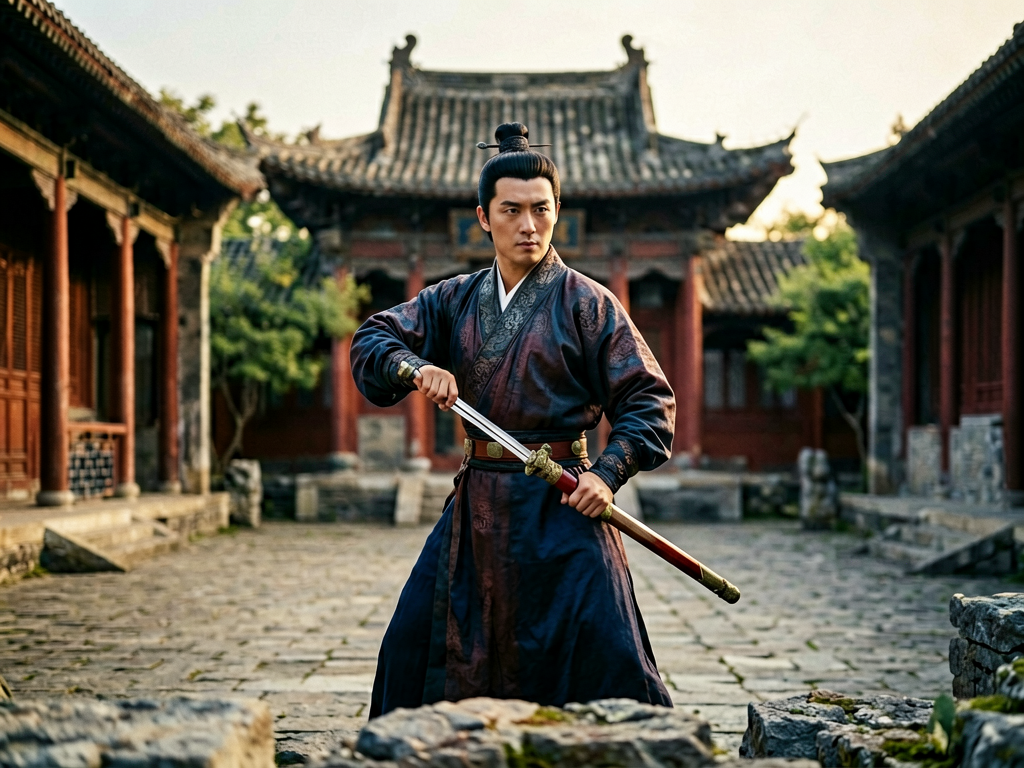
I still remember the first time I stepped into the Forbidden City. It was a chilly November morning, and the crowds were thin enough that I could actually imagine what it felt like to walk these paths without being jostled by a tour group. I stood in the center of the Hall of Supreme Harmony, looking up at that massive golden roof, and I tried to picture the people who used to run this place.
Most tourists see the architecture. They see the red walls and the yellow tiles. They snap a photo and move on to the next palace. But if you look closer, if you really look, you start to see the shadows. You start to wonder about the men and women who weren’t allowed to speak unless spoken to, who moved with a silence that was heavier than the stone beneath their feet.
That’s where the story begins. Not with the flashy kicks and flying leaps you see in Wuxia novels or kung fu movies. Those are for the public. For the stage. For the tourists. The real martial arts of the Chinese court were different. They were quiet, deadly, and deeply bureaucratic.
I’ve spent eight years living in China, and I’ve trained in a few styles. I’ve sweated in dojos in Beijing and watched masters in parks in Guangzhou. But nothing prepares you for the realization that the most powerful martial artists in Chinese history didn’t fight in mountains or temples. They fought in hallways, in palaces, and in the spaces between power and death.
Here’s the thing about Imperial China that most people miss: the Emperor was never truly safe. Even in the height of the Qing Dynasty, when the empire was at its peak, the threat of assassination was real. And the people who stood between the Dragon Throne and a dagger weren’t just guards. They were masters.
The Bodyguards Who Could Disappear
Let’s talk about the Biaoju, or martial arts escort agencies. You might have heard of them. They’re a staple of Chinese folklore. But in the court, things were tighter. The Imperial Guard, or the Jinyiwei in the Ming Dynasty and the Blue Caps in the Qing, were a different breed.
I remember asking a historian in Beijing about this over tea. He laughed, a dry, knowing laugh. He told me that the best guards didn’t look like warriors. They looked like servants. They looked like eunuchs. They looked like anyone else in the palace.
That was the point. The martial arts of the court were designed for close quarters. Hallways in the Forbidden City are narrow. You don’t have room to spin, to jump, to perform. You have room to stab, to choke, to disarm. The styles that developed for these spaces were brutal and efficient. There was no time for form. There was only survival.
I tried to learn some of these movements from a retired instructor in Xi’an. He was old, his hands shaking slightly, but when he moved, it was like lightning. He showed me a wrist lock that took three seconds to set up. “If someone has a knife,” he said, “you don’t fight the knife. You fight the arm. The knife is just metal. The arm is bone and meat.”
It’s a simple concept, but in the context of the court, it was everything. The Emperor couldn’t risk a public duel. He couldn’t risk scandal. He needed solutions that vanished as quickly as they appeared.
Styles Born from Necessity
So, what did these styles look like? They weren’t called “Dragon Style” or “Tiger Style” in the palace. Those names were for the theaters. In the court, they were classified by function. Some styles focused on footwork. Others on grappling. Some were specifically designed for fighting while wearing heavy ceremonial robes.
I’ll be honest, I’m no expert on every single style. But the ones that survived, the ones that were passed down in secret lineages, often share a common trait: economy of motion. Every movement has a purpose. There’s no wasted energy.
Take Bajiquan, for example. It’s known for its explosive power and short-range strikes. It’s the kind of style that’s perfect for a confined space. Imagine being in a corridor, trying to protect the Emperor, and an assassin lunges at you. You don’t need to wind up a punch. You need to explode forward, shoulder or elbow, and end the threat before it begins.
I visited a Bajiquan master in Tianjin recently. He was practicing in a small courtyard, surrounded by high walls. The air was cold, but he was sweating. He moved with a violence that was shocking to watch. It wasn’t pretty. It was functional. He told me that his style was once used by bodyguards in the north. “It’s not for show,” he said. “It’s for finishing.”
And that’s what the court martial arts were about. Finishing. Quickly. Quietly. Effectively.
There’s also the influence of the eunuchs. Yes, eunuchs in the Imperial Court. They weren’t just administrators. Many of them were trained in martial arts. They were trusted, they were always around, and they were often the only ones allowed in the inner chambers. It makes sense that they would train to defend themselves. Their styles were likely subtle, disguised as dance or gesture.
I found a reference to this in a book I picked up in a secondhand store in Nanjing. It mentioned a eunuch who could disarm a sword with a fan. I laughed at first. It sounded like fiction. But then I remembered that in China, history and fiction often blur. The lines are thin. And it’s entirely possible that a man with a fan could be one of the most dangerous people in the room.
The Decline of the Court Warriors
So, what happened to them? When did the court martial arts fade away?
It wasn’t a sudden end. It was a slow erosion. The Qing Dynasty fell in 1912. The Imperial Guard was disbanded. The Forbidden City became a museum. And with it, the patronage for these specialized styles dried up.
Think about it. Without the Emperor, who do you protect? Without the palace, where do you train? The martial artists of the court had to adapt. Some went into teaching. Some went into police work. Some disappeared into the underworld.
I’ve met descendants of these families. They’re quiet people. They don’t brag. They don’t post videos on TikTok. But when you talk to them, you sense a weight. A history. They carry the legacy of men and women who stood between the throne and chaos.
There’s a master in Shanghai whose grandfather served in the Imperial Guard. He’s a soft-spoken man. He runs a small tea shop in a quiet alley. I went there to talk to him. He poured tea for me, his hands steady. I asked him about his grandfather. He didn’t talk much about the fighting. He talked about the discipline. The loyalty. The burden of carrying a secret.
“He never spoke of it,” the master said. “But he watched me learn. And when I asked him why, he said, ‘Because the world is dangerous, and you need to know how to stand your ground.’”
It’s a poignant reminder. The martial arts of the court weren’t just about violence. They were about protection. About duty. About standing in the gap.
Why It Matters Today
Why does this matter to us now? We don’t have emperors. We don’t have imperial guards. We don’t live in palaces.
But the spirit of those court martial arts remains. It’s in the discipline. It’s in the focus. It’s in the idea that true power doesn’t need to shout. It doesn’t need to show off. It just needs to be ready.
I’ve seen this in modern China. I’ve seen it in the way people carry themselves. The quiet confidence. The respect for tradition. The understanding that history is not just something you read in a book. It’s something you live.
When I walk through the Forbidden City now, I don’t just see the buildings. I see the ghosts. I see the guards who stood watch. I see the masters who taught in secret. I see the eunuchs who held the keys to the inner sanctum.
And I feel a connection to them. A shared humanity. A shared struggle.
The court martial arts may be lost. They may be fragmented. But they’re not gone. They’re in the stones. They’re in the wind. They’re in the stories that are still being told.
If you’re interested in Chinese culture, don’t just look at the surface. Look deeper. Look at the shadows. Look at the people who worked behind the scenes. That’s where the real history lies.
I’m no expert. I’m just a traveler with a notebook and a curious mind. But I can tell you this: the story of the court martial arts is a story of resilience. Of adaptation. Of survival.
And isn’t that what we’re all trying to do? Survive. Thrive. Find our place in the world.
Next time you visit China, go to the Forbidden City. Go to the museums. Talk to the locals. Ask about the guards. Ask about the masters. You might be surprised by what you find.
You might find a piece of yourself. Or you might just find a better understanding of the past. Either way, it’s worth it.
The court martial arts are lost. But they’re not forgotten. Not by those who know where to look. And now, neither are you.
So, go ahead. Take that trip. Walk those halls. And listen. The stones have a lot to say.