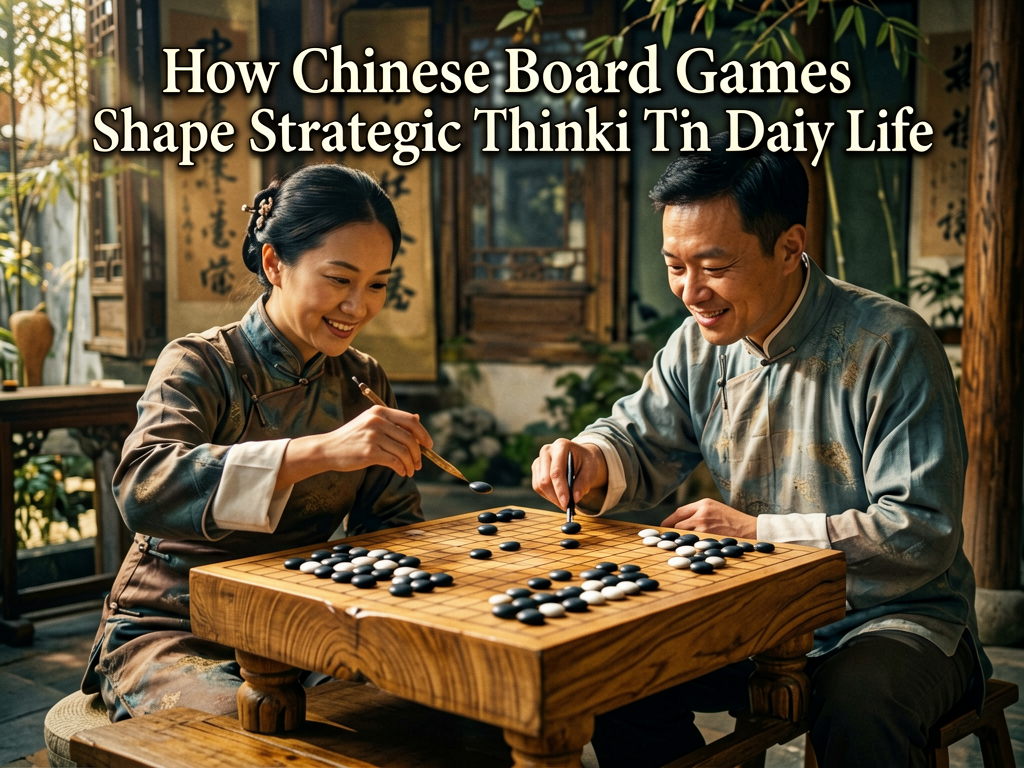
It was a rainy Tuesday in Chengdu when I finally understood why my Chinese friends are so calm under pressure. We were sitting in a cramped tea house, the kind with sticky tables and loud chatter, surrounded by the smell of jasmine and damp wool. Across from me sat Old Man Li, a retired engineer who had spent forty years building bridges. He wasn’t looking at his phone. He wasn’t complaining about the traffic. He was staring at a Go board, moving black stones with the precision of a surgeon.
I watched him place a single stone on the board. It looked insignificant. Just one piece on a grid of thousands. But the air in the room seemed to shift. I asked him what he was thinking. He smiled, that slow, knowing smile that confuses foreigners every time. He told me he wasn’t thinking about the stone. He was thinking about the empty space around it.
That moment changed how I see China. It’s not just about the high-speed trains or the skyscrapers. It’s about a mindset. A way of looking at the world that’s been practiced for millennia on wooden boards. If you want to understand how Chinese people handle conflict, negotiate deals, or even plan their family vacations, you have to look at the games they play. Specifically, Go, or Weiqi, and sometimes Xiangqi, the Chinese chess. These aren’t just pastimes. They’re mental gyms.
The Art of Indirect Approach
Western chess is loud. It’s about capturing the king. It’s direct, aggressive, and often chaotic. You throw your pieces at each other until one side falls. Go is different. It’s quiet. It’s about influence, territory, and patience. You don’t attack the enemy to destroy them; you surround them to make them irrelevant. You build walls so strong that the enemy has nowhere to go.
I tried playing Go when I first moved to Beijing. I was terrible. I thought every move had to be a big, dramatic statement. I wanted to win the battle immediately. My friend, Sarah, who has played since she was six, laughed at me. She said I was playing like a tourist. “You’re trying to conquer the board,” she told me. “You need to live on it.” It took me months to get it. I had to learn that sometimes, losing a few stones in one corner is worth gaining influence in the entire center of the board.
This indirect approach is everywhere in Chinese culture. Think about business negotiations. You rarely get straight to the point. You spend hours drinking tea, building rapport, and sensing the other person’s position. You’re not attacking their price; you’re surrounding it with context, history, and relationship. It’s frustrating if you’re from a culture that values directness. But it’s effective. It’s like Go. You don’t break the door down. You find the keyhole.
Patience as a Weapon
One of the hardest things for me to grasp was the concept of *yomi*, or reading ahead. In Go, you have to calculate moves ten, twenty, even thirty steps into the future. But it’s not just about calculation. It’s about intuition. It’s about feeling the flow of the game.
I remember watching a match in a park in Shanghai. Two men, maybe in their sixties, were playing for hours. The crowd around them grew and shrank like a tide. No one spoke. The only sound was the click of stones on the board. I asked one of the spectators what he was looking for. He said, “I’m looking for the mistake.” But he didn’t mean a blunder. He meant a lapse in judgment. A moment where one player forgot the big picture for a small gain.
This patience translates to everyday life. Chinese people are often accused of being slow to react. But I see it differently. They’re not slow. They’re waiting for the right moment. They’re watching the board. They’re letting the other person make the first move, making a commitment, and then striking where the weakness is. It’s not cowardice. It’s strategy.
I saw this in my own life. When I was trying to rent an apartment in Guangzhou, the landlord kept changing the terms. He added fees, he lowered the quality of the furniture. A Westerner might have just left. I almost did. But I remembered the game. I waited. I showed interest, then I pulled back. I let the landlord think he had me. Finally, he offered me the apartment at a much better price. I hadn’t fought him. I had outlasted him. It felt weird, but it worked.
The Balance of Yin and Yang
Go is a game of balance. Black and white, attack and defense, life and death. You can’t have one without the other. If you attack too much, you leave yourself open. If you defend too much, you lose territory. The best players are those who can switch between the two modes instantly.
This balance is central to Chinese philosophy. It’s in Taoism, in Confucianism, in the way people dress, eat, and talk. It’s not about being purely good or purely bad. It’s about finding the harmony between opposites. When I first came to China, I was shocked by the duality. People were incredibly generous to strangers, but ruthless in business. They loved loud parties, but valued deep silence in meditation. It seemed contradictory. But then I realized it was just like a Go board. The black stones need the white stones to define them.
I learned to appreciate this balance. I stopped trying to force things into neat categories. I stopped judging people for being inconsistent. Instead, I looked for the underlying pattern. I started to see how my Chinese friends balanced their work and play, their ambition and their contentment. It’s a tightrope walk, but they’re good at it. They know that if they lean too far one way, they’ll fall.
Community and Conversation
One thing I love about Chinese board games is that they’re social. You don’t play Go alone in your room. You play it in the park, in the tea house, in the office. It’s a conversation. The stones are the words. The board is the page. And the game is the story you’re writing together.
I’ve seen arguments break out over games, but they’re never angry. They’re passionate, but respectful. People offer advice, even if you didn’t ask for it. It’s a community activity. It brings people together. In a country with such a huge population and such rapid change, these games provide a stable ground. A place where rules are clear, and outcomes are fair.
It’s also a way to pass down wisdom. Old men teach young men. Parents teach children. It’s not just about winning. It’s about sharing a moment. I’ve spent hours listening to strangers talk about their lives while we played. They told me about their struggles, their dreams, their regrets. The game gave them a safe space to open up. I think that’s why it’s still popular today. It’s not just a game. It’s a connection.
Why It Matters for You
You might think, “I don’t play Go. Why should I care?” But you probably use these principles every day. Maybe you’re negotiating a salary. Maybe you’re dealing with a difficult colleague. Maybe you’re trying to plan a trip with friends. In all these cases, you’re playing a kind of game. You’re making moves, anticipating reactions, and trying to secure your position.
Learning even the basics of Go can change how you think. It teaches you to look at the big picture. It teaches you patience. It teaches you that sometimes, the best move is to do nothing. To wait. To let the other side reveal their hand.
I’m no expert, and I still lose to almost everyone I play. But I’ve noticed a difference in myself. I’m less reactive. I’m more observant. I’m more willing to take the long view. I’ve started to see my life as a board. Not everything is a battle. Some things are just about positioning. And sometimes, just being there is enough.
So, the next time you’re in China, don’t just watch the tourists take selfies. Go to a park. Find a table. Watch the old men playing. Ask to try. You’ll likely lose. You’ll probably feel frustrated. But you’ll also understand something deep about the Chinese mind. And maybe, just maybe, you’ll start to see the world a little differently.
It’s not about winning. It’s about playing. And in a world that’s always rushing, slowing down to play a game might be the most radical thing you can do.