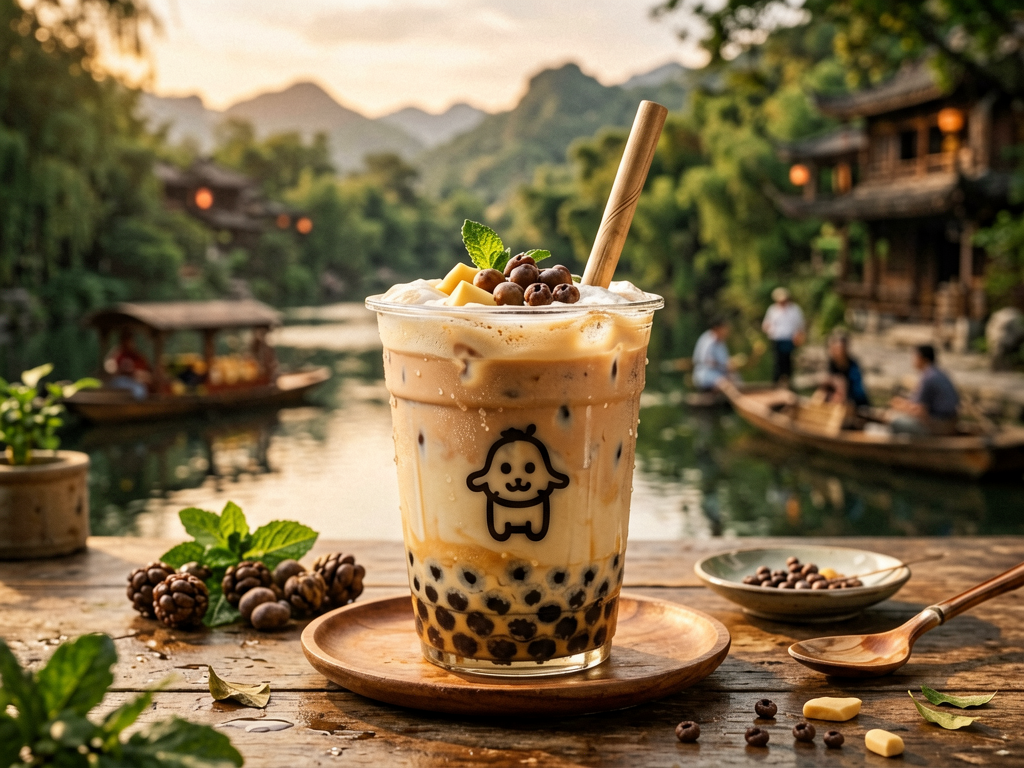
I still remember the first time I held a cup of bubble tea. It was in Taipei, somewhere around 2015, and I was utterly confused. The barista handed me a plastic cup filled with a cloudy, milky liquid and a straw that was suspiciously thick. I looked at the bottom of the cup, where dark, chewy spheres were swimming around like tiny alien eggs. I was terrified to try them. I thought they were maybe some kind of strange jelly or perhaps just large, rubbery beads.
I took a tentative sip. The tea was cold, sweet, and slightly floral. Then, I sucked on that massive straw. The pearls slid up, hit my lips, and offered a weird, chewy resistance. It wasn’t unpleasant. It was actually kind of thrilling. That moment hooked me. Now, eight years later, I can’t walk through a street in Shanghai or Chengdu without buying a cup. But have you ever stopped to think where this weird, chewy drink actually came from?
Most people think bubble tea is just some modern invention from the 2000s. They assume it’s a Silicon Valley tech startup idea or a trendy American fad. It’s not. The story is much older, much weirder, and rooted deeply in the culture of Taiwan. Let’s peel back the layers of this milky, sweet mystery.
The Accidental Invention in Tainan
To understand the origins, you have to go back to the late 1980s in Tainan, Taiwan. This is the old capital, a place with a slower pace than Taipei. I’ve spent a lot of time walking the old streets there, and it feels like a different century. The story usually points to a teahouse called Chun Shui Tang.
The legend says that the owner’s wife, Lin Hsiu Hui, was bored one afternoon. She was watching her son play with a cocktail shaker. He was shaking up tea with some tapioca starch balls, probably leftovers from dessert, because those were common in traditional Chinese sweet soups. She saw the swirling mixture and got an idea. Why not just mix them together? Why not drink it?
It sounds too simple, right? That’s the thing about great inventions. They often look stupid in hindsight. She added milk powder and sugar to the shaken tea. The result was smooth, creamy, and visually distinct. The tea separated into layers, which looked interesting. The tapioca balls added a texture you never got from plain tea. It was a textural experience, not just a flavor one.
Some historians argue that another tea house in Jinhua, Taiwan, called Han Lin Teahouse, invented it around the same time. They supposedly added the tapioca balls to sweetened tea to make it more substantial. Maybe they wanted a snack you could drink. Whether it was the wife in Tainan or the tea masters in Jinhua, the result was the same. A new category of beverage was born.
Why Tapioca? The Texture Revolution
Here’s the thing that always fascinated me. Why did tapioca balls take off? Why not just ice? Or fruit? Or nothing? The answer lies in the sensory experience. Traditional Chinese tea is about clarity, aroma, and aftertaste. It’s clean. Bubble tea is about chaos and texture.
The balls, which we call pearls or boba, are made from tapioca starch. That’s the extract of the cassava root. It’s a staple in many Asian kitchens. When cooked, it becomes translucent and chewy. It’s almost gummy. But when it’s cold, it’s firm. That contrast is key. You get the liquid refreshment and the solid chew at the same time.
I remember asking a local tea master in Taichung why he insists on using fresh tapioca pearls instead of the pre-cooked ones you see in the West. He laughed and said the pre-cooked ones are dead. They’re just mush. Fresh pearls have a soul. They have a bite. They fight back a little. That “fight” is what makes drinking the drink an event. It’s not passive consumption. You have to work for it.
This texture also changes how you drink. You have to suck hard. The wide straw isn’t a gimmick; it’s a necessity. It forces you to slow down. You can’t gulp bubble tea like a soda. You have to pause, wait for the pearl to rise, and then swallow. It’s a meditative act, in its own weird way. It turns a drink into a ritual.
The Shanghai Explosion and Global Spread
For years, bubble tea was just a local Taiwanese thing. You had to go there to get it right. Then, the 1990s happened. Taiwanese expats and students moved to places like Los Angeles and Vancouver. They brought their recipes. They opened small shops in Chinatowns. It started as an ethnic novelty. A weird Asian drink for adventurous foreigners.
But then, something shifted. The shops moved out of the Chinatowns and into shopping malls. They started adding fruit. They started using fresh milk instead of powder. The drink evolved. It became less about the traditional tea and more about the sweet, creamy, fruity explosion. This was the era of the “mixed tea.”
I’ll never forget walking into a shop in Shanghai in 2012. It was called “Yi Dian Dian,” a famous Taiwanese chain. The line was out the door. People were checking their phones, waiting for their turn. It wasn’t just a drink; it was a social status symbol. If you didn’t have a cup of bubble tea in your hand, you weren’t really participating in the city’s rhythm.
The Chinese market exploded. The demand became so huge that Taiwan couldn’t keep up. Local chains popped up everywhere. The competition drove innovation. Now, you have shops with digital screens, apps for ordering, and ingredients that change with the seasons. Mango, taro, cheese foam, red bean, grass jelly. The options are endless.
Western chains tried to copy it. But they often got the texture wrong. They used too much sugar or made the pearls too soft. They missed the balance. The real magic is in the tea base. It has to be strong enough to cut through the milk and the sugar. If the tea is weak, the drink is just sweet syrup. I’ve had my share of bad bubble tea. It’s cloying and one-dimensional. Good bubble tea is complex. It’s bitter, sweet, creamy, and chewy all at once.
Cheese Foam: The Modern Twist
If you think you know bubble tea, wait until you try the cheese foam version. This is a relatively new innovation, but it’s changed the game. It’s not just tea and pearls. It’s tea, pearls, and a thick, salty-sweet foam on top.
I was skeptical at first. Salt in my sweet drink? That sounded wrong. But I tried it in Hangzhou, and it blew me away. The foam is made from cream cheese, milk, and a pinch of salt. It’s whipped until it’s thick and rich. You drink the foam first, then the tea. The saltiness contrasts with the sweetness of the tea and the chewiness of the pearls. It’s a flavor profile that wouldn’t work in any other context.
It’s like eating a cheesecake and drinking iced tea at the same time. It’s indulgent. It’s heavy. I love it, but I also hate it. It’s a guilty pleasure. You know it’s going to sit heavy in your stomach, but you can’t resist. That’s the power of modern bubble tea. It’s not just a drink; it’s an experience. It’s designed to be enjoyed, not just consumed.
The Health Paradox
Let’s talk about the elephant in the room. Bubble tea is not healthy. It’s basically a dessert in a cup. A large cup can have hundreds, sometimes thousands, of calories. The sugar content is insane. I’ve checked the labels in some of the bigger chains, and it’s shocking. It’s like drinking a can of soda, but with more fat and fewer nutrients.
But here’s the twist. People in China drink it differently. They don’t always go for the maximum sugar. I often order my tea with 30% sugar, or even 0%. I use fresh fruit or less syrup. I choose green tea or oolong instead of black tea. The shopkeepers are used to it. They know my order. They don’t judge me. They just make it.
There’s a growing movement toward healthier options. Shops are offering stevia, almond milk, and oat milk. They’re using less ice to reduce dilution. It’s a slow change, but it’s happening. I’ve noticed that younger generations in China are more health-conscious. They want the taste, but they don’t want the guilt. So, the industry is adapting.
I’m no nutritionist, but I think balance is key. I don’t drink bubble tea every day. Maybe once a week. It’s a treat. It’s a reward. It’s a way to connect with friends. I’ll meet up with a colleague, and we’ll grab two cups. We’ll talk about work, about life, about the weather. The drink is just the excuse. The connection is the real product.
Why It Endures
So, why does bubble tea endure? Why hasn’t it faded like other trends? I think it’s because it’s versatile. It’s a blank canvas. You can make it fruity, creamy, floral, or earthy. You can make it hot or cold. You can make it sweet or savory. It adapts to every culture it touches.
In the West, it’s often seen as a quirky Asian novelty. In China, it’s a staple. It’s as common as coffee in the US. But in both places, it serves the same purpose. It’s a social lubricant. It’s a way to pause. In a world that moves too fast, bubble tea forces you to slow down. You have to wait for your drink. You have to suck on the straw. You have to chew the pearls.
It’s a small act of resistance against the speed of modern life. I love that about it. It’s not just a drink. It’s a moment. A moment of pause. A moment of texture. A moment of sweetness.
Next time you hold a cup of bubble tea, think about that woman in Tainan. Think about her son and his cocktail shaker. Think about the accidental invention that changed the way the world drinks. It’s a weird, chewy, sweet little miracle. And I wouldn’t have it any other way.
Go find a shop. Order something you’ve never tried before. Ask for fresh pearls. And take your time. The pearls will wait for no one, but they’ll wait for you.