I’ll be honest, I was expecting something cold. When I first booked a high-speed train from Xi’an to the Mausoleum of the First Qin Emperor, I figured it would be just another tourist trap. You know the drill. Overpriced souvenirs, crowded buses, and a glass case where you squint to see some dusty clay figures. I’ve visited enough museums in this country to know the routine.
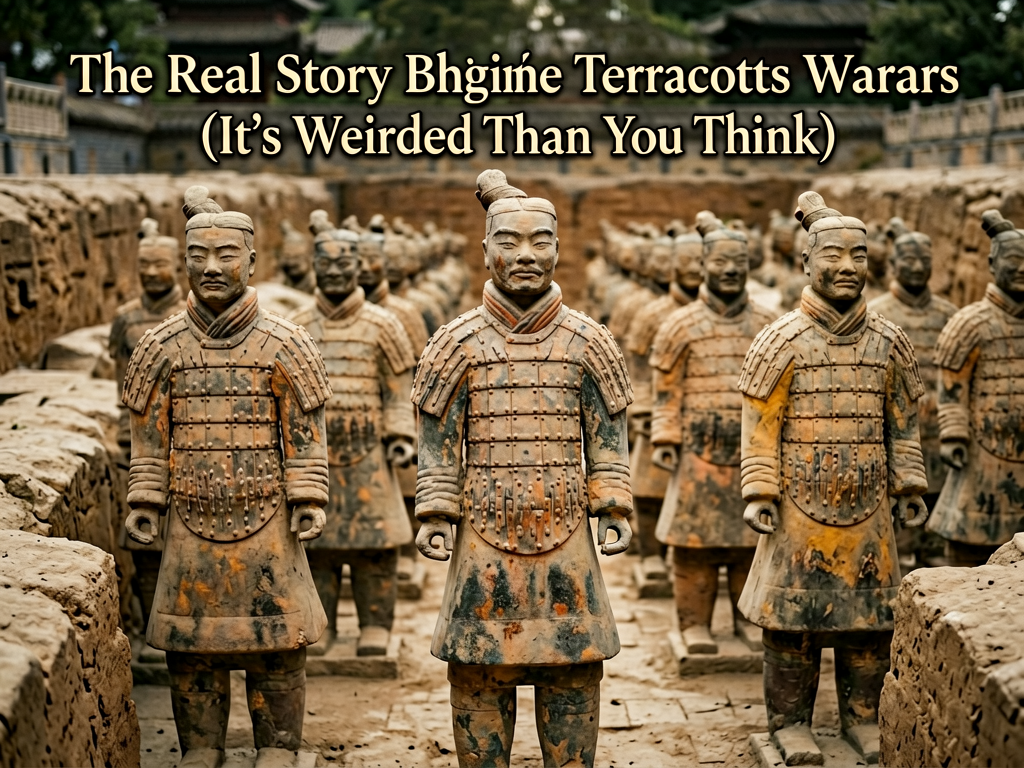
But standing in front of Pit 1 for the first time, my jaw actually hit the floor. It wasn’t just the scale, though that’s terrifying in its own right. It was the faces. Hundreds of them. And not a single one is the same.
We’ve all heard the legend, right? The one about 8,000 soldiers, horses, and chariots buried alive to protect the first emperor in the afterlife. It sounds like epic propaganda. It sounds like something a dictator would dream up to intimidate his enemies forever. But the real story? It’s way weirder, darker, and infinitely more human than that.
The Man Who Wanted to Cheat Death
To understand the warriors, you have to understand the guy who ordered them. Qin Shi Huang. He wasn’t just a king; he was a maniac. He united China for the first time in 221 BC, but he did it through sheer terror. He burned books. He buried scholars alive. He standardized weights, measures, and even the width of cart axles so everything moved in lockstep.
But his biggest obsession? Immortality. He spent his entire adult life trying to live forever. He sent expeditions out into the sea looking for the elixir of life. He ate mercury pills thinking they’d make him a god. Spoiler alert: it just poisoned him slowly.
I remember reading about his final days. He was on a tour of inspection when he got sick. He was terrified of dying, not because he was pious, but because he thought his death would mean the end of his absolute control. So, he built a tomb the size of a small city, buried deep underground, designed to mimic his empire.
Think about that for a second. He wasn’t just building a grave; he was building a backup server for his soul. He wanted to keep his army, his ministers, and his harem right there, waiting for his command, even in the dark.
The Factory, Not the Army
Here’s where it gets weird. For decades, people thought these warriors were hand-carved sculptures. High art. Masterpieces of ancient Chinese sculpture. But when archaeologists finally started digging deeper in the 1970s, they found something shocking. The workers signed their names on the clay.
Yeah, you read that right. “Li made this leg.” “Zhao made this head.” It wasn’t a palace of artists. It was a factory. A massive, state-run industrial complex producing genocide-ready hardware.
I spoke to a local guide in Xi’an, a guy named Wei who’s been showing tourists around for fifteen years. He pointed to the hands of a warrior in Pit 2. “Look at the calluses,” he said, tapping the glass. “These guys had jobs. They weren’t soldiers. They were potters, blacksmiths, and craftsmen who were forced to work until they died.”
The sheer logistics of this place are mind-bending. We’re talking about an empire-wide draft. They brought the best artisans from every conquered province to Xi’an. If you were a master potter in the state of Chu, suddenly you’re in Shaanxi, churning out clay soldiers for the emperor. And if you didn’t meet the quota? Well, let’s just say the punishment for failure was severe.
It’s not a tribute to martial glory. It’s a testament to forced labor. The emperor didn’t want heroes. He wanted obedient, interchangeable cogs in his machine. Even in death, he couldn’t let go of control.
The Blood-Stained Colors
Here’s the part that really blew my mind. When the warriors were first unearthed, they weren’t brown. They were bright. Vibrant. They were painted in shades of red, green, blue, and purple. I’m talking about the most vivid, eye-popping colors I’ve ever seen in an ancient artifact.
But here’s the catch. The moment the clay hit the air, those colors vanished. Within minutes, the paint curled and flaked away. The humidity in the soil had preserved the pigment for two thousand years, and the dry museum air killed it instantly.
We’ve spent millions of dollars trying to figure out how to stop this decay. We’ve got labs with special gas chambers just to keep the paint from turning to dust. It’s heartbreaking, honestly. It’s like watching a flower wilt in fast-forward.
But there’s a darker secret hiding in those colors. Recent chemical analysis revealed traces of mercury. Lots of it. The soil around the tomb is laced with toxic levels of the metal. This wasn’t just symbolic. Qin Shi Huang actually had underground rivers of mercury flowing through his tomb, mimicking the Yangtze and Yellow Rivers.
It’s a radioactive, toxic graveyard. The emperor wanted to rule the cosmos, so he poisoned the ground beneath him. I stood there looking at the ruins, thinking about how much poison he must have ingested himself. The irony is almost poetic. He tried to build a perfect, immortal empire, and all he left behind was a giant, toxic trap.
The Missing Heads
One of the most striking things about the Terracotta Army is what’s missing. A huge number of the statues have no heads. Just stumps. And it’s not because they were buried for millennia. It’s because they were smashed.
Legend has it that after the emperor died, his successor, the Second Emperor, or maybe even rebel armies later on, came to loot the tomb. But you can’t steal a clay statue easily. So, they smashed the heads off. The heads were the most detailed, the most valuable parts. The bodies? Too heavy, too boring.
When I walked through the pits, I kept looking for the missing heads. It’s a haunting reminder that nothing lasts. Even the First Emperor, the most powerful man in the world, couldn’t keep his army intact. The rebellion that took down his dynasty was led by commoners, farmers, and convicts. The very people he oppressed became the tools of his destruction.
I found myself wondering if that’s why the heads are missing. Maybe it’s a message. A silent protest from the descendants of the people who built this nightmare. “You tried to erase us,” the broken clay seems to say. “But you can’t hide what you did.”
Why It Still Haunts Me
Most people leave the museum thinking about the size. They talk about how many there are. But that’s missing the point. The Terracotta Warriors aren’t just a military display. They’re a psychological profile of a tyrant.
They show us a man who was so afraid of death that he spent his life preparing for it. A man who valued order over humanity, efficiency over art, and control over love. And yet, in his failure, he gave us something else. He gave us a glimpse into the lives of ordinary people. The potters who signed their names. The soldiers who never got to go home.
I spent hours just walking up and down the catwalks, looking into the eyes of these clay figures. They don’t look angry. They don’t look brave. They look tired. They look like workers waiting for their shift to end. And maybe that’s the most powerful thing about them. They’re not monuments to a god-king. They’re monuments to the human cost of ambition.
If you go, don’t just rush through Pit 1. Skip the main hall if you have to. Go to Pit 3. It’s smaller, quieter, and it’s where the command center was. You can see the generals there, the ones who planned the campaign. It’s intimate. It’s eerie. It’s real.
And honestly? It’s better than any movie. You can’t fake the weight of history when you’re standing in a hole in the ground, looking at a face that hasn’t seen the sun in two thousand years. It stays with you. It changes how you see the place.
Xi’an is a modern, chaotic, loud city. It’s full of neon lights and spicy food and traffic jams. But underneath all that noise, there’s this silent, clay army, waiting in the dark. And they’re still watching.