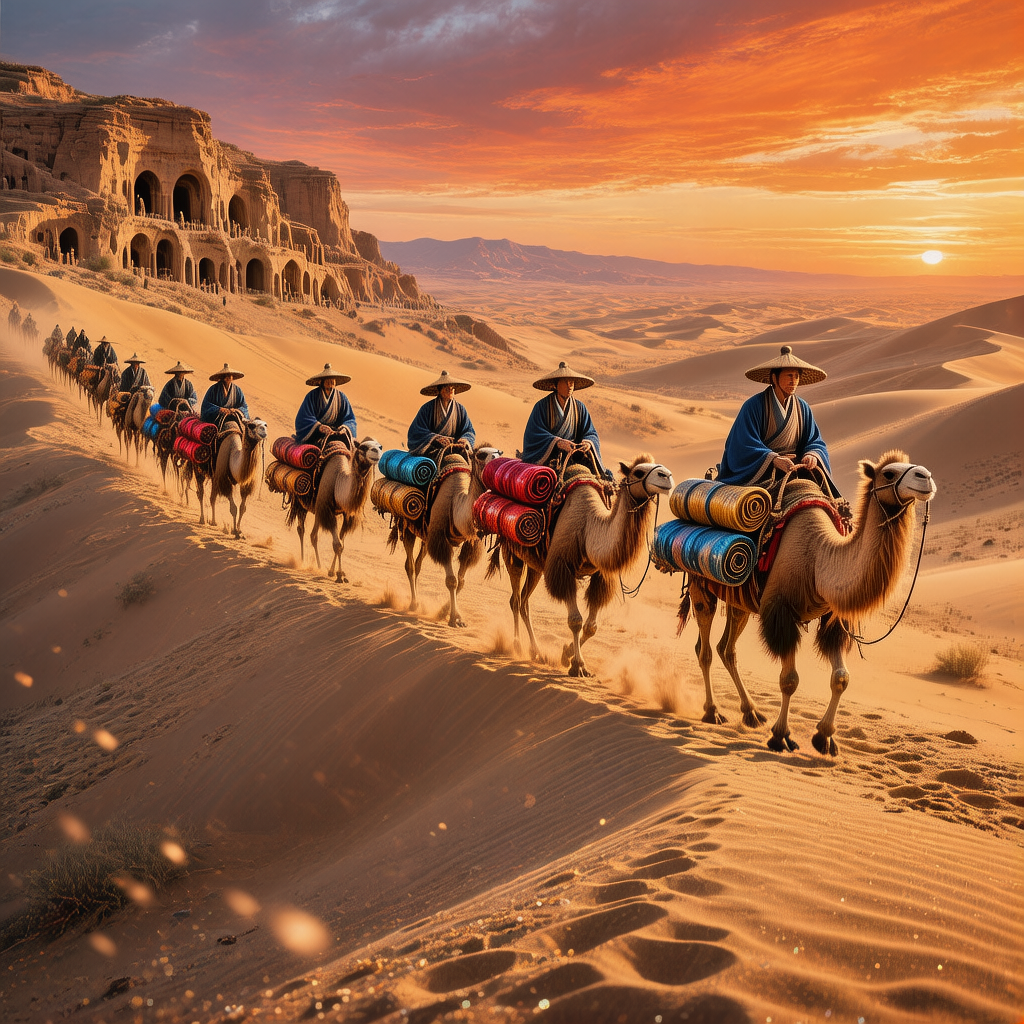
Stretching over six thousand kilometers across deserts, mountains, and grasslands, the Silk Road (丝绸之路, Sīchóu Zhī Lù) was never a single road but a vast network of trade routes connecting China to the Mediterranean world. For nearly two millennia, these routes carried not only silk and spices but ideas, religions, technologies, and artistic traditions that would fundamentally reshape civilizations on every continent. The echoes of those ancient caravans continue to reverberate through modern China, influencing everything from cuisine to architecture to the nation’s strategic vision for the 21st century.
The Origins: Zhang Qian’s Extraordinary Journey
The Silk Road’s formal history begins with one of history’s most remarkable diplomatic missions. In 138 BCE, Emperor Wu of the Han Dynasty dispatched Zhang Qian (张骞), a court official, to seek an alliance with the Yuezhi people in Central Asia against the Xiongnu nomads who threatened China’s northwestern frontier. What followed was a thirteen-year odyssey of captivity, escape, and exploration that would change the world.
Zhang Qian was captured by the Xiongnu almost immediately and held for a decade. He escaped, continued his mission westward, and reached the territories of modern Uzbekistan and Afghanistan, encountering sophisticated civilizations that China had never known existed. Though he failed to secure the military alliance, he returned to Chang’an (modern Xi’an) with something far more valuable: detailed knowledge of the lands, peoples, and products of Central Asia, along with the realization that trade routes already existed connecting these regions to India and the Middle East.
Emperor Wu recognized the strategic implications immediately. Within years, Han armies had secured the Hexi Corridor—the narrow passage between the Gobi Desert and the Tibetan Plateau that served as China’s gateway to the West—and established military garrisons along the route. The Silk Road was born, and China’s engagement with the wider world had begun in earnest.
Silk: The Thread That Connected Worlds
Silk was the commodity that gave the Silk Road its name, and its importance cannot be overstated. For centuries, China held a monopoly on silk production, guarding the secret of sericulture with the same intensity that modern nations protect nuclear technology. The Roman historian Pliny the Elder complained that Rome’s insatiable appetite for silk was draining the empire’s treasury, and silk was literally worth its weight in gold on Mediterranean markets.
The Chinese understanding of silk’s value was deeply strategic. Diplomatic gifts of silk cemented alliances, bribed enemies, and established China’s cultural superiority in the eyes of foreign peoples. The silk-for-horses trade with Central Asian nomads was perhaps the most consequential economic exchange in ancient history—China obtained the powerful Ferghana horses needed to counter nomadic cavalry, while Central Asian middlemen grew wealthy facilitating the westward flow of silk.
Beyond its economic importance, silk served as a medium of cultural transmission. Buddhist monks wrapped scriptures in silk, Christian priests used silk vestments, and Islamic courts draped their finest architecture in silk banners. The fabric became a universal symbol of luxury, refinement, and the exotic East—a cultural association that persists to this day.
The Desert Cities: Oasis Kingdoms of Commerce and Culture
Along the Silk Road’s arduous path, oasis cities served as crucial waystations where caravans rested, traded, and exchanged stories. These cities—Kashgar, Samarkand, Bukhara, Dunhuang, Turpan—became cosmopolitan centers where Chinese, Persian, Indian, Greek, and later Arab merchants rubbed shoulders, creating unique fusion cultures that blended elements from multiple civilizations.
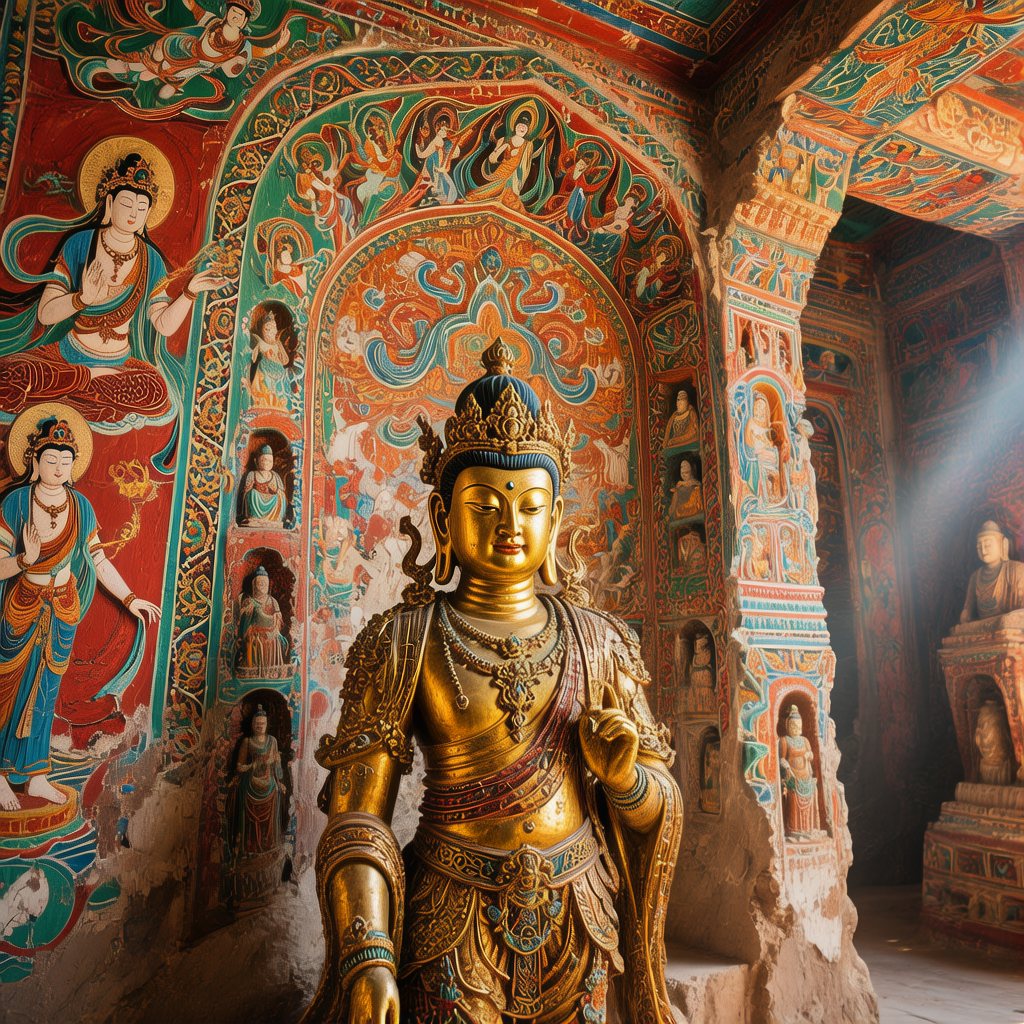
Dunhuang deserves special attention as the Silk Road’s most remarkable cultural treasure. Situated at the junction of the northern and southern routes around the Taklamakan Desert, Dunhuang was where east truly met west. The city’s Mogao Caves (莫高窟), a complex of 735 cave temples carved into a cliff face over a period of a thousand years, contain some of the finest Buddhist art ever created—frescoes and sculptures that blend Chinese, Indian, Persian, and Central Asian artistic traditions into a visual language of breathtaking beauty and spiritual depth.
The Library Cave, discovered in 1900, contained over 50,000 manuscripts dating from the 4th to the 11th centuries, including the world’s earliest dated printed book (the Diamond Sutra of 868 CE), documents in dozens of languages, and evidence of a remarkably pluralistic society where Buddhism, Christianity, Manichaeism, and Zoroastrianism coexisted peacefully. This discovery fundamentally reshaped our understanding of medieval cultural exchange and demonstrated that the Silk Road was never merely about commerce—it was a superhighway of ideas.
Religion on the Road: Buddhism’s Journey East
Perhaps the Silk Road’s most profound cultural legacy was the transmission of Buddhism from India to China. Beginning in the 1st century CE, Buddhist monks traveled the Silk Road’s routes, carrying sutras, relics, and a revolutionary philosophical system that would transform Chinese civilization. The translation of Buddhist texts into Chinese—often undertaken by multinational teams of Indian, Central Asian, and Chinese scholars working in Silk Road monasteries—produced some of the most remarkable cross-cultural intellectual achievements in human history.
Buddhism did not arrive in China as a finished product but was continuously reshaped through its encounters with Chinese thought. The distinctively Chinese schools of Chan (Zen) Buddhism, Pure Land Buddhism, and Tiantai Buddhism all emerged from this creative synthesis of Indian spirituality and Chinese philosophy. Buddhist art followed similar patterns of adaptation: the earliest Buddhist sculptures in China show clear Greco-Bactrian influences—a legacy of Alexander the Great’s Central Asian campaigns—while later works evolved into distinctly Chinese aesthetic forms.
The Silk Road also facilitated the spread of Islam into China, particularly through the maritime routes that complemented the overland trade. The Hui Muslim community, one of China’s largest ethnic minorities, traces its cultural origins to Silk Road merchants and scholars who settled in Chinese cities, creating a uniquely Chinese Islamic tradition that blended Sufi spirituality with Confucian ethics.
Technology Transfer: The World-Changing Exchanges
The Silk Road carried ideas and technologies that would fundamentally alter the course of global civilization. Papermaking, invented in China during the Han Dynasty, traveled westward along the Silk Road, reaching Samarkand by 751 CE and Europe by the 12th century. The introduction of paper to the Islamic world and then Europe was arguably as transformative as the printing press would be centuries later, enabling the preservation and dissemination of knowledge on an unprecedented scale.
Gunpowder, another Chinese invention, followed a similar trajectory, reaching the Islamic world by the 13th century and Europe shortly thereafter, forever changing the nature of warfare and, ultimately, the balance of global power. Compass technology, printing techniques, and agricultural innovations including the iron plow and seed drill all made the same journey westward.
Technologies flowing eastward were equally significant. Viticulture (winemaking) arrived in China from Central Asia, along with alfalfa, walnuts, pomegranates, and sesame. Glassmaking techniques from the Roman Empire reached China, where they influenced ceramic arts. Perhaps most importantly, the horse-drawn chariot and later the stirrup—inventions that revolutionized transportation and warfare—traveled both directions along the Silk Road, adopted and adapted by each civilization they touched.
The Maritime Silk Road: Oceans of Exchange
While the overland Silk Road captures the popular imagination, the Maritime Silk Road (海上丝绸之路) was equally important and, by the Song Dynasty (960–1279 CE), had become the dominant channel of international trade. Chinese ports like Guangzhou (Canton), Quanzhou, and Ningbo hummed with commerce, hosting communities of Arab, Persian, Indian, and Southeast Asian merchants.
Quanzhou during the Song and Yuan dynasties was one of the most cosmopolitan cities on Earth. The Venetian traveler Marco Polo described it as one of the world’s two greatest ports (alongside Alexandria), and the city’s remarkable religious landscape—featuring Buddhist temples, Islamic mosques, Hindu shrines, and a Manichaean temple standing within walking distance of each other—testified to the extraordinary cultural diversity that the Maritime Silk Road sustained.
Chinese maritime technology, particularly the magnetic compass and the sternpost rudder, revolutionized global navigation. The legendary voyages of Admiral Zheng He in the early 15th century, which reached as far as East Africa with fleets of over 300 ships and 27,000 crew, represented the culmination of centuries of Chinese maritime innovation and the Maritime Silk Road’s enduring importance.
The Belt and Road: The Silk Road Reborn
In 2013, China launched the Belt and Road Initiative (一带一路, Yīdài Yīlù), a massive infrastructure and economic development program explicitly framed as a modern revival of the ancient Silk Road. With investments totaling hundreds of billions of dollars across more than 140 countries, the initiative represents the most ambitious attempt to reconnect Eurasia since the original Silk Road’s decline.
The symbolism is deliberate and powerful. By invoking the Silk Road’s legacy of peaceful exchange and mutual prosperity, China positions its modern economic strategy within a historical narrative of beneficial connectivity. The initiative includes both overland corridors (the “Belt”) and maritime routes (the “Road”), mirroring the ancient Silk Road’s dual nature and demonstrating how deeply the original trade routes have shaped China’s strategic imagination.
Critics and supporters alike recognize that the Belt and Road Initiative draws on a deep well of cultural memory. The original Silk Road’s history of cultural exchange, religious tolerance, and economic mutual benefit provides a compelling narrative framework that resonates across the diverse nations the initiative targets.
Cultural Insights: What the Silk Road Teaches
The Silk Road’s legacy offers profound lessons for the contemporary world:
- Civilizations thrive through exchange, not isolation — Every major cultural flowering along the Silk Road occurred at points of intersection between different peoples and traditions
- Trade is a vehicle for ideas — Merchants carried philosophy and faith as surely as silk and spice, demonstrating that economic and cultural exchange are inseparable
- Diversity is strength — The most prosperous and creative Silk Road cities were those that welcomed multiple cultures, languages, and religions
- Geography shapes destiny — China’s position at the Silk Road’s eastern terminus shaped its development as profoundly as its internal dynamics
- Connectivity endures — The impulse to build connections across vast distances is a permanent feature of human civilization, recurring across millennia in ever-evolving forms
The Silk Road reminds us that globalization is not a modern invention—it is an ancient impulse, as old as civilization itself. The caravans that once crossed the Taklamakan Desert carried the same human desires that drive international commerce today: curiosity about the unknown, hunger for beauty and novelty, and the fundamental recognition that the world is richer when its peoples are connected. The Silk Road’s living legacy is not merely a collection of artifacts in museums but an ongoing conversation between East and West that continues to shape our shared future.