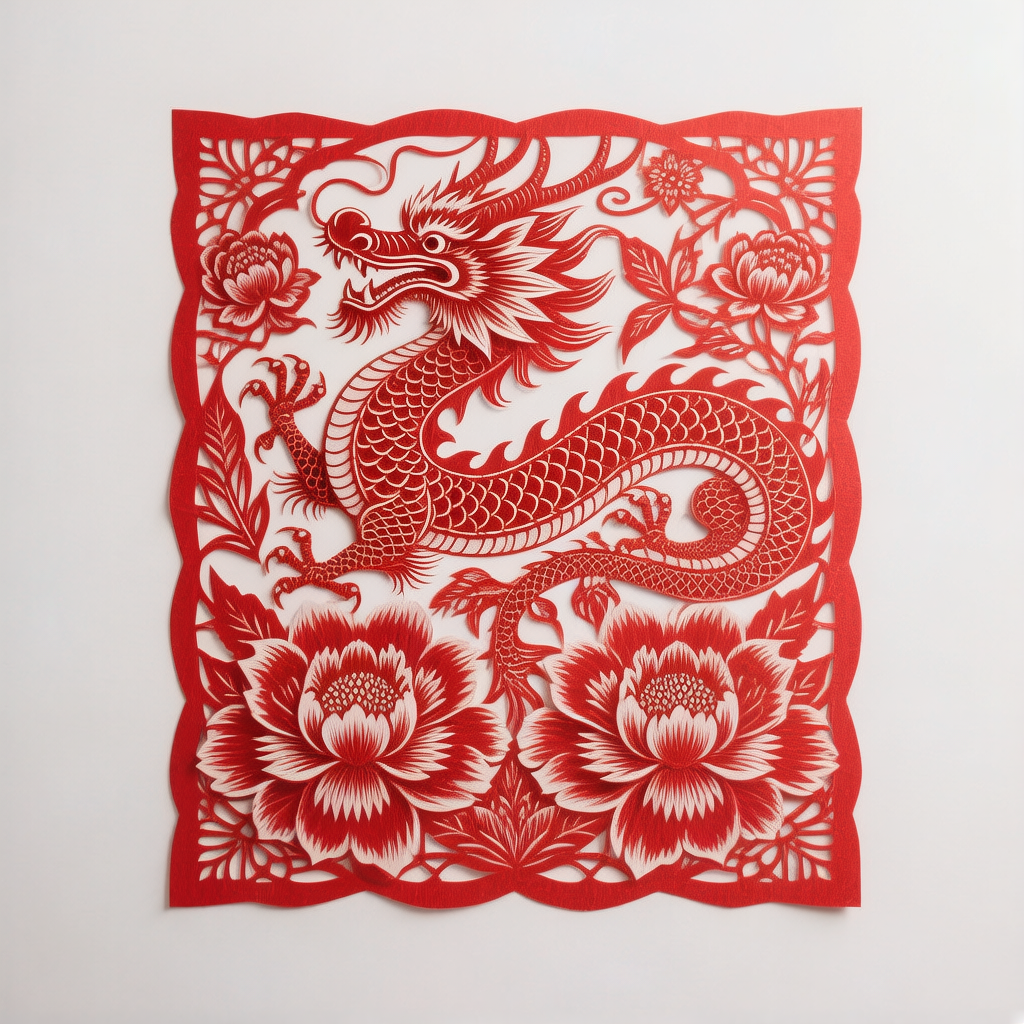
In the luminous glow of red paper illuminated by window light, an entire universe of meaning unfolds. Chinese paper cutting (剪纸, jiǎnzhǐ) is one of the oldest and most widely practiced folk arts in China, a tradition that transforms the simplest of materials—a sheet of paper and a pair of scissors—into intricate visual poetry. For over fifteen centuries, this art form has served as a medium for storytelling, spiritual expression, and communal celebration, producing works of astonishing delicacy that carry the weight of cultural memory in every precisely cut line.
Origins: From Imperial Courts to Rural Windows
The history of Chinese paper cutting is inextricably linked to the invention of paper itself. While archaeological evidence suggests that proto-forms of paper cutting may have existed with earlier materials like silk and leather, the art truly blossomed after Cai Lun’s refinement of the papermaking process during the Eastern Han Dynasty (25–220 CE). The earliest confirmed paper cuttings date to the Northern Dynasties period (386–581 CE), discovered in archaeological sites in Xinjiang province.
Initially, paper cutting was a pastime of the imperial court and aristocratic households, where concubines and court ladies created elaborate cuttings to decorate the palace during festivals. However, as paper became more affordable and widely available, the art form democratized rapidly. By the Tang Dynasty (618–907 CE), paper cutting had become a beloved folk tradition practiced across all social classes, with regional styles beginning to emerge that reflected local customs, beliefs, and aesthetic preferences.
The Du Yang Za Bian, a Tang Dynasty text, records that on the eve of the Spring Festival, the emperor would order scholars to compose poems and court ladies to cut phoenix and flower patterns from silk and paper to adorn the palace. This courtly tradition gradually merged with folk practices, creating a rich cross-pollination between elite and popular artistic sensibilities that continues to characterize the art form today.
Two Techniques, Infinite Possibilities
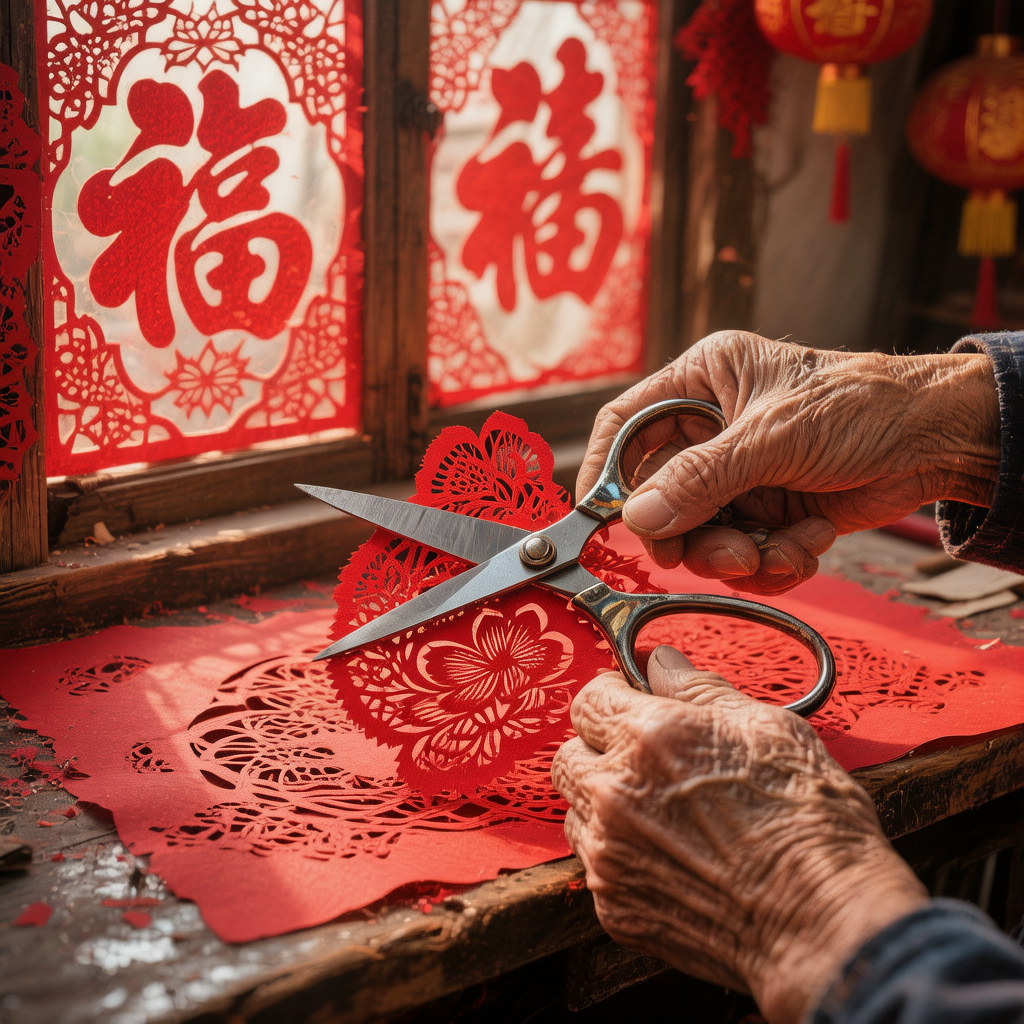
Chinese paper cutting employs two primary techniques that produce distinctly different results. The first, scissor cutting (剪刀剪纸), involves using scissors—often specially crafted with small, sharp tips—to cut multiple layers of paper simultaneously. The artist holds the paper in one hand while maneuvering the scissors with the other, creating fluid, organic lines that seem to flow directly from imagination to paper. Scissor cutting is typically associated with the spontaneous, expressive styles found in northern China.
The second technique, knife cutting (刻刀剪纸), uses a sharp knife to carve patterns from a stack of paper placed on a wax board. This method allows for extraordinary precision and the production of multiple identical copies, making it particularly suited to the elaborate, detail-rich styles of southern China. Knife-cut works can achieve a level of intricacy that seems almost impossible—hairs-width lines, impossibly small perforations, and patterns within patterns that reveal themselves only upon close inspection.
Both techniques share a fundamental principle: the design must be connected. Unlike Western silhouette cutting, where pieces can be removed freely, Chinese paper cutting requires that every part of the design remain attached to the whole. A single break in the line means the cutting falls apart. This constraint has given rise to a sophisticated visual language where positive and negative space are equally important, and the interplay between what is cut away and what remains creates the image’s meaning.
Symbolism: A Visual Language of Wishes
Chinese paper cutting is fundamentally a language of symbols, where every motif carries specific cultural meaning. Understanding these symbols unlocks a rich layer of communication that has sustained communities for generations.
Floral motifs are among the most common and carry precise meanings: the peony represents wealth and honor; the lotus symbolizes purity and marital harmony; the chrysanthemum signifies longevity; and the plum blossom, which blooms in winter, embodies resilience and the triumph of hope over adversity. When the lotus appears alongside a fish (鱼, yú), it creates a visual pun—年年有余 (nián nián yǒu yú), meaning “may you have abundance year after year,” since yú (fish) sounds identical to yú (surplus).
Animal symbols carry equally specific messages. The dragon and phoenix together represent marital bliss and cosmic balance. The bat (蝠, fú) is a homophone for good fortune (福, fú), so five bats arranged in a circle represent the Five Blessings: longevity, wealth, health, virtue, and natural death. The magpie perched on a plum branch signals the arrival of joyful news, while a pair of mandarin ducks symbolizes conjugal fidelity.
Character cuttings feature auspicious Chinese characters—most commonly 福 (fortune), 寿 (longevity), 喜 (happiness), and 春 (spring)—transformed into elaborate decorative works. The character 寿 (shòu) alone has over a hundred recognized stylized forms in paper cutting, each a unique artistic interpretation of the wish for long life.
Regional Styles: A Geography of Paper and Scissors
China’s vast geography and cultural diversity have produced distinctly recognizable regional styles of paper cutting, each reflecting the character and environment of its home region.
Northern styles, particularly from Shaanxi and Shanxi provinces, are known for their bold, vigorous compositions and expressive simplicity. These works often feature rustic subjects—farm animals, agricultural scenes, and folk tales—rendered with confident, sweeping cuts that prioritize emotional impact over delicate detail. The paper cuttings of Ansai County in Shaanxi, inscribed on UNESCO’s Intangible Cultural Heritage list, exemplify this tradition with their powerful, uninhibited aesthetic.
Southern styles, especially from Jiangsu, Zhejiang, and Guangdong provinces, are characterized by their extraordinary refinement and intricacy. The paper cuttings of Yangzhou, one of China’s most celebrated regional traditions, feature impossibly fine lines and elaborate compositions that can include hundreds of individual elements within a single work. These pieces often depict scholarly subjects—landscapes, literary scenes, and classical architecture—with a precision that rivals the finest brush painting.
Fujian and Guangdong traditions developed unique chromatic approaches, using multiple layers of colored paper to create vibrant, multi-hued compositions. In these works, different colored papers are cut separately and then layered to create richly colored scenes, a technique that produces effects impossible in single-color cutting.
Window Flowers and Festival Traditions
The most ubiquitous form of Chinese paper cutting is the window flower (窗花, chuānghuā), so named because these cuttings are traditionally pasted onto windows, where light passing through the cut-out areas creates a luminous, stained-glass effect. During the Spring Festival, millions of Chinese homes are transformed by window flowers, their red glow suffusing interior spaces with warmth and festive cheer.
The tradition of decorating windows with paper cuttings serves both aesthetic and symbolic functions. Practically, in the days before glass windows, paper cuttings helped reinforce the window paper that kept out cold winter winds. Symbolically, the red paper and auspicious designs were believed to attract good fortune while warding off evil spirits during the vulnerable transition between years.
Beyond Spring Festival, paper cuttings mark virtually every significant occasion in Chinese life. Wedding cuttings feature the double-happiness character (囍) surrounded by symbols of marital harmony. Birthday celebrations employ the longevity character and pine-crane motifs. Newborn celebrations feature the “hundred-good-omen” cutting, while funeral practices include white paper cuttings with designs appropriate to mourning and remembrance.
Masters and Transmission
Historically, paper cutting was a skill passed from mother to daughter, with young girls learning the craft by watching and imitating their elders. In rural villages, a woman’s paper cutting skill was considered a measure of her domestic competence and artistic sensibility, much as needlework was evaluated in other cultures. Masters of the art—often elderly women who had spent decades perfecting their craft—commanded deep respect in their communities.
The transmission process was deeply social. During the long winter months when agricultural work was suspended, women would gather to cut paper together, sharing patterns, techniques, and stories. This communal practice ensured that designs were constantly evolving, as individual artists added personal variations to inherited templates. The result was a living tradition, rooted in the past but perpetually refreshed by each new generation’s creativity.
Today, master paper cutters are recognized as Living National Treasures in China, and formal apprenticeship programs help ensure the continuation of endangered regional styles. Contemporary masters like Ku Shulan, the “Goddess of Paper Cutting” from Shaanxi province, have achieved international recognition for works that combine traditional techniques with deeply personal artistic visions.
Contemporary Revival and Innovation
Chinese paper cutting is experiencing a remarkable renaissance in the 21st century. Modern artists are expanding the boundaries of the tradition, creating works at architectural scales, experimenting with unconventional materials like metal leaf and acrylic, and incorporating contemporary themes alongside traditional motifs.
Fashion designers have embraced paper-cutting patterns, translating the intricate silhouettes into textiles, jewelry, and even building facades. The 2008 Beijing Olympics featured paper-cutting motifs in its official design program, introducing the art form to a global audience of billions. Digital artists are creating paper-cutting-inspired works using laser cutting and 3D modeling tools, while preserving the fundamental aesthetic principles that define the tradition.
Educational programs in Chinese schools now include paper cutting as part of the cultural curriculum, ensuring that children develop an appreciation for this heritage. Online tutorials and social media have created new communities of practitioners, allowing techniques and patterns to be shared across geographic boundaries in ways that were impossible in the past.
Cultural Insights: What Paper Cutting Reveals
The art of Chinese paper cutting embodies several core cultural values:
- Connection and continuity — The requirement that every part of a paper cutting remain connected reflects the Chinese philosophical emphasis on interconnectedness and the indivisibility of community
- Optimism and aspiration — Nearly all traditional paper cutting designs express positive wishes, revealing a culture that finds meaning in hope and celebration
- Economy of means — Creating maximum beauty from minimal materials reflects traditional Chinese values of resourcefulness and finding elegance in simplicity
- Collective memory — Each traditional pattern encodes generations of cultural knowledge, making every cutting a repository of shared history
- Living tradition — The constant evolution of designs while maintaining core principles demonstrates the Chinese approach to honoring the past while embracing the future
Chinese paper cutting reminds us that the most profound art often emerges from the most humble materials. A sheet of red paper, a pair of scissors, and a pair of skilled hands can produce works that speak across centuries—carrying wishes, telling stories, and keeping alive a tradition that transforms the everyday into the extraordinary, one delicate cut at a time.