Peking Opera, or Jingju, represents one of China’s most treasured performing arts, combining singing, speaking, acting, and martial arts in spectacular theatrical performances that have captivated audiences for over two centuries. This unique art form emerged in Beijing during the 18th century, absorbing techniques from Anhui and Hubei opera traditions to create a distinctly Chinese theatrical experience that showcases the extraordinary artistic achievements of Chinese culture.
Often called the “national opera” of China, Peking Opera represents a complete artistic system with its own distinctive characteristics in music, performance, costuming, and stagecraft. The art form requires years of rigorous training to master, with performers dedicating their lives to perfecting the complex skills necessary for authentic performance. This dedication produces artists capable of delivering unforgettable experiences that reveal the depth and beauty of Chinese theatrical traditions.
Origins and Historical Development
Peking Opera emerged during the Qing Dynasty when Anhui and Hubei opera troupes brought their performance styles to Beijing. These southern opera forms blended with local Beijing-area arts to create the distinctive style known today. The art form quickly gained popularity in the imperial court before spreading to common audiences, eventually becoming entertainment for all levels of society.
In 1790, to celebrate the birthday of Emperor Qianlong, four renowned Anhui opera troupes were invited to Beijing. Their performances proved so popular that they remained, establishing opera houses in the capital. These troupes blended their Anhui and Hubei styles with local Beijing elements, eventually creating what became known as Peking Opera. The art form absorbed the best elements from various regional opera traditions, developing into a comprehensive theatrical system.
Throughout the 19th and 20th centuries, Peking Opera continued evolving while maintaining its essential character. Major performers developed personal styles that influenced generations of subsequent artists. The art form weathered political and social changes, surviving periods of suppression to emerge as a recognized UNESCO Intangible Cultural Heritage in 2006, ensuring its preservation for future generations.
The Four Main Skills
Peking Opera performers must master four essential skills: singing (sheng), speaking (bai), acting (zuo), and martial arts (da). These four components combine in every performance, requiring performers to demonstrate exceptional versatility and technical proficiency. The integration of these skills distinguishes Peking Opera from other theatrical traditions that typically emphasize individual elements.
Singing in Peking Opera follows strict melodic patterns that convey emotional content and character identity. Different melodic patterns suit different character types, with male and female characters employing distinct vocal techniques. Male roles, particularly the laosheng or elderly male characters, require powerful, resonant voices trained to project through the performance space without amplification.
Speaking, or speech, involves both dialogue and recitative that must be clearly articulated for audience understanding. The performance style requires deliberate, rhythmic speech patterns that convey character emotion while maintaining theatrical authenticity. Performers train extensively in pronunciation and articulation to ensure clarity while achieving appropriate dramatic effect.
Acting encompasses all physical performance, including facial expressions, gestures, movement, and dance elements. Peking Opera acting follows stylized conventions that communicate character emotions and narrative events to audiences schooled in the art form’s visual language. Eye expressions prove particularly important, with performers using gaze direction and intensity to convey psychological states.
Martial arts, the fourth skill, appear in fight scenes and physical choreography that bring historical dramas and legendary stories to life. Performers train extensively in acrobatics, combat choreography, and physical conditioning necessary for convincing martial performance. These sequences showcase the extraordinary physical capabilities that distinguish Peking Opera performers from other theatrical artists.
Symbolic Face Paintings
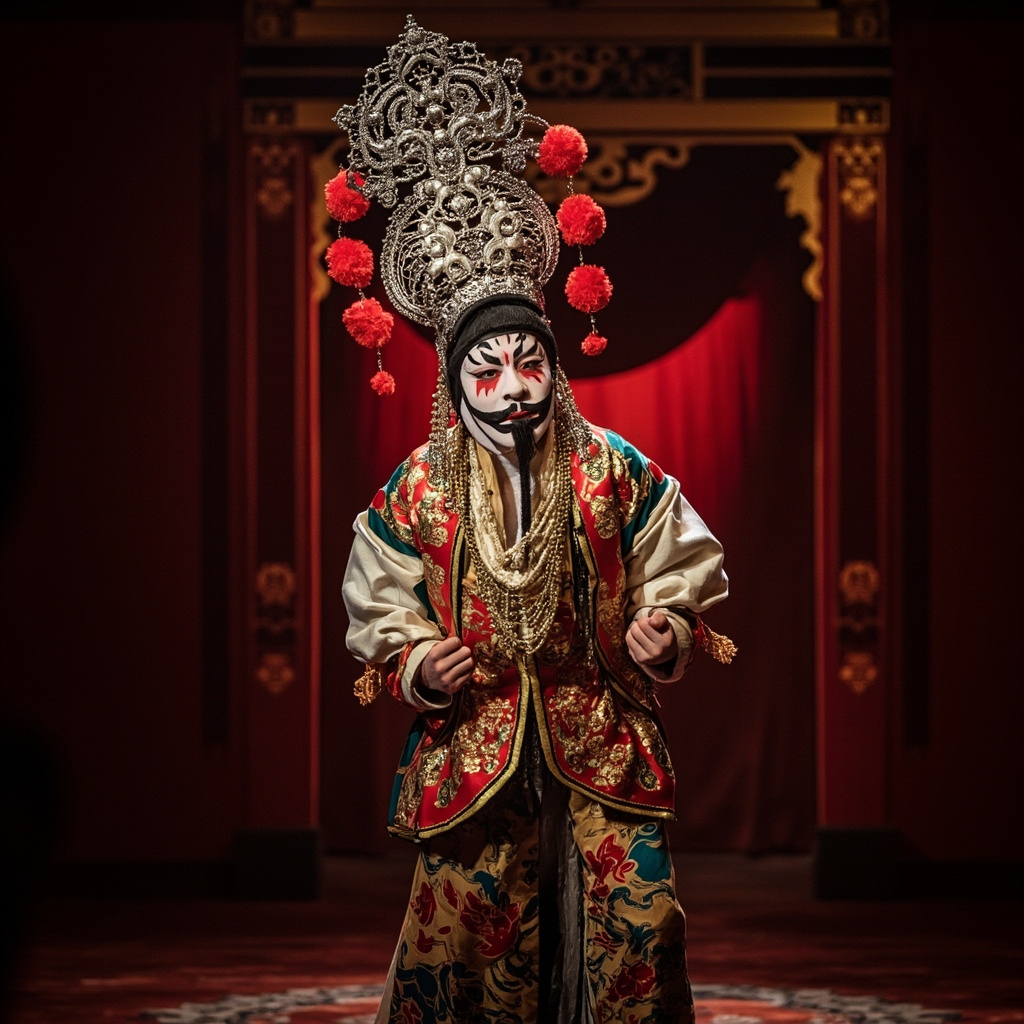
One of Peking Opera’s most distinctive features involves the elaborate face paintings worn by performers, particularly for male roles. These face designs, or lianpu, serve as visual indicators of character traits, moral qualities, and dramatic function. The color schemes and patterns communicate essential character information to audiences familiar with the symbolic vocabulary.
Red face paintings indicate loyalty, bravery, and righteous character. Characters like Guan Yu, the legendary general famous for his loyalty, typically appear with prominent red facial elements. White face paintings suggest treachery, cunning, or suspicious character. Ministers and schemers often appear with white faces, immediately signaling their problematic moral character to audiences.
Black face paintings represent integrity, bluntness, and straightforward character. The famous judge Bao Zheng appears with a black face, symbolizing his famous impartiality and commitment to justice. Gold and silver faces indicate supernatural or divine characters, while green, blue, and purple faces appear for various specific character types defined by generations of theatrical tradition.
Costume Significance and Symbolism
Peking Opera costumes rank among the most elaborate and symbolically rich theatrical wardrobes in world performance art. These elaborate garments follow strict rules governing colors, patterns, and accessories based on character type, social status, and dramatic function. The visual information conveyed through costume helps audiences immediately understand character relationships and narrative developments.
Imperial robes display nine ceremonial dragons, representing supreme imperial authority. High-ranking officials wear elaborate robes with specific insignia indicating their rank and function. Scholars and merchants wear less elaborate costumes that still communicate their social positions through color and accessory choices.
Armor appears in military roles, with design variations indicating the character’s army affiliation and military rank. Female costumes emphasize elegance through flowing sleeves and elaborate embroidery, with specific designs distinguishing imperial princesses from common women through careful use of colors and patterns.
Musical Elements and Instrumentation
Peking Opera music combines two main accompaniment traditions with a percussion section and melodic instruments. The wuzi, clapper accompanyment, provides rhythmic foundation using clappers and drums, while the丝弦accompanyment features string instruments providing melodic support. This combination creates the distinctive soundscape that defines Peking Opera’s aural identity.
The primary string instrument is the jinghu, a two-stringed fiddle that serves as the leading melodic instrument. Additional instruments include the sanxian, a three-stringed lute, and the pipa, a four-stringed lute. The percussion section features various gongs, drums, and cymbals that punctuate the performance and signal dramatic moments. The combination of melodic and percussion elements creates a rich sonic environment supporting performer expression.
Classic Performances and Stories
Peking Opera repertoire includes hundreds of traditional plays drawn from Chinese history, legend, and literature. Famous works include “The Legend of the White Snake,” telling the story of a snake spirit who falls in love with a human scholar. “The Drunken Concubine” portrays the tragic downfall of Yang Guifei, while “The Trial of the Stone” dramatizes an episode from the classic novel Dream of the Red Chamber.
Historical dramas featuring famous generals, wise officials, and legendary heroes populate the repertoire. Stories of loyalty, betrayal, love, and sacrifice provide emotional substance for performers to showcase their technical skills. Audiences familiar with these narratives appreciate both the performers’ technical mastery and their interpretation of beloved characters.
Experiencing Peking Opera Today
Visitors to Beijing can experience authentic Peking Opera performances at several historic venues. Lao She Teahouse offers regular performances combining traditional opera with explanatory commentary that helps foreign audiences appreciate the art form’s nuances. The National Centre for the Performing Arts and Capital Theatre present more traditional programming for audiences seeking authentic experience.
For those seeking deeper understanding, backstage tours and meet-the-artist programs reveal the extraordinary preparation required for performance. Watching performers apply their elaborate makeup and costumes provides insight into the dedication required for mastery. Some training centers offer introductory classes where visitors can experience basic Peking Opera movements and techniques firsthand.
Conclusion
Peking Opera rewards attentive viewers with rich cultural experiences that reveal centuries of artistic refinement. Understanding the basic conventions of face painting, costume symbolism, and performance skills enhances appreciation for this remarkable theatrical tradition. Whether experiencing a full performance or observing the preparation process, Peking Opera offers windows into Chinese cultural heritage that cannot be found elsewhere in the world.
The continued dedication of performers to mastering this demanding art form ensures that Peking Opera will remain a living tradition connecting contemporary audiences to China’s theatrical heritage. For visitors to China, attending a Peking Opera performance provides unforgettable cultural immersion and artistic appreciation that enriches understanding of Chinese cultural achievements.