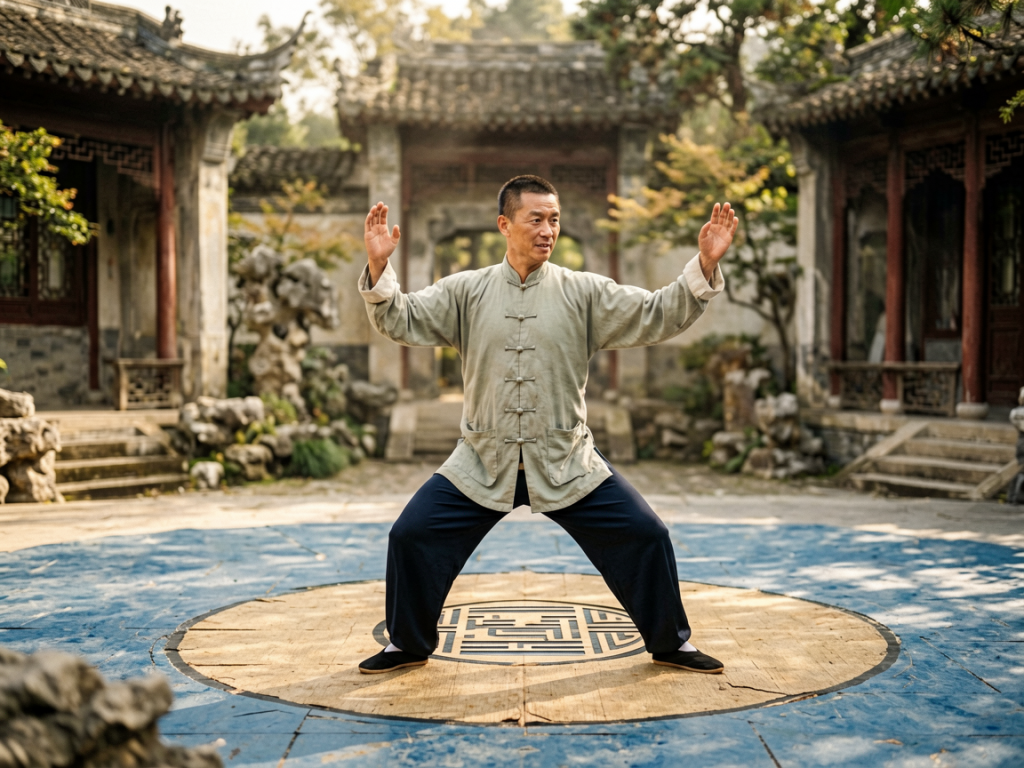
I watched a man in a faded track jacket pace a concrete ring behind the Temple of Heaven at five in the morning.
His left foot dragged slightly while his right pivoted. His shoulders rotated like a slow engine warming up. He kept glancing back over his left shoulder the whole time.
To anyone else, he looked completely lost. To me, he was doing exactly what he needed to survive a street fight.
That’s Bagua Zhang circle walking in its rawest form. It looks like nothing. It feels like torture. It actually changes how your nervous system processes threat.
I moved to Beijing eight years ago chasing stories and cheap noodles. I never planned to train martial arts seriously. Then a friend dragged me to a community hall near Dongcheng and forced me into a circle.
Don’t get me wrong. I’ve seen plenty of flashy demonstrations at tourist spots. I’ve watched men flip over each other on silk carpets while tourists clap politely. That’s theater.
This is different. This is the grinding, boring, repetitive foundation that actually wires your brain for real violence. Sound interesting?
Why You’ll Look Completely Lost in Public
When you first try Bagua Zhang circle walking, your ego takes a massive hit.
You’re supposed to walk a perfect loop while keeping your torso twisted. Your lead arm traces lazy figure eights above your head. Your rear hand guards your ribs. Your eyes stay locked on a fixed point over your shoulder.
Your brain hates it. Humans are wired to look where they’re going. Breaking that reflex feels physically uncomfortable within ten steps.
I remember the third week. I was practicing in Jingshan Park near a group of square dancers. An old lady in neon pink sneakers stopped mid-routine and pointed at me.
She asked if I’d eaten breakfast. I told her I was fine. She shook her head and kept dancing anyway.
That’s normal. The posture looks strange because it’s fighting basic human wiring. You’re forcing your neck to rotate while your hips drive forward. Your knees bend slightly to absorb the torque. Your weight shifts continuously between feet.
It’s not just stretching. It’s rewiring. You’re teaching your vestibular system to handle disorientation without panicking.
In a real confrontation, people don’t fight standing still. They lunge, they slip, they get shoved off balance. Circle walking simulates that chaos at a controlled pace.
Try walking a circle for twenty minutes straight. Your calves will burn. Your lower back will twitch. Your lungs will feel like they’re working overtime.
That’s the point. You’re building cardiovascular endurance while simultaneously drilling spatial awareness. Most modern fighters only get one of those benefits. They run straight lines. They sprint intervals. They forget how to turn without stopping.
Bagua Zhang circle walking forces you to maintain momentum through rotation. You learn to generate power from the ground up while your upper body stays relaxed.
It feels awkward until it doesn’t. Trust me. Give it two weeks and your body will start craving the rhythm.
The Body Remembers What the Mind Forgets
Combat instinct isn’t something you study. It’s something your muscles memorize through repetition.
I trained under a sifu named Master Wei for nearly three years. He ran classes out of a converted garage in Chaoyang. The floor was cracked concrete. The heater rattled loudly every winter.
He didn’t believe in forms you copy blindly. He believed in drills that broke your bad habits. Circle walking was his favorite weapon against rigid fighters.
Wei would make us walk for forty-five minutes straight. No talking. No phone checking. Just your breath, your footsteps, and the ache in your thighs.
Halfway through, beginners usually collapse or quit. Veterans adjust their grip and keep turning. I was the latter, but barely.
One Tuesday, I finally understood why he insisted on it. We switched to light sparring after the walk. My partner charged like a linebacker, expecting me to plant my feet and block.
My legs just moved on their own. I pivoted left, slipped inside his guard, and stepped around his blind side without even thinking.
I threw a palm strike that caught him square in the sternum. He stumbled back. I wasn’t trying to win. I was just reacting to the space he left open.
That’s combat instinct kicking in. Your conscious brain didn’t pick a move. Your feet found the angle before your thoughts could catch up.
Circle walking trains exactly that kind of automatic response. You’re constantly cutting angles while maintaining your centerline. You learn to redirect incoming force instead of meeting it head-on.
Most modern martial arts drill linear entries and exits. They work great for sport. They fail completely when the environment goes sideways.
Real fights happen in tight spaces. Hallways, bars, crowded streets. You can’t afford to wind up for a punch. You need to enter, control the line, and exit before the counter comes.
Walking the circle teaches you to flow through traffic without breaking your stance. You practice checking your surroundings while keeping your hands ready.
I’ve sparred with guys who train six days a week in pristine gyms. They’re fast, strong, and completely rigid. They freeze when the rhythm breaks.
Circle walkers don’t freeze. We shift. We adapt. We keep moving until the opening appears.
Is it easier than learning a kickboxing combo? Absolutely not. Is it more effective for unpredictable scenarios? I’m willing to bet money on it.
From Slow Circles to Sudden Explosions
People assume slow training means slow fighting. That’s a lazy misconception.
Bagua Zhang circle walking starts deliberate because your nervous system needs to map the geometry first. Once the pattern locks in, speed becomes natural.
I tested this theory during a weekend tournament in Tianjin. A friend invited me to watch a traditional martial arts exhibition mixed with open sparring.
Two guys entered the ring. One trained sanda. The other practiced Bagua. The sanda fighter threw crisp jabs and low kicks. He looked impressive.
The Bagua guy just circled. He kept his elbows tucked. His steps were quiet. He didn’t telegraph anything.
Then the sanda guy lunged for a clinch. The Bagua practitioner pivoted on his heel, slipped past the grab, and stepped behind his opponent’s lead leg.
He didn’t throw a fancy technique. He just used leverage and timing to dump the guy onto the canvas. Clean. Efficient. Over in three seconds.
The crowd erupted. The referee raised his hand. The slow circle had turned into a sudden explosion.
That’s the secret nobody talks about. You drill slowly to build precision. You store that precision as mechanical memory. Then you unleash it when adrenaline hits.
Adrenaline ruins fine motor skills. It shrinks your tunnel vision. It makes you rush. If your technique relies on complex choreography, you’ll choke under pressure.
If your technique lives in your bones, you’ll survive. Circle walking moves the skill from your cortex to your cerebellum.
You stop thinking about foot placement. Your feet just know where to land. You stop calculating angles. Your hips already turned them for you.
I tried combining circle walking with pressure testing a few years later. I’d walk the loop for twenty minutes, then immediately spar with someone throwing everything they had.
My legs felt heavy at first. Then they loosened up. My balance sharpened. I started seeing openings I normally missed.
The fatigue actually helped. Fighting tired forces you to rely on efficiency instead of athleticism. You stop wasting energy on wide swings or desperate scrambles.
You just move. You pivot. You control the distance. You wait for the mistake.
Traditional Chinese martial arts teachers always emphasized that principle. Fast strikes come from slow preparation. Quick reactions come from deliberate practice.
Modern sports science eventually caught up to that idea. They call it neuroplasticity now. I just call it what it is. You train the way you want to fight.
Want to survive a chaotic brawl? Stop drilling stationary targets. Start rotating. Start cutting angles. Start treating your feet like rudders instead of anchors.
Why Most Fighters Skip This Step
I’ll be honest. I didn’t want to learn circle walking either.
Back in my twenties, I wanted flashy techniques. I wanted joint locks that looked cool on video. I wanted to show off at dinner parties and impress dates.
Walking in a loop while twisting my spine felt like punishment. It offered instant gratification. It demanded patience I didn’t possess.
So did everyone else. They skipped straight to combinations. They chased belt promotions and competition medals. They treated martial arts like a checklist instead of a lifestyle.
Years later, I see the difference clearly. The guys who rushed into sparring got injured. Their knees blew out. Their shoulders developed chronic inflammation. Their egos took permanent damage.
The guys who sat with the basics stayed healthy. They kept showing up. They adapted their bodies to the demands of movement instead of forcing movement to fit their bodies.
Circle walking rebuilds ankle stability. It strengthens hip rotators. It opens thoracic mobility without risking spinal compression. It’s a full-body reset disguised as a simple drill.
You don’t need expensive equipment to do it. You don’t need a coach hovering over you. You just need flat shoes, a marked spot, and fifteen uninterrupted minutes.
I still do it most mornings before I head to the office. I walk the loop in my apartment hallway while listening to old jazz records. My neighbors probably think I’m crazy.
They’re probably right. But my knees stop aching when I squat. My lower back stays loose. I catch myself stepping sideways instead of backing up when someone cuts me off in traffic.
That’s the gift of circle walking. It doesn’t just prepare you for a fight. It prepares you for life.
Modern cities are chaotic environments. People rush. Cars swerve. Crowds surge. Your body learns to navigate that friction naturally when you practice rotating under load.
I could be wrong about the future of martial arts. I suspect more fighters will eventually abandon linear drills for circular ones. The data already supports it. Reaction times improve. Balance holds longer. Injury rates drop.
Until then, I’ll keep pacing my circles. I’ll keep watching people misunderstand me in public parks. I’ll keep trusting the process.
Give it a try tomorrow morning. Draw a chalk line on the sidewalk. Walk it for ten minutes. Turn your torso. Keep your eyes locked over one shoulder. Feel the burn.
Then step into the street and pay attention to how your body reacts to the world around you. You might just realize you’ve been training for combat all along.