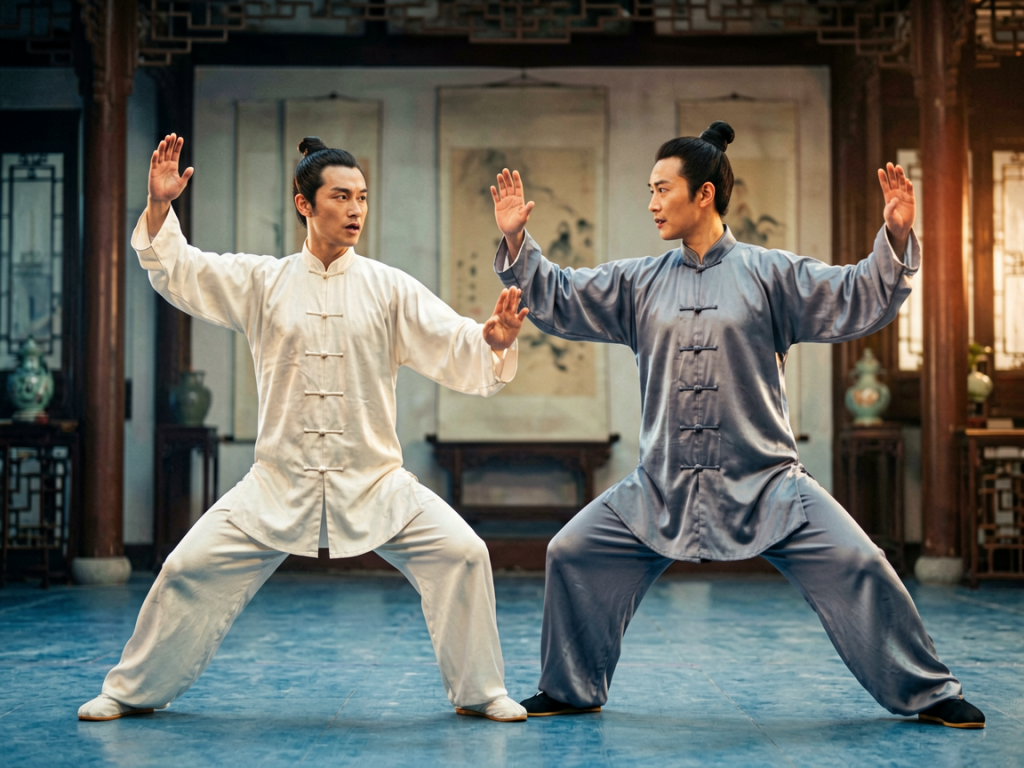
I still remember the exact morning I realized Chinese martial artists love to fight over paperwork more than people. It was early October, and the fog hung low over Donghu Park in Wuhan. I stood near the lotus pond with a paper cup of chrysanthemum tea, watching two separate groups practice side by side. One group moved in slow, sweeping arcs. The other group snapped, twisted, and occasionally stomped the dirt. I asked a nearby uncle what the difference was. He just laughed and told me both schools swear the other one isn’t real tai chi.
The Park Bench Verdict
Here’s the thing about internal martial arts in China. Nobody actually agrees on the baseline definition. I’ve lived here for eight years, and the moment you mention Chen-style tai chi versus Yang-style tai chi, you’ve basically activated a decades-old rivalry. The Yang practitioners insist their version preserves the original health focus perfectly. The Chen camp fires back that without spiral torque and explosive releases, you’re just doing gentle stretching. Both sides have legitimate historical records. Neither side concedes an inch while their mouth is full of arguments. I used to think one lineage had to prove the other wrong. Now I just watch them debate over folding chairs while sipping cheap oolong.
Sound interesting? It gets messier once you actually step onto the practice mat. I’ve attended workshops in three different provinces, and the attitude shift is instant. Teachers talk about ancestral purity like it’s a religious doctrine. Students treat lineage charts like family trees carved in stone. You’ll hear phrases like “true transmission” and “lost to modern dilution.” It sounds intense until you realize they’re just arguing over how to turn your hips. The drama fuels the culture. I wouldn’t trade it for anything.
Silk Reeling versus Flowing Rivers
Let’s actually look at the mechanics before we dive into the ego. I spent three months training under Master Zhou in Xinyang, and his hands felt like compressed springs. Every movement demanded what he called silk reeling. You pull, you twist, you coil, then you release. The Chen form requires you to drop into deep stances while rotating your ankles inward. It feels awkward at first. You’ll wobble. You’ll question your life choices. But then you start feeling the kinetic chain connect. Your calves burn. Your lower back unlocks. Your shoulder blades slide into place. The explosive technique they call fajin happens exactly when your body stops fighting gravity and starts using it.
Switch over to the Yang style, and the physics change completely. I joined a beginner class in Beijing after relocating for work. The instructor moved like water finding its level. No sudden jerks. No dramatic stomps. Just continuous weight transfer and long, unbroken arm lines. He explained that Yang Chengfu deliberately softened the original routines to make them accessible to older students and office workers. You can see why the adaptation worked. The Yang form looks incredibly graceful on camera. It’s much easier to memorize. It doesn’t require you to hold a horse stance until your thighs shake. I actually found the slower tempo easier to manage during rush hours. The Chen drills leave you drenched. The Yang routines leave you steady.
Which one actually builds better strength? I’ve compared my own progress across both styles, and the answer surprises most beginners. The Chen method demands fierce core engagement. Your fascia learns to store elastic energy. The Yang method trains nervous system calibration. You slow everything down until your breathing synchronizes with your steps. Both approaches deliver serious physical benefits. I just needed to sit through the learning curve differently. I could be wrong, but I think the best athletes eventually borrow from both camps.
When Masters Meet, Nobody Smiles
I went to a spring cultural festival in Guangzhou where both lineages performed on the same stage. The venue cost me forty yuan for a bench seat, but the atmosphere paid for itself immediately. Half the audience arrived early with thermoses and mahjong tiles. The other half brought clipboards to time the routines. When the Chen troupe finished their coiling sequences, a few veteran instructors nodded respectfully. Then the Yang performers took the floor. The energy in the room shifted instantly. Those long, flowing arms made the choreography look like a single brushstroke painting unfolding in real time.
But then an older Chen master leaned over to a friend and muttered something about missing internal kick mechanics. I didn’t catch the exact phrasing, but the tension was thick enough to spread on toast. It happens everywhere I go. I’ve watched this exact dynamic play out at university seminars, weekend tournaments in Nanjing, and even on WeChat group chats. Both schools genuinely believe they’re protecting the true transmission. They quote different historical texts. They reference different lineage charts. And honestly? They’re both right. Martial traditions adapt to survive. Water softens rocks. Fire tempers steel. Both methods preserve the core principle.
I tried attending a cross-training event once. A Yang instructor showed me how to distribute weight evenly across both feet. A Chen instructor later demonstrated how to anchor through the heel strike. My knees stopped clicking within a month. I loved that moment. It proved the rivalry exists mostly for marketing. The actual practice overlaps far more than the forums admit.
What Actually Makes It “Real”
So what does anyone mean when they claim another version isn’t authentic? I asked Professor Wei, a traditional Chinese medicine lecturer who practices qigong daily, that exact question over hot pot. He shrugged and said real simply means it works on your physiology. He wasn’t talking about street fighting. He was talking about circulation, joint lubrication, and autonomic regulation. The Chen routines demand extreme spiral traction. Your connective tissues stretch in rotational patterns. Your tendons learn to absorb shock efficiently. The Yang routines focus heavily on breath coordination and mental stillness. You reduce external noise until your parasympathetic nervous system takes over.
Both approaches deliver measurable health outcomes. I tracked my own metrics for six months while alternating between the two styles. The Chen drills improved my balance and reduced my resting heart rate slightly. But the intense fajin practice kept me wired at night. I tossed and turned until my circadian rhythm reset. Switching to the Yang form changed everything. I finally dropped into deep sleep cycles. My blood pressure stabilized. I’m no expert, but my annual checkup definitely reflected the shift. Doctors love consistent movement. They don’t care which lineage you follow.
The philosophical divide usually comes down to intention. Some practitioners view tai chi strictly as a combat system. Others treat it as moving meditation. I respect both perspectives equally. I’ve watched young corporate employees in Shenzhen pick up the Yang routine just to decompress after twelve-hour shifts. I’ve seen retired military officers in Shanghai drill Chen forms to rebuild mobility after decades of heavy manual labor. Both groups get stronger. Both groups stay healthier. The authenticity debate just makes for better dinner table conversation.
Leaving the Dojo Behind
Look, the whole “is it real?” argument completely misses the point. These forms were never designed to be frozen artifacts. They evolved alongside the people who practiced them. I’ve bought skewers from street vendors who bet their own lunch money on which style would dominate a regional competition. I’ve lost those bets more times than I’d comfortably admit. Now I just buy two thermoses and sit on the wooden bench. I watch the mist rise. I listen to the synchronized breathing. I notice how both groups eventually arrive at the same quiet center.
I still prefer the Yang flow. It matches my daily rhythm. It doesn’t demand extreme flexibility on days I’ve been sleeping poorly. But I deeply respect the Chen coil. It respects my limits and pushes them gently. If you ever find yourself standing in a Chinese public square at dawn, watching strangers move in perfect harmony, don’t pick a side. Just breathe. Notice how the different doorways lead to the same room. That’s the entire story. That’s the part nobody prints in promotional brochures. Practice what fits your body. Argue with your friends over noodles. Keep showing up.