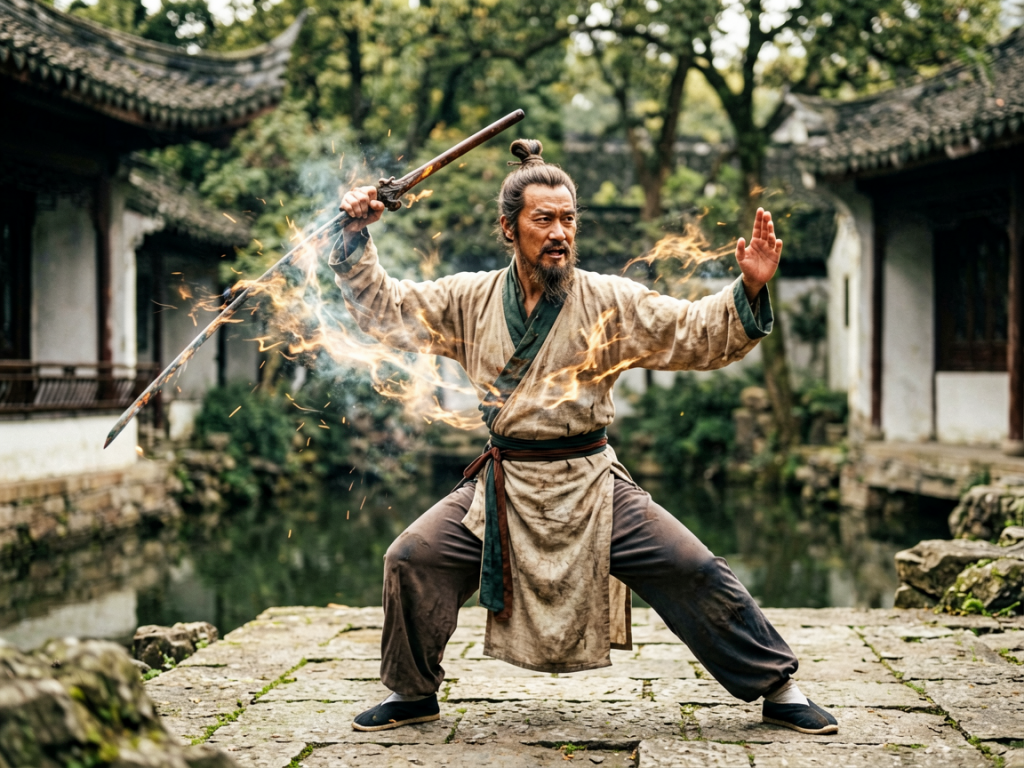
The Day the Old Master Shook My Bones
I’ll never forget the first time I felt Fa Jin. It wasn’t in a movie. It wasn’t in some wuxia novel with glowing energy auras. It was in a drafty community center in Shanghai, raining cats and dogs outside.
I was standing there, stiff as a board, listening to my sifu talk about relaxation. He looked like a retired accountant. Soft hands. A bit of a belly. Then he tapped my chest with two fingers.
Pow. I flew backward three steps. I didn’t move my feet. I didn’t brace myself. I just felt like a leaf caught in a sudden gust of wind. My lungs went empty. My legs turned to jelly.
“That,” he said, adjusting his glasses, “is Fa Jin. Explosive power.” I rubbed my sternum. It didn’t hurt, but my soul felt rattled. Sound interesting? Wait till you hear how he did it.
Forget the Hollywood Hype
If you’ve seen kung fu movies, you think Fa Jin is like Superman punching through a wall. You’re imagining muscle fibers ripping and screaming. You’re visualizing a bodybuilder flexing so hard he explodes.
To be fair, I thought the same thing at first. I’m no expert, but I’ve read enough physics to know that muscles don’t work like springs. They pull. They contract.
So where does the explosion come from? It’s not in the arm. It’s in the ground. And it’s all about timing. Specifically, the timing of relaxation.
Here’s the thing about internal arts like Tai Chi, Baguazhang, or Xingyi. They teach you to stay soft until the very last millisecond. Imagine a whip. The handle moves slowly. But the tip? The tip snaps forward faster than sound.
Your body is that whip. Your mind controls the handle. Your core is the coil. And your extremities are the tip. If you tense up early, you break the chain. You become a stick. And sticks don’t have Fa Jin.
The Mechanics of the Snap
Let’s get technical for a second. But don’t worry, I promise I won’t put you to sleep. We need to talk about structure. In Western lifting, we isolate muscles. Biceps curl. Triceps push. Simple.
In internal martial arts, we connect everything. It’s called whole-body power. When my sifu hit me, he didn’t just use his arm. He pushed with his back leg. He rotated his hips. He snapped his spine. He extended his arm.
All of it happened at once. That’s the key. Simultaneity. If you rotate your hips before you extend your arm, the power leaks out. You’re just poking someone. But if you do it all in one breath? Bam.
I remember practicing this for months. Just standing in a horse stance. Just rotating my waist. My sifu kept hitting my side with a bamboo cane. Not hard. Just enough to knock me off balance.
“Soften,” he’d say. “Then snap.” I was frustrated. I wanted to punch fast. I wanted to look cool. But fast without connection is just noise. I had to learn to be lazy first. That’s the paradox.
You have to be lazy until the moment of impact. It’s counterintuitive. Your brain screams at you to tense up when someone charges at you. That’s your fight-or-flight response. But Fa Jin requires you to override that instinct.
You have to trust the structure. You have to trust that if you keep your joints aligned and your muscles loose, the force will transfer cleanly. It’s like a Newton’s cradle. One ball hits, the other flies out.
Why Most People Get It Wrong
I see this mistake everywhere. Even experienced fighters fall into this trap. They think Fa Jin means jerking their limbs. They twitch their shoulders. They flail their arms. It looks chaotic. It feels frantic.
But real Fa Jin is silent. It’s smooth. Think about a cat jumping. Does it shake before it leaps? No. It coils, still as a statue, then explodes upward. One motion. No wasted energy.
I tried to mimic the twitching once. My sifu stopped me immediately. “You’re angry,” he said. He pointed at my chest. “Your heart is racing. Your breath is shallow. You’re fighting yourself.”
He made me sit down. We sat for ten minutes. Just breathing. Feeling my feet on the floor. Connecting my heels to my knees, knees to hips, hips to spine.
It was boring. Honestly? It was the hardest part of training. Sitting still while your mind runs a marathon. But once I relaxed, the power appeared. It wasn’t added. It was revealed.
This is why people call it internal. It’s not about building bigger muscles. It’s about removing the barriers that stop your natural strength from flowing. Gravity is free. Ground reaction force is free. You just have to stand correctly.
When you’re tense, you block the ground. You’re like a shock absorber gone bad. You soak up your own energy. But when you’re relaxed and aligned? You become a conduit. The earth pushes up, and you shoot that energy straight into your opponent.
I loved that feeling. It’s better than most alternatives because it doesn’t require gym memberships or protein shakes. It just requires attention. And a lot of repetition.
The Role of Intent (Yi)
We can’t talk about Fa Jin without mentioning Yi. Intent. Mind over matter. Some folks dismiss this as woo-woo mysticism. I get it. If you tell a scientist that your thoughts can move a body, they’ll laugh.
But here’s the reality. Your nervous system controls your muscles. If your mind is distracted, your signals get fuzzy. If your mind is focused, the signal is crisp. Sharp. Fast.
Think about catching a ball. You don’t think about moving every finger individually. You just want the ball. Your hand catches it. That’s intent directing physiology.
In Fa Jin, you aim your intent before you move your body. You visualize the target through the person, not at them. You’re not hitting their skin. You’re hitting their center of gravity. Or their spirit.
My sifu said, “The eye sees, the heart directs, the body executes.” Three stages. If you skip the heart, you’re just a robot. Robots are predictable. Humans with intent are dangerous.
I tested this in a sparring session last year. I wasn’t trying to hurt my partner. I was just trying to move him. I focused on his shoulder blade. I sent my Yi there. I snapped my waist.
He stumbled back, eyes wide. “How?” he asked. I shrugged. “I didn’t touch you hard,” I said. “I just told my body to go.” He looked confused. But he bought it. That’s the power of focus.
It’s easier than you’d expect to learn this mindset. You practice it in daily life. When you walk, imagine your steps are heavy. When you pick up a cup, feel the weight before you lift. Train your awareness.
Because Fa Jin isn’t just for fighting. It’s for living. It’s about efficiency. Why waste energy worrying? Why tense up when you don’t need to? Find the snap in your everyday actions. Lift with your legs. Speak with conviction. Walk with purpose.
Practical Steps to Start
So, how do you actually start? You don’t need a dojo. You don’t need a master. Well, you probably do, but you can start alone. Stand in a neutral stance. Feet shoulder-width apart. Knees slightly bent.
Drop your shoulders. Unclench your jaw. Let your arms hang heavy. Feel the weight of your head pulling down, stretching your spine. Imagine a string lifting the crown of your head.
Now, shift your weight to one leg. Slowly. Keep the other leg loose. Feel the pressure in your foot. Now, quickly return to center. Don’t push with your toes. Just let the momentum carry you.
Repeat this. Shift, snap, return. Shift, snap, return. It’s small movements. Micro-movements. But they build the neural pathways. You’re teaching your body how to relax under load.
I did this every morning for six months. While drinking my coffee. While waiting for the subway. Small shifts. Quick snaps. It changed how I moved. I felt lighter. Faster. Stronger.
And it’s safer too. When you learn to relax, you don’t injure yourself. You absorb impacts better. You recover faster. It’s a gift that keeps on giving. Plus, it looks cool when you walk into a room with that kind of calm authority.
I know it sounds simple. Too simple. But mastery is always simple. It’s just hard to stick to. Most people want the quick fix. The secret technique. The magic pill.
There is no magic pill. There’s just the whip. There’s just the ground. There’s just you, learning to stop fighting yourself.
The Final Truth
Fa Jin isn’t magic. It’s physics. It’s anatomy. It’s psychology. But it feels like magic when you experience it. Like I did in that rainy Shanghai gym.
Don’t let the complexity scare you off. Start small. Relax. Connect. Snap. Repeat. You might not fly across the room. But you’ll feel the power rising. And that’s enough.
I’m still learning. Eight years in, and I’m still finding new layers. It’s a journey, not a destination. And honestly? I wouldn’t have it any other way.
Give it a try. Just for five minutes. See what happens when you stop holding your breath. See what happens when you let go. You might be surprised.
Trust me. It’s worth it.