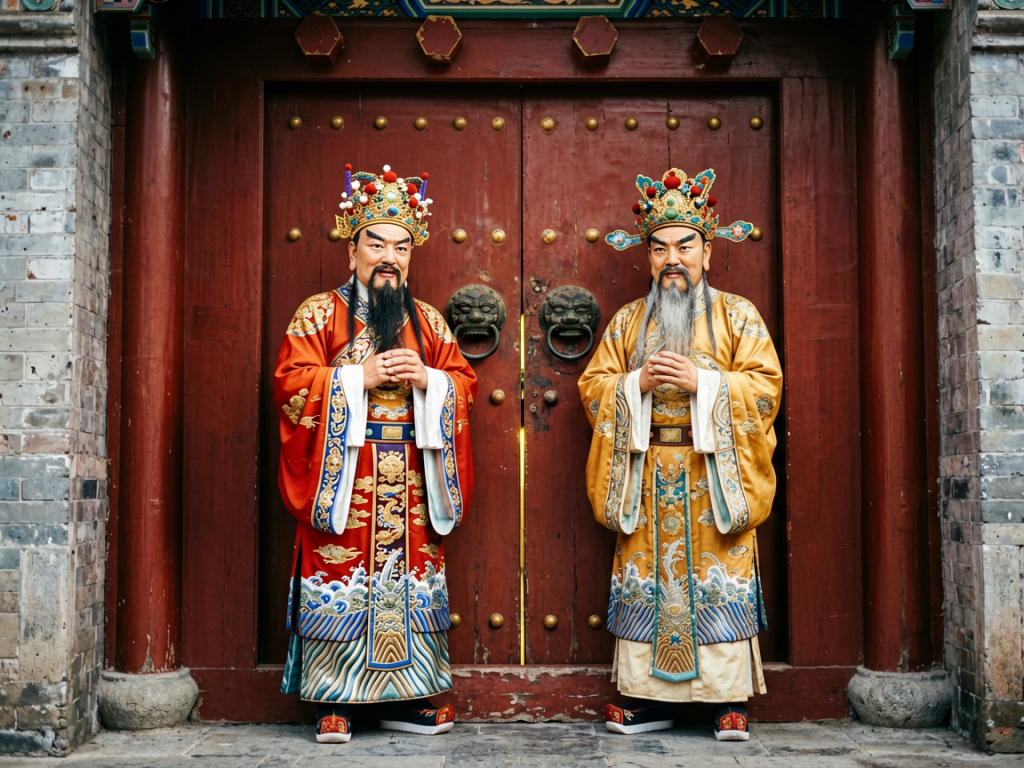
Remember that winter I spent in a tiny courtyard house in Beijing? It was minus ten degrees, the kind of cold that makes your nose hairs freeze instantly. My landlord, an elderly lady named Auntie Li, was bustling around the entrance, wrestling with a pair of glossy, oversized prints.
She waved me over, grinning through her scarf. “Help me fix these,” she said. “The Old God needs to see the new God in.” I thought she was talking about some weird religious hierarchy. She wasn’t. She was swapping out the traditional Door Gods for the new year.
If you’ve ever walked through a neighborhood in China during the Lunar New Year, you’ve seen them. Those huge, colorful posters pasted on either side of every front door. They’re fierce. Some look like warriors in armor, others like benevolent scholars. They’re called Men Shen, or Door Gods.
You might think they’re just old-school decoration. But trust me, they’re way more than that. They’re the spiritual security guards of Chinese homes. And even though we live in an era of smart locks and Ring cameras, millions of families are still slapping paper saints on their doors every January.
Who Exactly Are These Fierce Guys?
I’ll be honest, when I first arrived in China, I assumed there were dozens of different Door Gods. Like Santa’s little helpers, but with swords. Turns out, it’s a bit more complicated. There are basically two main camps: the military generals and the civil officials.
The military guys are the heavy hitters. Their names are Qin Qiong and Yuchi Gong. These were real historical figures from the Tang Dynasty, serving Emperor Taizong. Legend has it the Emperor suffered from nightmares caused by ghosts outside his palace door. So, these two loyal generals stood guard all night. They were so effective at scaring off spirits that the Emperor told them to rest. But the ghosts kept coming.
So, the Emperor ordered their portraits hung on the gates instead. It worked. Now, whenever you see those two guys in full battle armor, holding weapons like halberds or hammers, you’re looking at Qin Qiong and Yuchi Gong. They’re tough-looking for a reason. They aren’t there to invite you in; they’re there to make sure nothing bad gets in.
Then you have the civil versions. These are usually Wen Chang or Zhong Kui, though Zhong Kai sometimes crosses over. They look less like soldiers and more like confident bureaucrats or scholars. They hold brushes or scrolls instead of swords. Their vibe is “I’ve got the paperwork right, go away.” It’s funny how the Chinese tradition offers both force and diplomacy as protection strategies.
Some regions have other local deities too. In some parts of the south, you might see Guan Yu, the God of War, holding a long green dragon blade. He’s huge in Chinese culture for loyalty and righteousness. Hanging him on your door is like saying, “My family is loyal, and we don’t mess around.”
Why Paper Stickers When You Have Smart Locks?
This is the question I get asked the most. I mean, seriously. You can install a fingerprint scanner that works faster than you can blink. Why paste a piece of paper on the wood? Isn’t that superstitious nonsense?
To be fair, I asked the same thing when I moved into my first apartment. My neighbor, a young tech worker, laughed at me for thinking it was archaic. He told me it’s not about magic. It’s about intention.
In Chinese culture, the door is the mouth of the house. It’s where Qi, or energy, flows in. If you don’t have a guardian, bad energy slips in. It’s like leaving your windows unlocked in a storm. You don’t do it because you’re afraid of wind; you do it because it feels wrong.
There’s also the aesthetic factor. A plain white door looks boring. A door with bright red, gold, and intricate blue Door Gods? That’s festive. That’s life. It signals to anyone walking by that a celebration is happening inside. It’s visual warmth in the middle of winter.
I tried explaining this to my American friends. One said, “So it’s like putting up Christmas lights?” I said, “No, it’s like having a bouncer at your house.” He didn’t get it. He just thought it was cute.
But here’s the thing. Even young people who don’t believe a word of the mythology still buy them. Why? Because it’s a ritual. And rituals bind communities together. When you see your neighbor putting up their Door Gods, you know the New Year is close. It’s a shared cultural cue. It’s comforting in a way that is hard to describe if you haven’t experienced it.
The Evolution: From Woodblock Prints to Phone Cases
Traditionally, Door Gods were woodblock prints. Artists would carve the image into wood, ink it up, and stamp it onto paper. The process was slow, and each print had slight variations. That’s why vintage Door Gods are so prized. They have texture. They smell like ink and age.
I remember buying a set from a street vendor in Xi’an. The ink was still wet. The vendor told me the block had been passed down three generations. The lines were bold, the colors vibrant–red for luck, green for safety, yellow for wealth. It felt substantial. You could feel the weight of the history in the paper.
Today, you can buy Door Gods on Alibaba for pennies. They’re mass-produced, glossy, and perfect. But you also see them everywhere else. I saw a Door God sticker on my subway card last week. Then there was a plush toy version at the airport gift shop. Someone even designed a minimalist, anime-style Door God for a gaming app.
Is it losing its soul? Maybe. But it’s also surviving. Culture changes, and symbols adapt. If Door Gods weren’t relevant, they’d disappear. Instead, they’re evolving. They’re becoming part of the modern Chinese identity, not just a relic of the past.
I actually bought a Door God keychain last year. It’s small, metal, and engraved. I hang it on my bag. It’s not for protection anymore. It’s just a reminder. A connection to the places I’ve lived and the people I’ve met. It’s a conversation starter. People ask, “What’s that?” and I get to tell the story of Qin Qiong and Yuchi Gong. It’s better than most alternatives for breaking the ice.
How to Actually Put Them Up (Don’t Mess This Up)
If you’re going to put up Door Gods, there are rules. Well, loose rules. Don’t treat it like a DIY home decor project. Respect the icons.
First, timing matters. You usually put them up on New Year’s Eve, or a few days before. Not weeks in advance. Let them wait until they’re needed. Second, placement is key. They should face outward. Yes, outward. They’re guarding the exterior. If you put them facing inward, you’re inviting trouble in, which is exactly the opposite of the point.
And never, ever put them upside down. I saw a tourist do this in a museum exhibit once. The guide looked horrified. It’s bad luck. It’s like putting a picture frame crooked, but with supernatural consequences.
My advice? Buy a new set every year. Don’t reuse the old ones. Once the New Year starts, the old guardians have done their job for the previous cycle. You need fresh energy for the new year. Peel off the old ones, clean the door, and slap on the new, shiny pair.
I helped a friend do this last year. We spent twenty minutes trying to get the tape right. We wanted it straight. We wanted it symmetrical. It took longer than assembling IKEA furniture. But when we stepped back and looked at the door, it just felt complete. The house looked alive. It felt protected.
Why It Matters Now More Than Ever
We live in a weird time. Everything is digital. Our security is online. Our connections are virtual. It’s easy to feel untethered. But traditions like Door Gods ground us. They remind us that we are part of something bigger than ourselves. Something that has existed for thousands of years.
When you see those fierce faces staring out from a door, you’re seeing a reflection of our collective desire for safety and peace. It’s not really about gods. It’s about hope. We want our families to be safe. We want good fortune to find us. And we want to pass that wish down to our kids.
I love this aspect of Chinese culture. It’s practical yet poetic. It’s ancient yet adaptable. You don’t need to believe in the magic to appreciate the sentiment. You just need to understand that protecting your home is sacred.
So, next time you’re in China, or even just visiting a Chinatown, look at the doors. Look for the red, the gold, the fierce eyes. Take a moment to appreciate the story behind it. Then maybe, just maybe, put up a Door God yourself. Or at least buy one for your mom. She’ll probably love it.
And if someone asks why, you can tell them. You can talk about Qin Qiong and Yuchi Gong. You can talk about tang dynasty emperors and nightmare-free sleep. But mostly, you can just smile and say it’s about keeping the bad vibes out. Sound interesting?
It’s simpler than you’d expect. And honestly, it looks pretty cool too. I’m no expert, but I think everyone needs a little bit of protection in their lives. Even if it’s just paper and glue.