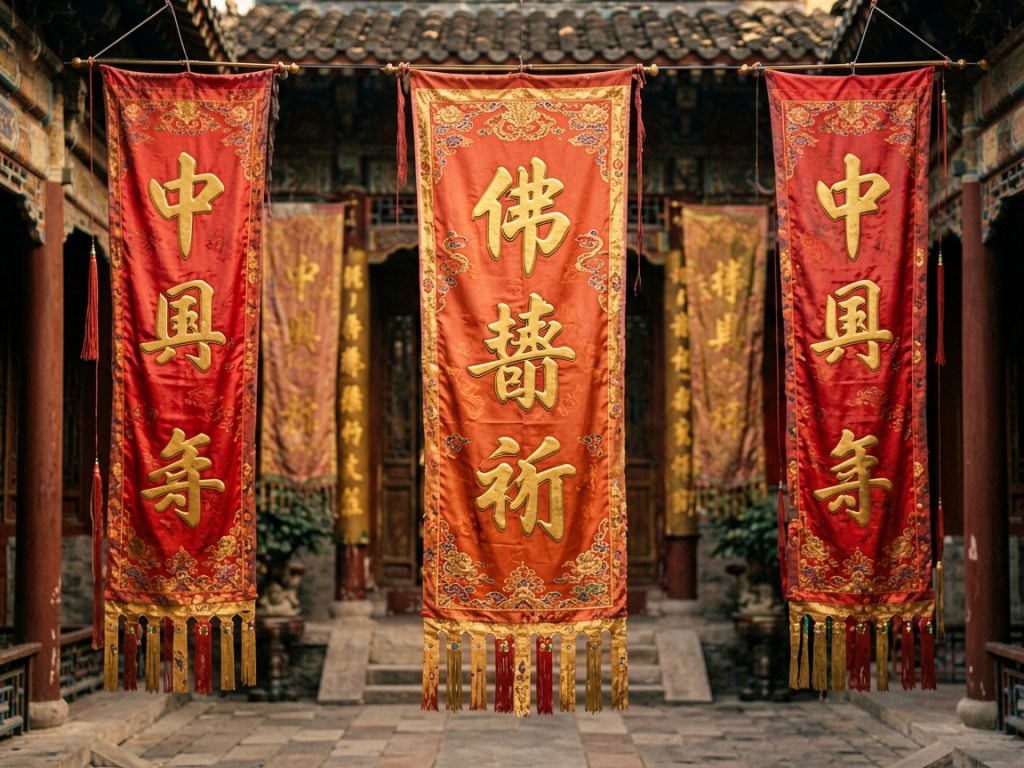
I still remember the first time I saw a funeral in my hometown of Suzhou. It wasn’t the wailing that caught me off guard, though there was plenty of that. It was the sheer volume of fabric. Long vertical banners hung from every doorway, draped over railings, and even tied to the branches of old plane trees lining the street.
I was standing there with my camera, trying to capture the solemnity of the moment, when my Chinese neighbor, Old Chen, gently tapped my shoulder. He pointed at one of the banners and then at another nearby one. They looked identical to my untrained eye, except for the text. But he shook his head vigorously and whispered something that still gives me chills.
“Don’t take photos of the red ones,” he said. “And never, ever mix them up.”
I thought he was being superstitious. I didn’t realize then that in Chinese culture, color isn’t just aesthetic. It’s a rigid code of respect, hierarchy, and life status. Get it wrong, and you aren’t just being rude. You might accidentally insult the entire lineage of the deceased.
The Golden Rule: Red is for Life, Yellow is for Death
Here’s the thing about Chinese funeral customs that trips up almost every foreigner. We’re taught that black and white are the colors of mourning. And sure, they play a part. But the primary signal comes from the banners themselves, known as wanlian.
If you see a bright, festive red banner at a funeral, do not panic. Do not assume there’s been a misunderstanding. That red banner means something very specific. It usually indicates that the deceased was an elderly person who lived a long, full life. In Chinese tradition, this is called xihong or “happy red.” It signifies a zhongxiu–dying of old age after seeing multiple generations.
It’s a celebration of a life well-lived. The red symbolizes good fortune and longevity. It’s actually quite beautiful once you understand the context. It’s like saying, “She lived to 95, had ten grandchildren, and passed away peacefully in her sleep. That’s a blessing.”
However, if that same elderly person had died suddenly from an accident, or much earlier than expected, the banners would be yellow. Or sometimes green, depending on the region. Yellow represents mourning, grief, and the end of a journey that wasn’t supposed to happen so soon. It’s somber. It’s heavy.
Mixing these up is catastrophic. Imagine putting a red banner on a young man who died in a car crash. To the community, it would look like you’re mocking his tragic death by celebrating it as a joyous, natural end. It’s a profound breach of etiquette. I’ve seen neighbors whisper behind their hands when they spotted the wrong color. They wouldn’t confront you, but the shame would hang in the air thicker than the incense smoke.
Who Gets the Red? The Age Matters
You might be wondering, “How old is too old for red?” That’s a fair question. I asked my auntie in Shanghai last year, and she laughed until she cried. She told me it’s not just about the number. It’s about the generation gap.
Generally, if the deceased is above 60, there’s a chance for red, provided it was a peaceful passing. But the sweet spot is usually 70 or 80 and above. If someone dies at 45, red is absolutely out of the question. Even if they were healthy. Especially if they were healthy. Dying young is considered a great tragedy, a loss of potential and energy. The banners must reflect that sorrow.
I once attended the funeral of a university professor in Beijing who passed away at 68. He was brilliant, beloved, and had just retired. His family chose yellow banners. Some people argued for red because he was “old enough.” But the family felt he hadn’t reached the ideal longevity threshold they hoped for. It was a nuanced decision, but the yellow was respected. It honored the grief without pretending everything was perfect.
Conversely, I saw a case in Guangzhou where an 82-year-old woman died after a long illness. The family used red banners with gold characters. When I asked why they didn’t use white mourning clothes, the son explained that white is for immediate family, while the community recognizes the red banners as a sign that her time had come. It was comforting, not depressing. It shifted the focus from loss to gratitude.
The Text and the Calligraphy
Let’s talk about the words on those banners. They aren’t random phrases. They are couplets, meticulously crafted to summarize the life of the deceased. The calligraphy matters immensely. Gold characters on red, or black characters on yellow? That’s standard. But the font style says something too.
I’m no expert on calligraphy, but I know enough to notice the difference. Formal, strict scripts are used for serious, solemn occasions. For a zhongxiu (happy funeral), the script might be slightly more elegant, almost celebratory. It’s subtle, but locals notice.
The couplet itself often follows a specific structure. The upper scroll praises the virtue or achievement of the deceased. The lower scroll expresses the grief or respect of the surviving family. And there’s always a central title, usually the name of the deceased followed by a respectful honorific.
In rural areas, the text can be incredibly specific. I remember reading a banner in a village in Henan that simply said, “Father of Ten Sons, Grandfather of Twenty-Five.” It wasn’t just a name. It was a resume. It told you exactly who this man was in the context of his clan. That level of detail is lost in translation, but the visual impact remains. The sheer number of characters, the weight of the fabric, the position of the banner relative to others.
Positioning is key. The banners are usually hung symmetrically on either side of the main gate. If the deceased was male, the left banner (from the viewer’s perspective facing the house) typically refers to the father or husband. The right refers to the mother or wife. Swapping them implies a confusion of roles that is deeply unsettling to traditional minds.
Modern Shifts and Regional Nuances
Now, before you think this is all ancient history, let me tell you that things are changing. In big cities like Shenzhen or Hangzhou, many younger families are opting for simpler ceremonies. Some even skip the elaborate banners entirely, choosing to wear black armbands or just keeping it quiet.
But when they do use banners, the rules are still strictly enforced, sometimes more so than in the past. There’s a fear of losing cultural identity, so the symbols become anchors. I’ve noticed that in urban funerals, the yellow is becoming the default, even for the elderly. Red feels risky. It feels like inviting gossip. “Did they really live to 90?” people ask. “Was it really peaceful?” Yellow is safe. Yellow is universally understood as mourning.
There are also regional quirks. In southern China, particularly among the Hakka people, the colors can vary based on clan traditions. I heard stories of blue banners being used in some specific contexts, representing water and flow, but those are rare and highly specific. For most of us foreigners, sticking to the red/yellow/black/white spectrum is the safest bet.
And speaking of white, that’s for the inner circle. The close family wears white headbands or armbands. Outsiders, friends, colleagues–they might wear dark suits or simple white shirts. The contrast between the intimate white mourning and the public display of colored banners creates a layered social experience. You know who was close by what they wear. You know how the community viewed the life by what they hang outside.
Why This Matters to Us
So, why am I telling you this? Why should you care about the color of a piece of cloth in a country you might never visit?
Because respect is in the details. When we travel or live abroad, we often focus on the food, the scenery, the history. We forget the rituals that bind communities together. Funerals are one of the most intimate community events. They are where society reaffirms its values about life, death, and family.
Understanding that red isn’t always happy, and yellow isn’t always just sad, changes how you see the world. It teaches you that grief has different shades. It teaches you that a “good death” is a culturally constructed concept that varies wildly across borders.
I’ll be honest, I’m still nervous when I see those banners now. Not because I’m afraid of offending anyone, but because I’m reminded of how much weight culture carries. Every stitch, every character, every hue is a deliberate choice made by grieving hearts. It’s heavy. It’s meaningful.
Next time you see a Chinese funeral, look past the flowers. Look at the banners. Ask yourself: Is this a celebration of longevity? Is this a lament for a life cut short? Is this a quiet acknowledgment of peace?
You won’t need to speak the language to feel the answer. The colors will tell you everything.