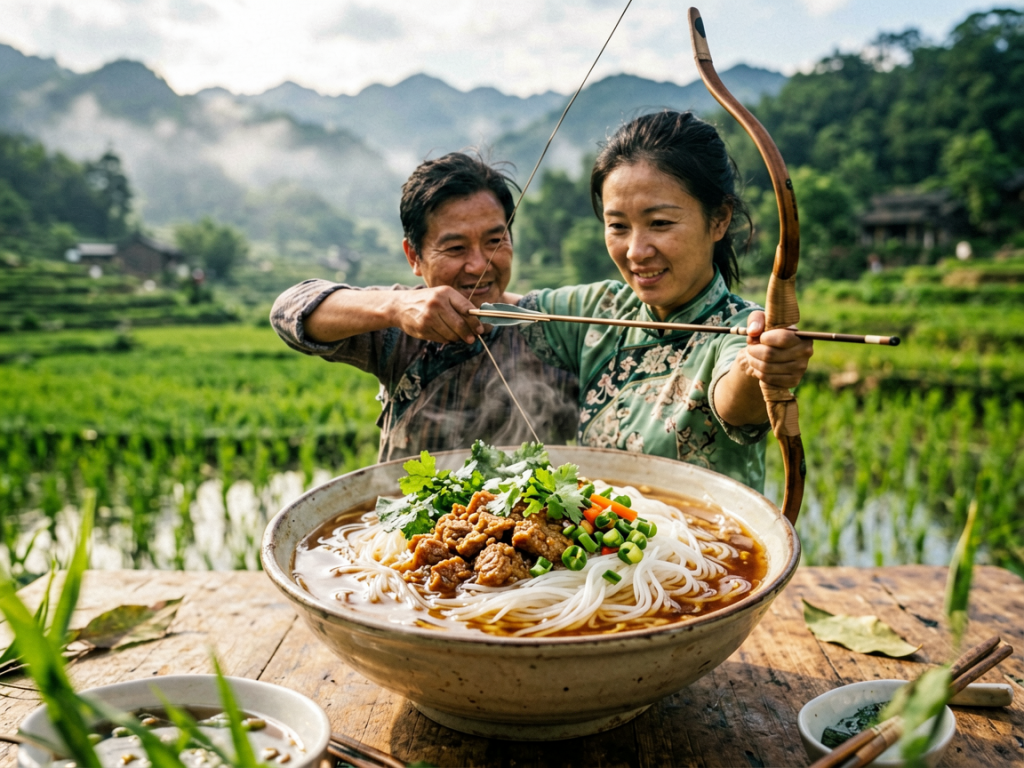
I’m sitting in a tiny, plastic-chair-filled shack in Kunming. The air is thick with steam and the sharp, pungent scent of fermented garlic. In front of me sits a bowl of mixian that looks deceptively simple. Just white noodles swimming in a dark, oily broth.
But trust me, there’s nothing simple about it.
I’ve been living in China for eight years now. I’ve eaten my share of Lanzhou beef noodles and Sichuan hot pot. But Yunnan rice noodles? They’re a different beast entirely. They’re chaotic, aggressive, and utterly impossible to put down.
People ask me why I keep going back for more. I tell them it’s the complexity. It’s the texture. It’s the history. But really, it’s because eating them feels like solving a puzzle that tastes like heaven.
You might think it’s just carbs and water. You’d be wrong. Let me take you through the madness.
The Crossbow That Changed Everything
I’ll be honest, the title of this piece is half-joke, half-truth. I didn’t actually hunt with a traditional crossbow through the mountains of Dali. Not in the historical sense, anyway.
But I did spend three days wandering the ancient tea horse road trails near Shaxi. And in those old towns, you see the relics. You see the iron crossbows hanging above doorways. They weren’t just weapons; they were tools for survival.
And here’s the thing about survival in Yunnan. The terrain is rugged. The weather changes in minutes. You need food that travels well and gives you quick energy.
Rice noodles fit that bill perfectly. Unlike wheat noodles, which get soggy or sticky when reheated, rice noodles hold their structure. They’re resilient. Much like the people who eat them.
I remember asking an old man in Lijiang why his family had kept the same noodle recipe for generations. He pointed at the mountains around us. “The land is hard,” he said. “The food must be strong.”
That’s the spirit of Yunnan cuisine. It’s not delicate. It’s bold. It demands attention.
So, when I talk about the “crossbow migration,” I’m talking about how these noodles traveled with soldiers and traders across difficult landscapes. They carried the culture with them, bite by bite.
The Broth Is Where the Soul Lives
If you order rice noodles anywhere else in China, you might get a bland, watery broth. In Yunnan, the broth is the king.
I tried a bowl of guoqiao mixian–the famous “bridged noodles”–in a restaurant near the Green Lake Park. The waiter brought out a massive clay pot of boiling soup. It looked like plain chicken stock.
Then he dumped in a mountain of raw ingredients. Thin slices of beef. Quail eggs. Bean sprouts. Chrysanthemum petals. And finally, the noodles.
I watched, skeptical. How could raw meat cook in seconds? The waiter smiled. He stirred it for ten seconds. Ten! Then he handed me the bowl.
I took a sip. My eyes widened. The heat of the oil trapped on top had cooked the meat perfectly. The flavor was intense, savory, and deeply comforting.
This is the magic of Yunnan broths. They’re often made from old hen bones, ham hocks, and a secret blend of spices. Some shops simmer theirs for twelve hours.
I tasted a hint of star anise, sure. But there was also something earthy. Something that reminded me of the damp forests in Xishuangbanna.
To be fair, not all broths are created equal. I’ve had bad ones. Watery, salty, lacking depth. But the good ones? They stay with you for days.
When I drink a proper bone broth, I feel connected to the soil. It’s rich with minerals and collagen. It warms you from the inside out.
Is it healthy? Probably. Is it delicious? Absolutely. That’s the balance Yunnan chefs master every single day.
The Spice Factor: Don’t Fear the Chili
Let’s talk about the heat. Yunnan people love their spicy food. But it’s not the numbing, mouth-puckering spice of Sichuan.
It’s a dry, aromatic heat. It comes from chilies that are grown in the volcanic soil of the region. They have a smoky sweetness to them.
I visited a small stall in Kunming where the owner ground her own chili oil right before serving. The smell hit me like a physical blow. It was intoxicating.
“Too much?” she asked, eyeing my hesitation.
“Just a little,” I said.
She laughed. She added two spoonfuls of red oil, then a dollop of sour pickled mustard greens. The contrast was immediate.
The chili provides the fire. The pickles provide the acid. The noodles provide the comfort. It’s a triangle of flavors that works every time.
Some visitors find it overwhelming at first. I get it. My tongue still burns when I think about that first night in Dali.
But here’s the truth: you can’t experience Yunnan without embracing the spice. It’s part of the culture. It’s part of the landscape.
The mountains are high. The nights are cold. You need that heat to keep moving forward.
I’ve started making my own chili oil at home now. It’s not as good as the street vendors, but it’s close enough to satisfy the craving.
And yes, it’s addictive. Once you taste that perfect balance of fat, acid, and heat, other foods start to feel flat.
Texture Wars: Fresh vs. Dried
You might wonder, what’s the difference between fresh and dried rice noodles?
Simple: chew. Fresh noodles are slippery, soft, and melt in your mouth. They’re great for light broths.
Dried noodles, or rehydrated ones, have more bite. They hold up better to heavy sauces and long cooking times.
In Kunming, most places serve fresh noodles. You boil them for exactly forty-five seconds. Forty-five! I timed it once. If you go over, they turn to mush.
I tried a bowl of shuangqiao mixian in Dali. The noodles were thick, almost like spaghetti but smoother. They coated the spicy broth perfectly.
The texture gave me something to think about while I ate. It wasn’t just about swallowing. It was about experiencing the mouthfeel.
Contrast that with the thin vermicelli-style noodles in some northern Yunnan dishes. Those are delicate. They require a lighter touch.
I prefer the thicker noodles. There’s more substance to them. More character.
But it’s subjective. Try both. See what speaks to you.
That’s the beauty of this food. It adapts to you. You adapt to it.
The Social Aspect: Eating Together
Rice noodles aren’t just food. They’re a social event.
I’ve sat in crowded halls where dozens of people eat side-by-side, slurping loudly. It’s not rude here. It’s expected.
The noise means you’re enjoying the meal. The steam rising from the bowls creates a communal warmth.
I watched a group of young students discussing their exams while dipping their noodles into chili oil. They laughed, argued, and shared condiments freely.
It reminded me of my college days back in the US. Except here, the stakes felt lower. The food brought everyone together.
Even strangers nod at each other when they spot a good bowl. There’s an unspoken bond over mixian.
We’re all just trying to find comfort in a bowl of hot soup.
Why I Keep Coming Back
So, why is it so addictive? Is it the carbs? The spice? The history?
It’s all of it. And none of it.
It’s the way the food makes me feel. Alive. Present. Connected to this strange, beautiful place.
Every time I order a bowl, I’m not just eating dinner. I’m participating in a tradition that’s centuries old.
I’m tasting the mountains. I’m tasting the rain. I’m tasting the resilience of the people who call this region home.
And honestly? I wouldn’t trade it for anything.
If you’re planning a trip to China, skip the tourist traps. Find the small shops with the plastic stools. Order the spicy beef noodles with extra chili oil.
Prepare for your palate to wake up. Prepare to sweat. Prepare to fall in love.
That’s the Yunnan way. And it’s the only way worth knowing.
I’m already dreaming about my next bowl. Can you blame me?