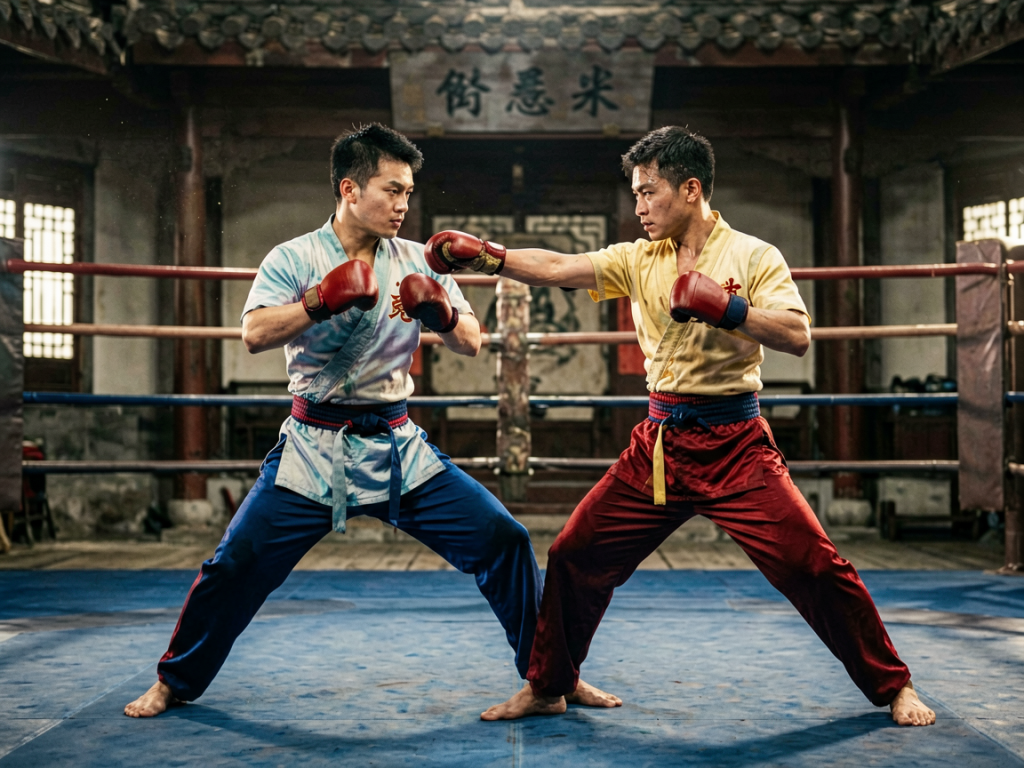
I’ll be honest, I was skeptical at first. When I heard that mixed martial artists were spending their mornings shadow-boxing with wooden dummies instead of sparring, I assumed it was just some weird cultural tourist trap. You know, the kind of thing where you pay fifty bucks to hit a bag while a instructor tells you to breathe harder.
But after eight years living in China, I’ve learned not to judge too quickly. The martial arts scene here is a labyrinth. It’s messy, beautiful, and often confusing. Recently, though, a pattern emerged that caught my eye. Top-tier MMA gyms in Shanghai and Chengdu started opening their doors to traditional practitioners. And not just for photos. They were actually training.
So, I grabbed my notebook and followed them into the shadows of the modern combat world. What I found wasn’t what you’d expect from a Hollywood movie. It was quieter. More technical. And surprisingly effective.
The Strike That Changed Everything
It started with a single punch. Well, technically, it was a series of strikes, but let’s call it what it was: the straight left that shouldn’t have worked. I remember watching a sparring session in a basement gym in Chaoyang District, Beijing. The air smelled like stale sweat and old leather mats.
A fighter named Li, who had been training Muay Thai for five years, stepped into the ring with a guy named Wei. Wei wore a simple white tracksuit. He didn’t look like much. He looked like the uncle who sells tea at the market. But when the bell rang, things got weird.
Li threw a heavy right hand. Wei didn’t block it. He didn’t slip it either. He just angled his body slightly, let the fist miss by an inch, and slapped Li’s arm away with a relaxed, loose wrist. It was called “Peng” in Baguazhang. It felt like hitting water. Liquid water that happens to weigh four hundred pounds.
Then Wei countered. A short, sharp strike to Li’s ribs. Not a haymaker. Just a poke. But it carried the weight of his whole body. Li gasped. His eyes went wide. It wasn’t the pain that shocked him; it was the speed. And the fact that he couldn’t see it coming until it was already inside his guard.
After the round, Li sat on the bench, breathing hard. He looked at me and said, “That’s different.” He was right. It’s different. In MMA, we’re taught to brace for impact. We tighten up. We create a wall. But traditional Chinese martial arts teach you to be the door that swings open.
I asked Wei how long it took him to get that feeling in his wrist. He shrugged. “Ten years,” he said. “Most people quit after two. Their hands hurt too much.”
Why Cage Fighters Are Obsessed With Internal Power
Here’s the thing about modern MMA. It’s optimized. We’ve stripped away anything that doesn’t work. Takedowns? Keep them. Ground and pound? Essential. Striking? Make it efficient. If it doesn’t score points or knock someone out, it’s gone. But in doing so, we might have lost something subtle. Something that helps when the fight gets messy.
Traditional Kung Fu isn’t about efficiency in the Western sense. It’s about structure. It’s about generating power from the ground up, through the legs, spinning the hips, and releasing it through the fingertips or the palm. This is what they call “Fa Jin” or explosive power.
I tried to learn Fa Jin last spring. My instructor, Master Chen, made me stand in a horse stance for forty-five minutes. Just standing. No moving. My quads burned like fire. I wanted to quit. I really did. But then he told me to imagine my feet were roots growing into the concrete floor.
When I finally moved, striking a heavy bag, I didn’t punch with my arms. I pushed with my legs. The bag didn’t just swing; it jumped. Master Chen nodded. “Good,” he said. “Now do it again. And again.”
MMA fighters are realizing that their striking can be stiff. They wind up. They telegraph. Traditional trainers teach them to relax before the hit. Paradoxically, you need to be loose to be hard. Like a whip. If a whip is tight, it’s just a stick. If it’s loose, it snaps.
This is why you see fighters like Zhang Weili incorporating elements of Chinese boxing into her game. She’s not trying to become a Kung Fu master. She’s trying to steal the trick. The trick is unpredictability. And relaxation.
The Golden Finger and The Reality Check
I need to address the elephant in the room. Or rather, the finger. Yes, there is still that myth about the “Golden Finger” piercing a watermelon. Or breaking concrete blocks with pinky fingers. I’m no expert, but I know physics. And I know that most of that is showmanship.
But don’t dismiss it entirely. There is truth in the technique. I watched a demonstration in Shaolin Temple recently. A monk, barely twenty years old, placed his finger on a stack of tiles. He didn’t hit them. He just leaned. The tiles cracked. It wasn’t magic. It was precision. He found the weak point and applied pressure exactly where it mattered.
In a fight, that’s what you want. You don’t always need to throw the biggest punch. You need to hit the nerve cluster. The throat. The floating rib. The solar plexus. Traditional training teaches you to see the body as a map of vulnerabilities, not just a target for damage.
However, there’s a catch. You can’t practice this on a heavy bag. The bag doesn’t care if you hit it correctly. It just swings back. I spent three months training with a partner who wore thick protective gear. We focused on sensitivity drills. Push-hands. Feeling where your opponent’s balance shifts. It’s boring. It’s slow. It’s nothing like the flashy knockouts on ESPN.
But when I went back to sparring, I noticed I wasn’t guessing anymore. I could feel when my opponent was about to throw before they even moved their shoulder. It gave me a split-second advantage. In MMA, that’s everything.
It’s Not About Becoming a Monk
Let’s clarify something important. These fighters aren’t turning into monks. They’re not swearing off meat or living in caves. They’re borrowing tools. Think of it like going to a French bakery to buy croissants. You don’t need to learn how to make dough. You just want the good stuff.
I’ve seen this hybrid approach work wonders. Take the grappling game. Traditional Chinese wrestling, Shuai Jiao, is older than Brazilian Jiu-Jitsu by centuries. It focuses heavily on off-balancing opponents. MMA fighters are studying Shuai Jiao not to learn how to bow, but to learn how to dump a heavyweight without getting crushed in the process.
It’s pragmatic. It’s cold. It’s effective. I saw a fighter use a Shuai Jiao sweep to counter a takedown attempt from a German wrestler. The wrestler went flying. The crowd went silent. Then they erupted. That moment wasn’t scripted. It was the result of months of quiet, unglamorous training in a dusty gym in Tianjin.
The key takeaway here is adaptability. Pure traditionalists often struggle in the cage because they refuse to adapt. Pure MMA fighters sometimes struggle with close-quarters combat because they rely too much on distance management. When you mix them, you get a strange, potent cocktail.
The Sound of Silence in the Gym
There’s a specific sound in a traditional Kung Fu gym. It’s not the roar of crowds or the thud of gloves. It’s the sound of feet sliding on wood. The shush-shush-shush of Bagua steps. It’s meditative. I love it.
I sat in the corner of one such gym in Guangzhou, watching a group of MMA athletes practice footwork. They were sweating profusely. Their faces were grim. They weren’t smiling. They were trying to move without making a sound. Without losing their center of gravity.
One of them, a lightweight named Alex, stopped mid-step. He looked frustrated. “I keep falling forward,” he said. His coach, an old man with a grey ponytail, didn’t say a word. He just walked over and tapped Alex’s lower back. “Soft,” he whispered. “Be soft.”
Alex laughed. He looked at me, embarrassed. “He says I’m too stiff,” Alex explained. “I try to force it. He says force is weakness.”
It’s a tough lesson for Western athletes. We’re conditioned to push. To dominate. To conquer. Traditional Chinese philosophy often teaches yielding. To overcome hardness with softness. It sounds like philosophy class drivel until you’re getting punched in the face. Then it becomes survival.
Why This Matters For You
You might be wondering, “Agnes, why should I care? I don’t fight in cages.” Fair question. But this trend reveals something bigger about how culture is shifting. We’re realizing that our modern solutions aren’t always the best ones. Sometimes, we need to look back to move forward.
Whether you’re into fitness, philosophy, or just curious about China, this intersection of old and new is fascinating. It shows that tradition isn’t dead. It’s evolving. It’s adapting to survive in a brutal, modern world.
I’m genuinely excited to see where this goes. Will we see a new generation of fighters who blend the raw power of wrestling with the fluid grace of Tai Chi? I think so. I’ve seen glimpses of it. I’ve felt it in those quiet moments in the gym.
So next time you watch a fight, look closer. Look past the tattoos and the bright lights. Watch the feet. Watch the hands. See if you can spot the ripple. The subtle angle. The moment where strength meets stillness.
It’s a beautiful thing. And it’s happening right now, in the shadows of China’s busiest cities. Don’t miss it.