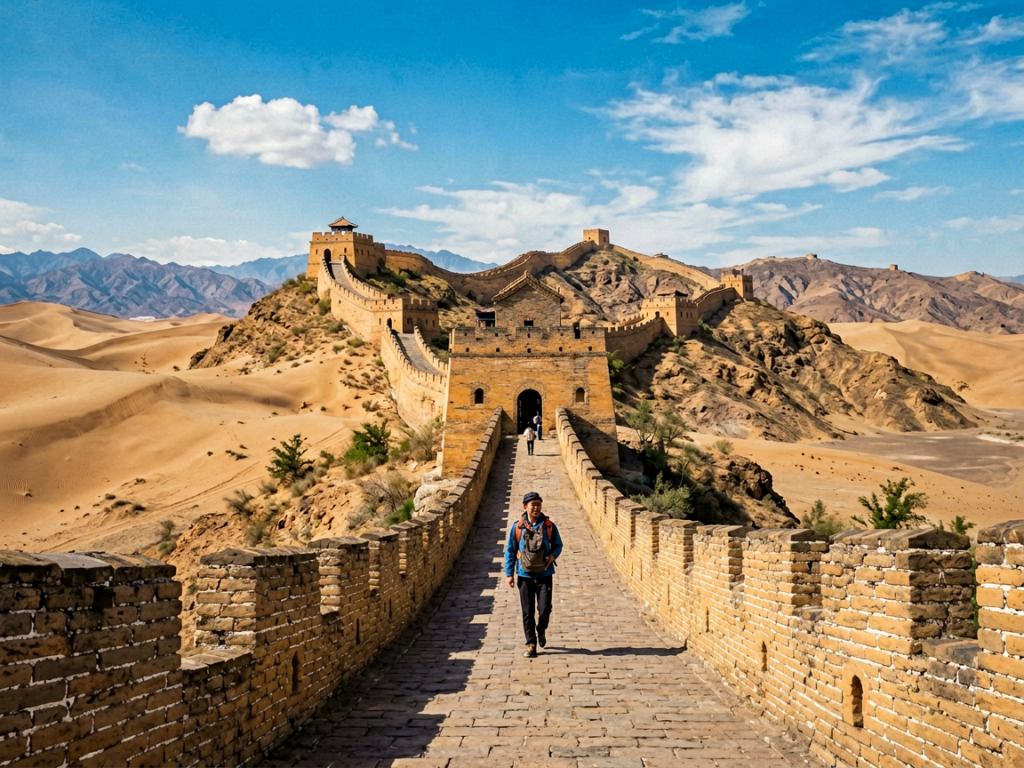
Here’s the thing about China’s Great Wall. Most people go to Badaling. They stand in a sea of selfie sticks, elbowing strangers for a clear shot of a crumbling stone rampart. It’s crowded. It’s touristy. And honestly? It’s a bit of a letdown if you’re looking for the soul of the thing.
I spent eight years living in China, and I’ve seen enough of its history to know that the real magic isn’t in the places everyone goes. It’s in the quiet corners. The dusty towns where the wind howls through ancient gates and the silence feels heavier than the heat.
If you’re serious about Chinese culture, you need to make the detour to Jiayuguan. It’s the westernmost pass of the Ming Dynasty Great Wall. It’s where the empire’s expansion hit a wall–literally and geographically. It’s the end of the line before you hit the vast, unforgiving expanse of the Gobi Desert.
I’m no expert on military strategy, but standing at the Jiayu Pass, I felt the weight of centuries. This wasn’t just a wall; it was a statement. It was China saying, “Here stops the empire. Beyond this is the unknown.” And let me tell you, the unknown is beautiful.
Getting There Is Half The Adventure
First, let’s talk logistics, because Jiayuguan isn’t exactly a hop, skip, and a jump from Beijing or Shanghai. You’ve got to earn your keep to get there. I took the high-speed train from Lanzhou, the capital of Gansu province. It took about two hours. The train is modern, clean, and efficient. But don’t let that fool you.
The landscape outside the window changes the moment you leave the city. The green hills give way to brown earth. Then, the brown turns to yellow. Then, it turns to a stark, dusty grey. The Gobi Desert isn’t just a place; it’s a mood. It’s desolate. It’s empty. And it’s absolutely captivating.
When you arrive in Jiayuguan, don’t expect a bustling metropolis. It’s a small, functional city built on coal and steel. The air smells like dust and diesel. The streets are wide and clean, lined with poplar trees that struggle to survive in the dry wind. It’s not glamorous. But it’s real.
I rented a car for my trip. Trust me, do the same. Public transport here is sparse. You need wheels to get to the remote parts of the pass and the nearby desert. The drive is short, but the scenery is what matters. You’re driving through a land that feels like Mars. It’s easy to forget you’re on Earth.
Walking The Last Rampart
So, you’re at the Jiayuguan Pass. What do you actually do? You walk. You walk the walls. They are steep in places, and the stairs are uneven. The sun is fierce. There’s no shade. But the view? It’s unmatched.
I remember standing on the main tower, looking west. I could see the Hexi Corridor stretching out behind me, a thin green ribbon of life sandwiched between two deserts. To the north and south, it was just endless dunes and rock. The isolation is palpable. You feel small. You feel ancient.
The architecture here is different from the sections near Beijing. It’s made of rammed earth, yellow clay, and red sandstone. It’s battered by the wind. It’s scarred by time. But it’s still standing. That resilience speaks to me. I ran my hand along the rough wall. It was warm. It felt alive.
There’s a specific spot near the western gate where the wind picks up. It howls through the arches, creating a low, mournful sound. Locals call it the “Ghost Wind.” I stood there for ten minutes, just listening. I thought about the soldiers who stood here centuries ago. They were alone. They were cold. They were scared. And they held the line.
It’s not a pretty tourist experience. It’s gritty. It’s raw. And that’s why I love it. You’re not just looking at a monument; you’re feeling the history. You’re breathing the same air as the Ming Dynasty guards. Sound interesting? It is.
Desert Camels And Starry Nights
After exploring the pass, head to the nearby desert area. It’s a short drive away. This is where you meet the camels. And no, I don’t mean the cute, petting-zoo camels you see in theme parks. I mean the Bactrian camels. The two-humped beasts of the Gobi.
I hired a local guide, an old man named Li, who’s been herding camels for forty years. He spoke broken English, but his eyes were sharp. He showed me how to feed the camels. They’re gentle giants. Their breath is hot. Their fur is thick. They don’t care about your Instagram feed. They care about the grass.
We took a short ride into the dunes. The sand is golden. It shifts under the camel’s feet. The silence out here is different. It’s not empty; it’s full. It’s the sound of the earth breathing. Li pointed to the horizon. He said the desert was alive. I believed him.
That night, we stayed in a simple guesthouse. The rooms were basic. No frills. But the sky? The sky was insane. Away from city lights, the Milky Way stretches across the heavens like a spilled bucket of diamond dust. I lay on the roof, shivering in the cold desert air, staring up. I felt incredibly lucky. And incredibly insignificant. Both at the same time.
Food in Jiayuguan is another highlight. It’s a mix of Northwest Chinese flavors. Heavy on the lamb. Heavy on the cumin. I had a lamb skewer at a roadside stall. The meat was tender. The spice was fiery. It was the best thing I ate all trip. I drank a local beer, cold and crisp, to wash it down. It tasted like victory.
Why You Should Go Now
I could be wrong, but I think Jiayuguan is underappreciated. Most tourists rush through Gansu to get to Dunhuang and the Mogao Caves. They don’t stop here. They miss the end of the wall. They miss the desert. They miss the silence.
But if you take two days, you’ll see something different. You’ll see the grit of China’s interior. You’ll see the strength of its history. You’ll see the beauty of its emptiness.
It’s easier than you’d think to plan a quick getaway. Fly into Lanzhou. Take the train to Jiayuguan. Rent a car. Stay two nights. Explore the pass. Ride a camel. Eat the lamb. Sleep under the stars. It’s a simple itinerary. But it’s the kind of travel that sticks with you.
I’m not saying this will change your life. But it might change your perspective. In a world that’s always loud, always connected, always busy, the Gobi Desert offers a rare gift. It offers space. It offers quiet. It offers a chance to just be.
So, skip the crowds at Badaling. Skip the packaged tours. Go to the end of the wall. Go to Jiayuguan. The desert is waiting. And trust me, it’s worth the detour.