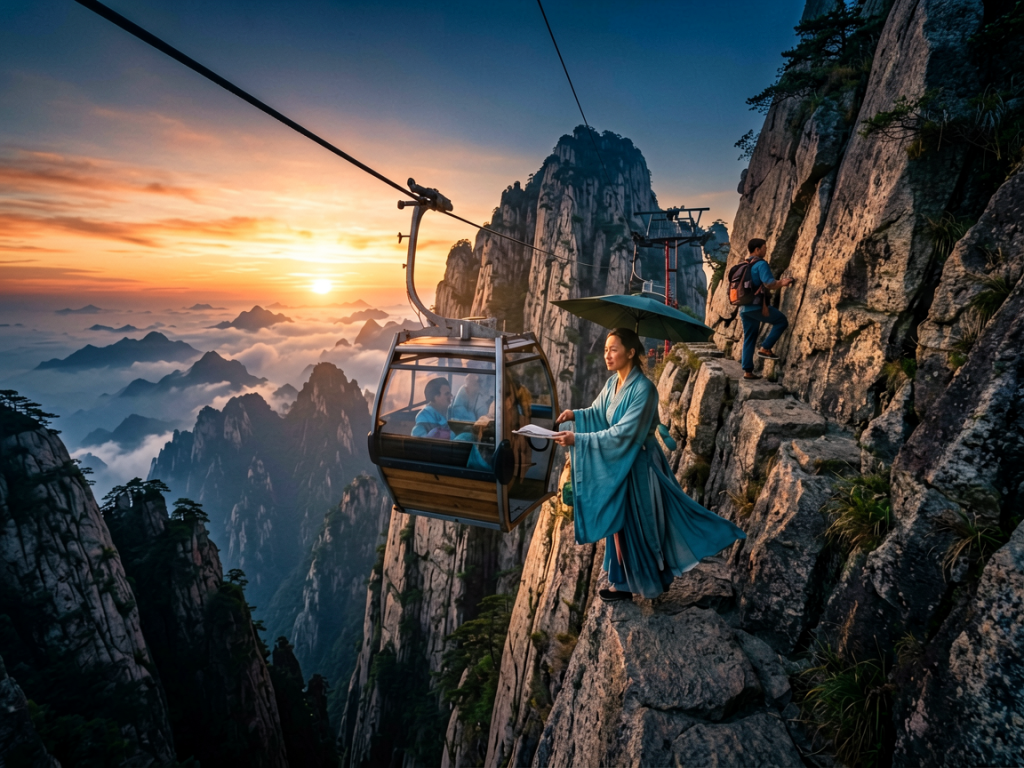
Look, I’ll be honest. When my Chinese friend first suggested we hike Mount Tai (Tai Shan) at 2 AM, I almost laughed in his face. It was summer. The humidity in Jinan was thick enough to chew on. My idea of a good time was a cold beer and a ceiling fan, not ascending a mountain in the dark while my legs were still trembling from the previous day’s sightseeing.
But here’s the thing about China. You don’t just visit. You participate. And there are few rituals more deeply ingrained in the cultural fabric than climbing Tai Shan to see the sunrise.
It’s not just a hike. It’s a pilgrimage. It’s a test of endurance. And honestly? It completely changed how I view travel in this country.
If you’re thinking about booking a cable car because you value your knees, stop. I did that too, on my second trip. And let me tell you, it’s like eating instant noodles when you could have had a five-course meal. You’re missing the point entirely.
The Weight of History
Tai Shan isn’t just a mountain. It’s the oldest of the Five Great Mountains, and it’s been sacred for 3,000 years. Emperors came here to perform sacrifices to heaven and earth. Confucius stood on its peak and felt small. That’s a lot of pressure for a pile of rocks.
When you stand at the base in Dai Temple, you’re not just looking at a trail. You’re looking at a staircase carved into the history of civilization. The stone steps are worn smooth in the middle by millennia of sandals, boots, and bare feet. It’s eerie and beautiful.
I remember reading that the mountain has over 60,000 steps from the bottom to the summit. I didn’t believe it. I thought it was an exaggeration, like saying a bag of chips has 500 calories. But as I started my ascent, the number started to make sense.
The air gets thinner as you go up, but the density of history gets thicker. You pass temples clinging to the cliffs like barnacles. You see inscriptions carved into the rock faces that date back to the Han Dynasty. It’s not just scenery; it’s a library of stone.
Most tourists skip this part. They zoom up in a bus or a cable car. They take a selfie at the top and zoom back down. They miss the silence. They miss the weight of it all. I’m no expert on Taoism or Confucianism, but you can feel the reverence in the air. It’s heavy. It’s real.
The Dark March
So, why do it at night? Why suffer through the dark?
The simple answer is the sun. The sunrise from the Golden Summit (Jinggang) is legendary. But the complicated answer is the company.
I expected to be alone in the dark. I was wrong. The mountain is packed. It’s a sea of headlamps and phone flashlights bobbing up the switchbacks. It’s like a slow-moving ant colony, but with more complaints and fewer ants.
There’s a strange camaraderie in shared suffering. When you’re halfway up, gasping for air, your legs burning, you start talking to strangers. In my home country, talking to strangers is a one-way ticket to jail. Here, it’s the social norm.
I met a group of students from Beijing. They were singing folk songs to keep their spirits up. I met an elderly couple who had climbed it every year for twenty years. The husband was wheezing, but he wouldn’t let his wife carry her water bottle. I met a solo traveler from Germany who had done it three times and was crying happy tears because the view was worth the pain.
It’s not intimidating. It’s inclusive. Everyone is there for the same reason. Everyone is struggling. It breaks down barriers faster than any dinner party ever could.
Just make sure you have a headlamp. The path is steep and uneven. Tripping over someone’s backpack in the dark is a common tragedy. I watched a guy tumble past me. He got up, brushed off his pants, and kept going. No drama. Just determination. That’s the Tai Shan spirit.
The Ascent: Legs of Lead
Let’s talk about the physical toll. It’s brutal.
The first few hours are deceptively easy. You’re warm from the exertion. The adrenaline is high. You’re chatting with your new friends. Then, around 3 AM, the reality sets in.
Your legs turn to lead. Your lungs burn. The cold mountain air bites at your exposed skin. You start questioning every life choice that led you to this moment. Why didn’t I take the cable car? Why did I eat that spicy hotpot last night? Will I ever walk again?
There’s a section called the “Eighteen Bends.” It’s exactly what it sounds like. A series of tight, steep switchbacks that seem to go on forever. I’ve hiked in the Alps. I’ve climbed in the Andes. This is different. It’s not just the altitude. It’s the psychological weight of knowing there are still 2,000 steps left.
But here’s the trick. You don’t think about the 2,000 steps. You think about the next three. Then the next three. You find a rhythm. Step, breathe. Step, breathe. It becomes a meditation. A moving meditation.
I stopped checking my watch. I stopped counting calories. I just focused on the person in front of me. If they were moving, I was moving. If they stopped, I stopped. It’s a collective effort. We’re all in this together.
And the views? They’re sparse at night. Just glimpses of the valley below, dotted with the lights of Jinan. It’s like looking down at a galaxy. It’s quiet. It’s peaceful. It’s a stark contrast to the noise of the city we left behind.
The Payoff
You reach the summit area around 4:30 AM. The air is freezing. The wind is biting. Everyone is shivering, huddled in jackets bought from street vendors for ten yuan.
There’s a queue for the best viewing spots. It’s a crush of bodies. But nobody is angry. We’re all waiting. Waiting for the same thing.
The sky starts to lighten. A deep, bruised purple fades into a soft orange. The clouds below us churn like a sea. It’s dramatic. It’s cinematic. It’s better than any movie I’ve ever seen.
Then, the sun breaks through. A single beam of light hits the horizon. Then another. The golden dome of the mountain ignites. The clouds below turn into a sea of gold.
I didn’t clap. I didn’t cheer. I just stood there. My legs were shaking. My face was numb. But my heart was full. It’s one of those moments you can’t explain to people who weren’t there. You have to see it to believe it.
It’s not just a sunrise. It’s a renewal. It’s a reminder that you can endure discomfort for something beautiful. It’s a lesson in patience. In China, this is a common theme. The process is often more important than the destination.
Practical Tips for the Ascent
If you’re planning to do this, here’s some advice from someone who learned the hard way.
First, don’t buy your tickets at the last minute. The mountain has capacity limits. I’ve seen people turned away because the quota was full. Book online in advance. Use the official WeChat mini-program. It’s efficient and saves you a headache.
Second, bring cash. While WeChat Pay is king, some small vendors at the mountain top still only take cash. The prices at the top are inflated, but that’s the law of supply and demand. A bottle of water might cost you 20 yuan instead of 2. Don’t be shocked. It’s part of the experience.
Third, dress in layers. The base is hot. The summit is freezing. I wore a t-shirt at the start and a down jacket at the top. Take off the layers as you go up. Don’t be a hero and freeze. Hypothermia is real, even in summer.
Fourth, bring snacks. The stairs are steep. You need energy. I recommend high-calorie, lightweight food. Chocolate, nuts, energy bars. Don’t bring heavy water bottles. Fill up at the stations along the way. They’re frequent.
And finally, respect the mountain. It’s a sacred place. Don’t litter. Don’t shout. Keep your voice down. The locals appreciate quiet reverence. It shows you understand the significance of the place.
Why You Should Do It
I could be wrong, but I think modern travel has become too comfortable. We want the convenience of the cable car. We want the comfort of the hotel. We want the efficiency of the high-speed train.
And that’s fine. But where’s the grit? Where’s the struggle?
Climbing Tai Shan at night forces you to slow down. It forces you to confront your limits. It connects you to the land in a way that sitting in a bus never will.
You smell the pine trees. You feel the rough stone under your hands. You taste the sweat and the cold air. You hear the breathing of the people around you.
It’s raw. It’s real. It’s alive.
I’ve traveled to dozens of countries. I’ve seen the Northern Lights in Iceland. I’ve hiked Machu Picchu in Peru. I’ve watched the sunrise in Bali.
None of them compare to this. Not because the view is more spectacular (though it is). But because of the context. Because of the history. Because of the effort.
Tai Shan demands something from you. It asks for your sweat, your time, your endurance. And in return, it gives you a memory that will last a lifetime.
So, next time you’re in Shandong, don’t just drive up the mountain. Walk up it. Do it at night. Wake up early. Suffer a little.
You won’t regret it. I promise. When you stand at the top, watching the sun rise over a landscape that has inspired emperors and poets for millennia, you’ll understand. You’ll feel small. And you’ll feel connected. And that’s a feeling you can’t buy with a cable car ticket.
Just bring good shoes. And a sense of humor. You’ll need both.