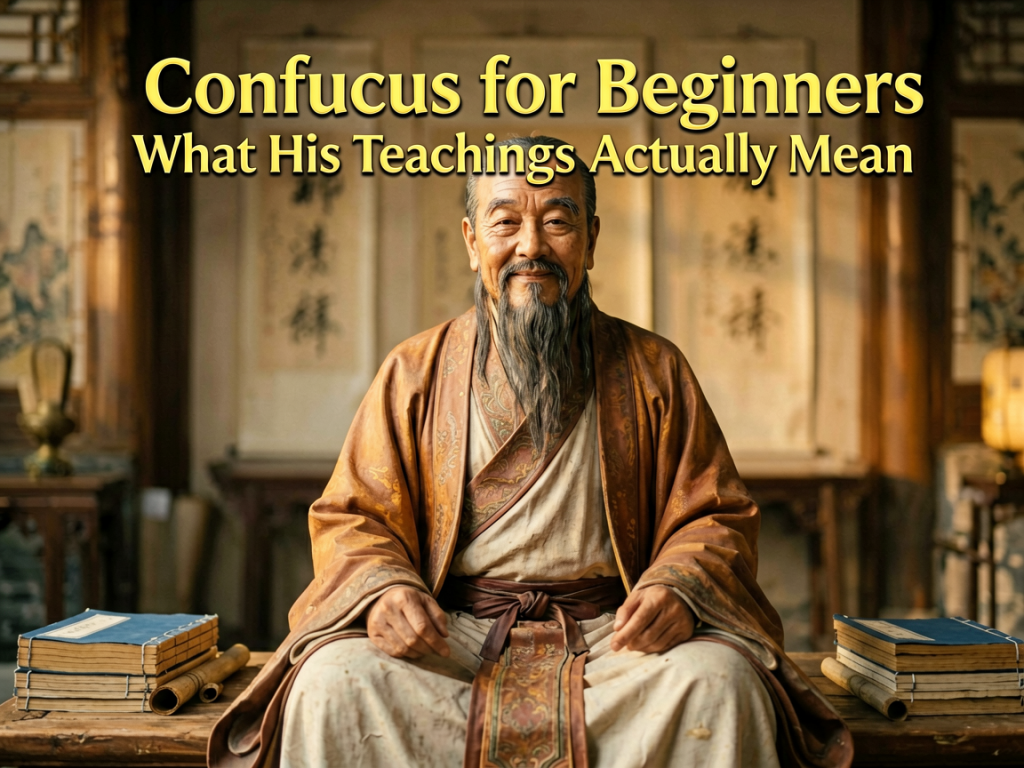
Honestly, when I first moved to Beijing, I thought I knew what Confucius was. I’d seen the statues. I’d heard the word guanxi thrown around in every business meeting. I even had a t-shirt with his face on it that looked suspiciously like a disgruntled owl.
I was wrong. So wrong.
For the first few months, I treated Confucianism like some outdated relic, a bunch of moral instructions from a guy who probably hated fun. I was an outsider trying to understand the invisible grid that holds Chinese society together. It felt stiff. Rigid. Like wearing a suit that doesn’t fit quite right.
But then, something clicked. It wasn’t a lightning bolt moment. It was more like slowly realizing why everyone keeps holding the door open for the person behind them, or why dinner bills get fought over so aggressively.
If you’re looking to understand modern China without getting bogged down in academic jargon, you need to look at Confucius differently. He’s not just a philosopher from 2,500 years ago. He’s the operating system running in the background of daily life. And trust me, once you see it, you can’t unsee it.
It’s Not Just About Being Polite
Here’s the thing that trips most Westerners up. They hear “Confucian values” and immediately think of bowing, saying please, and standing up for elders. Sure, those things happen. But that’s the surface level stuff.
The core of Confucius’s teaching isn’t really about manners. It’s about roles. It’s about understanding exactly where you stand in relation to everyone else, and acting accordingly.
Think about your last family reunion or a big office gathering back home. You know exactly how to act around your boss versus how you act around your college roommate. You shift your tone. You change your posture. That’s Confucianism in action.
In China, this hierarchy isn’t just social etiquette; it’s considered essential for harmony. If everyone knows their role and plays it well, the group functions smoothly. Chaos ensues when people step out of line.
I remember sitting in a tea house in Chengdu, watching a young manager serve tea to his senior colleague. The junior guy held the pot with both hands, pouring carefully so no drops spilled. It wasn’t servitude. It was respect for the structure. And surprisingly, it made the whole team feel secure.
You might find this stifling at first. It definitely felt that way to me. But after living here for years, I’ve come to appreciate the stability it provides. It takes the guesswork out of relationships. You don’t have to wonder if you’re disrespecting someone if you stick to the recognized protocols.
Ren Is Way More Than Kindness
Let’s talk about ren. This is probably the most famous Confucian concept. Most translation apps will tell you it means “benevolence” or “humaneness.” Those words feel pretty dry, don’t they?
To me, ren is basically empathy with muscle. It’s the active desire to be good to others because you recognize their humanity.
Confucius taught that you start with your family. If you can’t treat your parents with genuine care, how can you expect to care about strangers? It’s a ripple effect. The closer the relationship, the stronger the duty.
I saw this play out in real time during the pandemic lockdowns in Shanghai. Neighbors who barely spoke before suddenly organized delivery runs for each other. They were sharing medicine, food, and news. It wasn’t charity. It was ren in practice. It was recognizing that our fates were linked.
This focus on relational ethics changes how you view individual rights. In the West, we often prioritize the self. In Confucian thought, the self is defined by its connections to others.
Does that mean you lose your identity? Not necessarily. It just means your identity is tied to how well you fulfill your responsibilities to the people around you.
When I started asking my Chinese friends about their biggest worries, they rarely talked about career advancement or personal freedom. They talked about letting their families down. Or failing their friends. That shift in priority is massive.
It’s easier than you’d expect to adopt a bit of this mindset. Just check in with your inner circle before checking your social media feed. See if anyone needs help. That’s ren. Simple, but profound.
The Art of Doing Things Right
There’s another concept that gets misunderstood a lot: li. People translate this as “ritual” or “ceremony,” which sounds boring. And sure, there are ceremonies involved.
But li is really about the proper way to do things. It’s the script for social interaction. It’s knowing how to eat with chopsticks without making a sound. It’s knowing how to gift money in a red envelope so you don’t accidentally insult the recipient.
I learned this the hard way. Early on, I went to a dinner party and handed a gift card directly to the host. A mistake. The host looked uncomfortable. Later, a friend explained that giving cash or cards directly can feel transactional, like you’re paying off a debt. It’s better to give something tangible, like fruit or wine, wrapped nicely.
Li ensures that interactions are smooth. It removes friction. When everyone follows the same unwritten rules, you avoid awkwardness.
This applies to business too. Contracts matter, sure. But the handshake matters more. The shared meal matters more. If you skip the li, you haven’t really built trust.
Some people argue that rituals are just superficial. I disagree. Rituals shape behavior. By forcing you to slow down and perform a specific action, they remind you of your respect for the other person.
It’s better than most alternatives because it builds consistency. You can’t fake li forever. Eventually, the form becomes the substance. You start caring because you’re practicing the care.
Guanxi Isn’t Corruption
We need to address the elephant in the room. Guanxi. Everyone hears this word and thinks “bribery.” Or “favors.” Or “the backdoor.”
That’s a lazy interpretation. While corruption exists, guanxi is fundamentally about social capital and reciprocal obligation.
Think of it as a long-term investment in relationships. If I help you move house today, you owe me. Not immediately, maybe not ever in dollars and cents, but the debt exists. And when you’re in a tough spot, I’ll help you.
This network of mutual support is what makes life run in China. You can’t just walk into a hospital and expect to see a specialist easily. You need a connection. You need someone who knows the doctor.
Is it unfair? Sometimes. But it’s also deeply human. We all rely on friends and family. Guanxi just scales that up to a societal level.
I’ve found that treating guanxi as a web of genuine care rather than a transactional marketplace changes everything. When you build trust over years, not minutes, the benefits compound.
Don’t try to buy your way in. Spend time with people. Show up. Remember their birthdays. Help them when they’re struggling. That’s how you build guanxi.
Why This Still Matters Today
You might be thinking, “Okay, but does any of this actually affect my life?”
Absolutely. Even if you never visit China, understanding these principles helps you make sense of global politics, business trends, and cultural clashes.
Many conflicts between East and West stem from these exact differences. One side values individual autonomy. The other values collective harmony.
Neither is right. Neither is wrong. But knowing *why* people act the way they do saves you a lot of frustration.
I used to get annoyed when my Chinese colleagues wouldn’t speak up in meetings. I thought they were passive. Now I know they were waiting for the right hierarchy to be established, for the right role to be filled.
Once I understood that, I stopped pushing them to be louder. Instead, I created spaces where they felt safe to contribute within the structure. The results were much better for everyone.
Confucius wasn’t trying to control people. He was trying to create a world where people could live together peacefully. That’s a goal worth striving for, no matter where you are.
Start Small
You don’t need to memorize the Analects to start living by Confucian principles. In fact, that would probably backfire.
Just start paying attention to your relationships. Who are you responsible to? How can you show them respect?
Try holding the door. Try listening more than you speak. Try remembering that small detail about your friend’s kid’s soccer game.
It sounds cliché. I’m no expert, but these tiny acts of ren and li add up. They build the trust that holds communities together.
And honestly? It feels good. You feel connected. You feel like part of something larger than yourself.
That’s the secret of Confucius. He didn’t promise enlightenment. He promised harmony. And in a chaotic world, that’s a pretty good deal.
I’ll be honest, I’m still learning. I still mess up the tea pouring sometimes. I still forget whose turn it is to pay. But I’m trying. And that’s what counts.
So, next time you see a statue of an old man looking stern, don’t just walk past. Give him a nod. He’s been waiting for you to catch up.