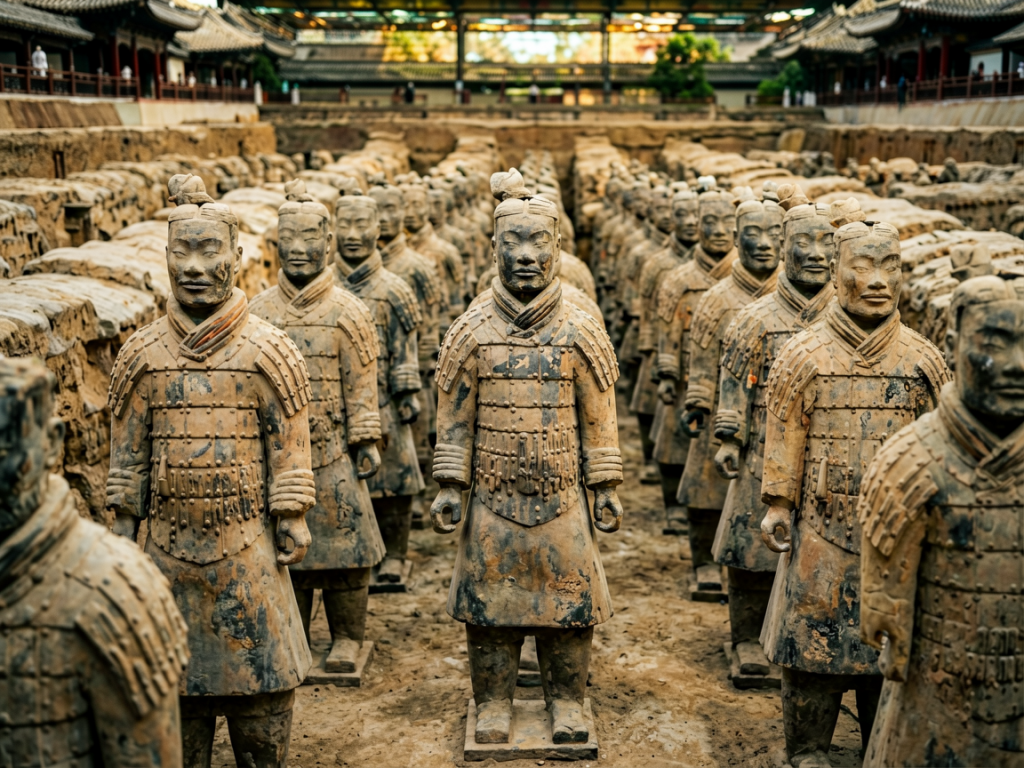
I still remember the first time I saw them. I was standing in Pavilion No. 1, the air thick with the humidity of a Xi’an summer and the murmur of thousands of tourists. The sun was filtering through the high roof, hitting the dusty pits, and suddenly, the scale of it just knocked the wind out of me. You’d think it would feel majestic. Maybe a little awe-inspiring.
Instead, it felt eerie. Like walking into a graveyard that forgot to close.
Everyone knows the basics, right? Qin Shi Huang, the First Emperor, built an army to protect him in the afterlife. Six thousand clay figures. Horses, chariots, generals. It’s the most famous archaeological find in China. Or at least, it’s the one that puts Xi’an on the map. But if you dig a little deeper–past the gift shops selling little clay heads and the audio guides reciting the same script–you’ll find a story that’s way weirder than history class ever let on.
Honestly, the official narrative is a bit of a polished myth. The real story is messy, violent, and deeply human. And it’s far more interesting.
The Emperor Who Hated Death
Let’s talk about Qin Shi Huang. Most history books paint him as a tyrant, which he definitely was. But to understand the Warriors, you have to understand his obsession. This guy didn’t just want to rule China while he was breathing. He wanted to rule forever. And he was terrified of dying.
So, he didn’t just build a tomb. He built a mini-universe. I spent a week in Xi’an last year just walking around the Lishan mountain area, and the sheer scale of his paranoia is staggering. He wasn’t just collecting stuff; he was trying to replicate his empire in the dirt.
Here’s the thing about Qin Shi Huang: he wasn’t a philosopher king like Confucius. He was a legalist. He believed in strict laws, harsh punishments, and absolute control. When he died in 210 BC, he didn’t leave behind a legacy of wisdom. He left behind a legacy of fear. And that fear is baked into the clay.
Think about it. These aren’t cute, cartoonish soldiers. They’re grim. Their expressions are serious, almost bored. They look like they’ve been drafted against their will. And in a way, they were.
Not Clay, But Craftsmanship
I’ll be honest, I expected the statues to look uniform. You’d think an emperor with infinite resources would want his army to look exactly alike. Like clones. But when you get close–really close, like within arm’s reach–you’ll see something surprising.
Every single face is different.
I asked a local guide about this. His name is Wei, and he’s been working in the museum for twenty years. I pointed to a warrior and asked, “Is that the same model as the one next to him?” He laughed. “No,” he said. “That’s a portrait. They used real soldiers as models.”
It’s a haunting thought. Imagine being a conscript from the state of Zhao or Chu, dragged hundreds of miles to the capital. You’re forced to stand still for months while artisans sculpt your face into clay. Then, you’re killed–literally–to be buried with your own likeness. It’s grim, but it’s also incredible artistry.
The colors are another shocker. Most people see them in the museum, and they look brown. Terracotta, hence the name. But when they were first unearthed, they were painted in bright, vivid colors. Red, blue, green, pink. The Museum has special rooms now where you can see fragments of that original vibrancy. It’s like looking at a war that’s still bleeding.
The paint was made from mineral pigments. But here’s the twist: the paint was applied to a lacquer layer. And lacquer dries fast. When the tombs were exposed to air thousands of years ago, the humidity change caused the lacquer to curl and peel within minutes. So, we’re seeing the faded, brown versions. The real warriors were technicolor nightmares.
The Dark Secret of the Workers
This is where it gets weird. And I mean really weird. You don’t hear this on the bus tours.
For decades, archaeologists have found something disturbing in the pits. Bones. Human bones. Not just the soldiers, but civilians, artisans, maybe even the craftsmen who made the statues.
I visited the excavation site for Pit No. 3, the command center. It’s smaller, quieter. The floor is paved with stone slabs. But under those slabs, in the surrounding trenches, we’ve found mass graves. It suggests that the people who built the tomb weren’t just buried with it to keep the secrets. They were sacrificed.
Human sacrifice was old hat in ancient China. But the scale here is hard to wrap your head around. Estimates suggest hundreds, maybe thousands, of people were killed to accompany the Emperor. It’s not just a tomb; it’s a crime scene.
I found myself staring at the silence of the pit and wondering about the noise of its construction. The noise of chisels, the shouting of overseers, the screams of the victims. The silence now feels heavy. Oppressive.
And then there’s the question of the horses. The horses are mostly stone and wood, not clay. They’re real animals, preserved in the earth. But the horses were likely real horses too, killed and buried with the army. Can you imagine the smell? The sheer volume of organic matter decaying in a sealed underground chamber?
It’s not a romantic place. It’s a industrial-scale slaughterhouse for the afterlife.
The Chemical Poison
Here’s another detail that’ll make you pause. The soil around the tomb is saturated with mercury. High levels. Like, toxic levels.
I remember reading a report on this years ago and thinking it was an exaggeration. But geologists have confirmed it. Rivers of liquid mercury, mapped out in the tomb’s layout, representing the Yellow River and the Yangtze. It’s a celestial map underground.
But mercury is poisonous. It’s volatile. It’s a heavy metal that messes with your brain. So, the Emperor didn’t just want to be buried with an army. He wanted to be buried in a chemical weapon.
I asked Wei if he worried about the toxicity. He shrugged. “We wear masks,” he said. “But the Emperor? He took pills for immortality. Mercury pills. Cinnabar, actually. Which is mercury sulfide. He ate it until his body shut down.”
So, the man who built the most impressive funeral in history killed himself with his own medicine. And now, his tomb is a radioactive hazard zone for archaeologists. It’s poetic justice, or maybe just bad luck. Either way, it’s a reminder that power doesn’t protect you from biology.
Why It Matters Now
I know what you’re thinking. “I’m just here for the photos.” And that’s fine. The Warriors are Instagram gold. But there’s a deeper layer here that connects to modern China.
Qin Shi Huang unified China. He standardized the writing system, the currency, the weights. He built the roads. He created the concept of “China” as a single political entity. Everything we see today, from the bureaucracy to the unity of the state, traces back to him.
When I walk through Xi’an, I see the modern city–the malls, the high-speed trains, the neon lights. But underneath it all, there’s this ancient weight. The idea that the state is bigger than the individual. That order is more important than freedom. That legacy lasts longer than life.
The Warriors are a monument to that philosophy. They’re not just soldiers. They’re a statement. A statement that says, “I will be remembered. I will be eternal. And I will control you, even in death.”
It’s chilling. But it’s also the reason these figures are still standing. They’re not just art. They’re a testament to the human desire to cheat death.
The Unfinished Army
Here’s the final twist, and it’s the one that stays with me. The Warriors are incomplete.
We’ve only excavated a small fraction of the tomb complex. And within the pits themselves, many of the statues are just heads or legs. Some are unfinished sketches in clay. The rebellion broke out shortly after the Emperor’s death. The workers turned on their masters. The tomb was looted. The project stopped.
So, what we’re looking at is a snapshot of chaos. An empire collapsing in real-time, frozen in clay. The soldiers are poised for battle, but the war they were fighting never happened. They died for a dream that dissolved the day their boss breathed his last.
I stood there, looking at a warrior with no torso, just a head and upper chest, and I felt a weird sense of solidarity. We’re all just waiting for something to finish. Waiting for the next chapter that might never come.
It’s a humble perspective, especially when you’re surrounded by the grandest ego trip in human history.
Go See It, But Look Closer
So, go to Xi’an. Buy the ticket. Stand in Pavilion No. 1. Take the selfie. It’s worth it. The scale is undeniable. The craftsmanship is mind-blowing.
But don’t just look at the front row. Look at the cracks. Look at the different faces. Listen to the silence. And remember the people who made them. Remember the people who were killed to make them. Remember the man who ate mercury to live forever and ended up as a pile of dust.
The Terracotta Warriors aren’t just a tourist attraction. They’re a warning. And a masterpiece. And a mystery.
Trust me, once you see them, you won’t forget them. Not the brown clay. But the blood, the paint, and the poison underneath.
That’s the real story. And it’s way better than the brochure.