Honestly, I’ve eaten my fair share of dumplings in my eight years living here. I’ve had them on street corners in Beijing, tucked into alleyways in Xi’an, and even tried my hand at making them myself in a tiny apartment kitchen that smelled like garlic and regret for three days straight.
But nothing–absolutely nothing–compares to the anxiety-inducing ritual of eating proper Shanghai xiaongbao. It’s not just food. It’s a test of patience, dexterity, and nerve. You’re sitting there with a steaming plate, knowing that one wrong move and you’ve got soup on your shirt, not in your stomach.
If you haven’t mastered the technique yet, don’t worry. I’m still working on it. But let’s talk about why this specific dumpling is such a culinary beast to perfect, and where you should go if you want to experience the real deal.
The Anatomy of a Soup Bomb
To understand why xiaolongbao is so hard to make, you have to look past the dough. Anyone can roll out dough. Anyone can boil water. The magic–and the misery–lies in the skin and the broth.
Traditional hand-pulled skins are thin, almost translucent, yet strong enough to hold liquid. They require a skill set that usually takes years to develop. Most modern places use machines or semi-frozen dough to keep costs down. That’s fine for a quick bite, but it’s not the same.
The filling is another story. In Shanghai, the meat isn’t just pork. It’s a gelatinous paste made from pork skin that’s been boiled down into a jelly. This jelly gets mixed with the minced meat. When you steam it, the jelly melts back into soup.
This means the dumpling is half-solid, half-liquid before it even hits your mouth. If the ratio is off, you get a dry bun. If the skin is too thin, it bursts. Too thick, and it tastes like raw flour. It’s a delicate balance that requires precision.
I once watched a master chef in Yuyuan Garden make these in front of me. She folded exactly eighteen pleats into each bun. Not seventeen. Not nineteen. Eighteen. She moved with a rhythm that looked like dance. I tried to count them, but I lost track by the fourth one. It was mesmerizing.
The Pleat Problem
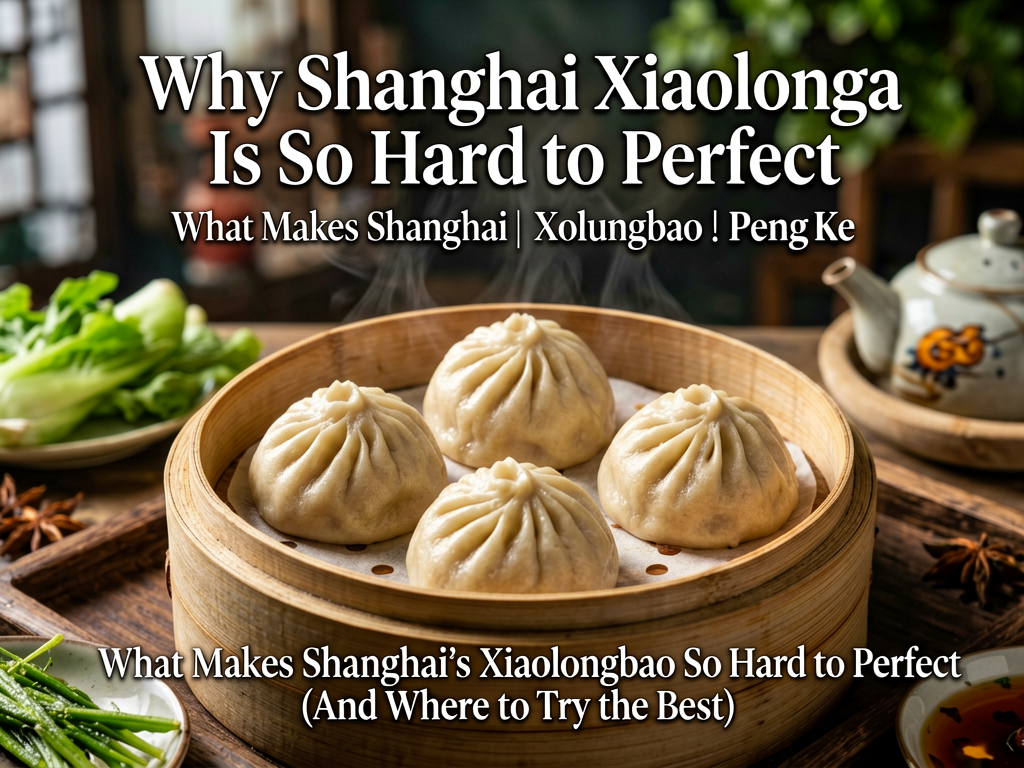
Let’s talk about those pleats. They aren’t just for show, although they definitely add to the aesthetic appeal. Those folds trap the steam inside while allowing excess pressure to escape gently. They create the structure that holds the soup.
Most tourist traps skip the hand-folding entirely. They use molds or just pinch the dough shut. The result? A flatter, denser dumpling with less surface area for flavor. You lose that airy texture that defines a great xiaolongbao.
When I first started eating here, I didn’t notice the difference. I just ate what was in front of me. It wasn’t until I went to a small, unmarked shop in Jing’an district that I realized how much I’d been missing.
The owner doesn’t speak much English. He doesn’t need to. You watch him work. His hands move faster than I can see. He pinches, twists, and seals. Each one looks identical. That uniformity is hard-won.
If you see a place where the buns look slightly different sizes or shapes, run. Or at least hesitate. Consistency is key. It shows they care about the process, not just the output.
Eating Etiquette: Don’t Be That Tourist
Okay, here’s the part where people mess up. And I mean everyone does it at first. You bring the plate to the table. The server leaves. You pick up the dumpling with your chopsticks. You put it in your mouth. Boom. You’ve burned your tongue and stained your shirt.
There’s a protocol. Learn it. Respect it. It makes the experience ten times better.
First, you need vinegar. Black vinegar, preferably with ginger strips. Pour a little bit onto your small dipping saucer. Don’t drown the dumpling; just get the base wet.
Next, lift the dumpling gently. Place it in the center of the saucer. Bite a tiny hole in the side. This is crucial. Do not bite the top. If you bite the top, all the soup will pour out before you can drink it. That’s a mess we don’t need.
Sip the soup slowly. Let it cool down a bit. Taste the pork and the gelatin. Then, eat the rest of the dumpling. Dip it in the vinegar and ginger if you like. Eat it in one or two bites. Chewing too much breaks the skin and lets the remaining juice escape.
It sounds complicated, but after two or three plates, it becomes muscle memory. I still mess up occasionally, especially when I’m tired. But I’ve learned to slow down. Rushing ruins the flavor.
I remember a trip with friends to a busy spot near The Bund. We were hungry and excited. One guy just grabbed two and bit into them immediately. He spat them out because they were too hot. We laughed at him, but he didn’t get it. Now he’s the first one to ask for instructions.
Where to Find the Real Deal
So, where should you go? There are hundreds of options. Some are chains. Some are hidden gems. Here are a few that stand out.
Jia Jia Tang Bao in Huangpu is legendary. It’s small. It’s always crowded. The lines can be long, but they move fast. The buns are hand-folded and incredibly juicy. Prices are reasonable for the quality. Expect to pay around 30 to 50 RMB per plate depending on the size.
I’ve been going there for years. The owner recognizes regulars. It feels personal. The staff won’t judge you if you ask for extra ginger. They’re used to foreigners who don’t know the rules yet.
Another favorite is Nanxiang Steamed Bun Restaurant in Yuyuan Garden. It’s touristy, yes. But the history is real. This is where the style originated. The buns are slightly larger and the skin a bit thicker. It’s a different texture, but still excellent.
Go early. Lunch crowds are insane. Dinner is better but still busy. If you can, try the vegetarian version. It’s surprisingly good. Mushroom and bamboo fillings hold up well against the delicate skin.
For something more upscale, check out He Bao Gao Dian. It’s located in a nice hotel setting. Service is impeccable. The buns are perfect every time. But you’ll pay double what you would elsewhere. It’s worth it for a special occasion, or if you want to impress a client.
Don’t sleep on street stalls either. In old neighborhoods like Xintiandi or Fuxing Road, you’ll find small carts selling fresh batches. They might not have the fancy presentation, but the taste is often superior. Look for steam rising from the baskets. That means they’re fresh.
The Secret Ingredient: Timing
You might think the secret is in the recipe. And sure, the broth mix matters. But timing matters more.
Xiaolongbao are best eaten immediately after steaming. They sit for more than five minutes, the skin starts to dry out. The soup congeals. The texture changes completely.
In Shanghai, restaurants understand this. They cook in batches. They send them out hot. If you wait too long between orders, you’re eating cold leftovers disguised as fresh food.
I’ve had bad experiences waiting for a second batch. By the time it arrived, the buns were sticking together. The steam had escaped. It was sad. Always order when you’re ready to eat. Don’t hold back.
This applies to everything in Chinese cuisine, really. Freshness is paramount. Meat should be tender. Vegetables crisp. Noodles al dente. If you see a pile of buns sitting under a heat lamp, walk away. That’s not how it’s done.
Why It Matters
We talk a lot about modern China. Skyscrapers. High-speed trains. Digital payments. All impressive. But food connects us to history. To family. To tradition.
Shanghai xiaolongbao is more than a snack. It’s a symbol of refinement. It takes effort. It takes skill. It takes time. In a city that moves so fast, slowing down to eat a dumpling properly is a radical act.
It forces you to pause. To breathe. To appreciate the complexity of something simple. That’s why people love it. That’s why I keep coming back.
You don’t have to be an expert to enjoy it. Just be willing to learn. Ask questions. Watch others. Try again. The first time you get it right–the first time the soup flows perfectly into your mouth without spilling–it’s worth every struggle.
I still burn my tongue sometimes. I still miss a drop or two. But I wouldn’t trade those moments for anything. That’s the charm of Shanghai. It’s messy, chaotic, and utterly delicious.
So, next time you’re in town, skip the fast-food chains. Find a local spot. Order a steamer basket. Sit down. Take your time. And respect the pleats.
You might just find your new favorite meal. Or at least, a good story to tell later. Trust me, it’s better than most alternatives out there. And honestly? It’s easier than you’d expect once you get the hang of it.