The Trap of the Li River
I’ll be honest, I hated the boat ride.
I stood on the deck of a massive, air-conditioned cruise ship, clutching my sunscreen like a lifeline. The sun was beating down, but the real heat came from the sweat of the three hundred other tourists packed onto the deck. We were moving from Guilin to Yangshuo, or so the itinerary said. But let’s call it what it really was: a floating waiting room with a view.
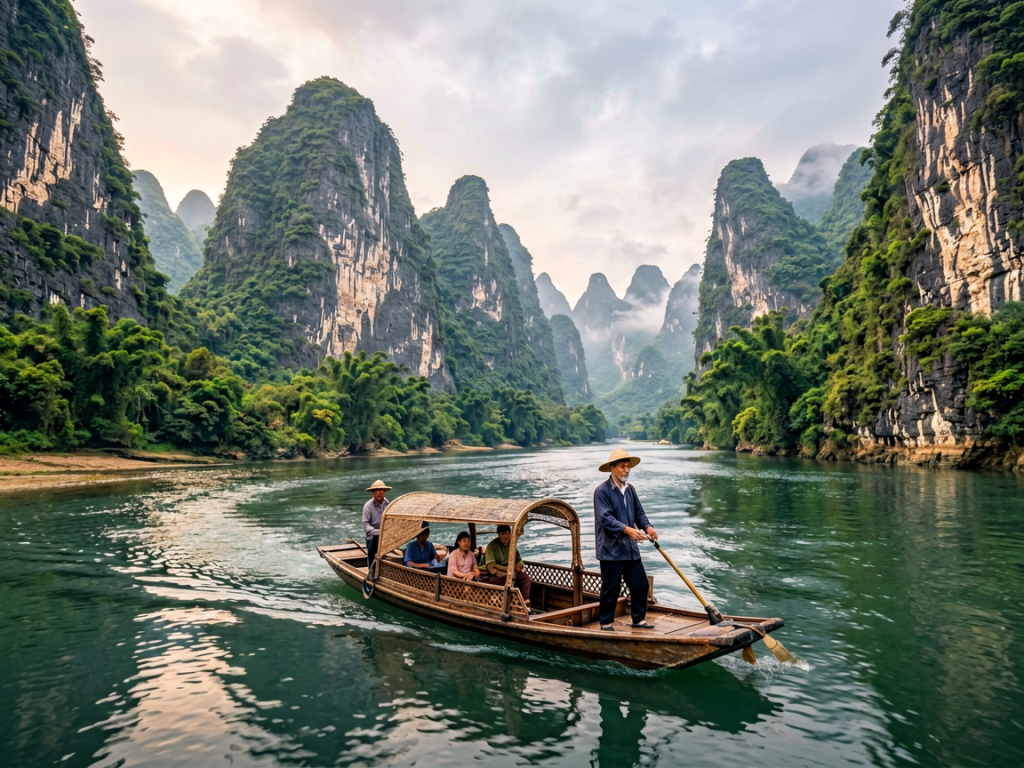
The scenery was undeniably pretty. Those iconic karst mountains rising out of the green water are famous for a reason. But seeing them through a glass window or from a fixed distance feels like watching a movie. It’s passive. It’s safe. And it’s completely disconnecting.
You get maybe twenty minutes to look at a specific rock formation. Then the boat turns. Next up is another rock. You’re told where to stand for the photo. You’re told when to sit down for lunch. You’re told exactly what time you’ll arrive at your hotel in Yangshuo.
It’s efficient, sure. But it’s not travel. It’s logistics.
I looked around at the faces next to me. Most were staring at their phones. Some were asleep. A few were taking the same selfie they’d already taken ten times. Nobody was talking. Nobody was breathing in the air.
That’s when I decided I’d never do it again. Not for the price I paid, anyway.
Instead, I went back. And this time, I rented a bicycle.
The Slow Travel Advantage
There’s a reason why locals and long-term expats in Yangshuo rarely take the big boats. They know something the tourists don’t. They know that the magic of Guangxi province isn’t just in the mountains. It’s in the spaces between them.
When you’re on a boat, you’re locked into a schedule. You can’t stop to watch a farmer tend to his water buffalo. You can’t pause to smell the osmanthus flowers blooming along the riverbank. You can’t duck into a tiny village to buy a sticky rice cake from an old woman who doesn’t speak English.
But on a bike? You can do all of that. And more.
I remember my first ride out of Yangshuo town. The air was cool and smelled of damp earth and green tea. I pedaled away from the main drag, past the souvenir shops and the loud bars, and into the rural backroads.
The silence hit me first. It wasn’t empty silence. It was a full, living silence. I could hear the wind rushing past my ears. I could hear the tires humming on the asphalt. I could hear the distant lowing of cattle.
It’s a sensory experience you just can’t get from a motorized vessel.
Riding through the countryside around Yangshuo is like riding through a painting. The landscape changes subtly with every kilometer. One moment you’re passing vast rice paddies, the rice stalks bowing under the weight of the grain. The next, you’re winding up a small hill with a view of a valley so green it hurts your eyes.
You control the pace. You set the rhythm. If you see something interesting, you stop. If you’re tired, you rest. There’s no captain yelling over a loudspeaker to hurry up and get to the next viewing platform.
It’s freedom. Real, unadulterated freedom.
Hidden Gems You’ll Miss Otherwise
Here’s the thing about the popular tourist spots in Guilin. They’re popular for a reason, but they’re also crowded, commercialized, and often overpriced.
The Ten-Mile Gallery, for example, is beautiful. But when you’re stuck in traffic on a bus or zipping past it at forty miles per hour on a scooter, you miss the details. You don’t see the small temples hidden in the hillsides. You don’t see the kids playing basketball on a dirt court near a bamboo grove. You don’t see the local women washing vegetables in a clear stream.
When you ride a bike, you’re slow enough to notice these things.
I once took a wrong turn near Yulong River. I meant to head toward the popular rafting spots, but I ended up on a narrow dirt path leading into a small village. I thought I was lost. I was terrified for a second.
But then I saw the house. It was an old stone structure, centuries old, with a family eating dinner on their porch. An old man waved at me. A little girl ran out to pet my bike.
I stopped and bought some mangoes from their tree. They were cheap, sweet, and juicy. The man offered me tea. We didn’t speak the same language, but we smiled. That interaction meant more to me than any guided tour ever could.
If I had been on a boat, I would never have seen that village. The boat stays on the main river. It doesn’t turn into dirt paths. It doesn’t stop for mangoes.
By bike, you can find these hidden gems. You can explore the side valleys. You can climb the small hills that offer panoramic views of the entire region.
I found a spot near a waterfall that no tour group visits. It was just me and a few locals fishing. I sat on a rock for an hour, watching the water cascade over the stones. It was peaceful. It was private. It was mine.
That’s the difference. The boat gives you a view. The bike gives you a place.
It’s Easier Than You Think
I know what you’re thinking. “But what about the hills?”
Guilin and Yangshuo are hilly. No one will deny that. The terrain is rugged. The roads can be steep. If you’re used to flat cities, this might sound daunting.
But trust me, it’s manageable.
You don’t need a high-end mountain bike. A simple electric bike, or “e-bike,” is the local favorite. You can rent one for about 30 to 50 RMB a day. That’s less than a coffee in many places.
These bikes are sturdy. They have powerful motors that help you climb the steeper inclines. You just twist the throttle, and up you go. It’s like having a personal sherpa.
I’m not a fitness buff. I can barely do ten pushups. But I rode an e-bike for six hours one day. I covered fifteen kilometers. I felt good. I didn’t break a sweat until the very end, and even then, it was just a pleasant warmth.
The roads are well-maintained. Most of the scenic routes are paved. There are signs in Chinese and English pointing to the main attractions. You don’t need a GPS. You can just follow the river, or follow the mountains. They’re hard to miss.
And if you get tired? You can stop. You can rest. You can take a break at a roadside stall.
I ate a bowl of Guilin rice noodles for lunch on the side of the road. It cost 15 RMB. It was the best meal I had in China that week. Hot, spicy, fresh, and served in a plastic bowl on a plastic stool. It was authentic. It was real.
You can’t eat that on a boat. The boat food is usually buffet-style. It’s generic. It’s bland. It’s designed to please the masses, not excite the palate.
Why I Choose Two Wheels Every Time
So, why is Guilin better by bike than by boat?
Because travel isn’t about checking boxes. It’s not about seeing the most sights in the shortest time. It’s about connection. It’s about feeling the world around you.
The boat is a bubble. It’s safe, comfortable, and predictable. But it’s also sterile. It separates you from the landscape. It separates you from the people. It separates you from the experience.
The bike breaks that barrier.
When you’re on a bike, you’re part of the landscape. You’re breathing the same air as the farmers. You’re sharing the road with the trucks and the scooters. You’re experiencing the heat, the humidity, the wind, and the rain.
You’re alive.
I’ve traveled all over China. I’ve taken trains, planes, buses, and cars. I’ve hiked mountains and swum in rivers. But nothing compares to the feeling of riding through the karst landscape of Guangxi.
It’s slow. It’s quiet. It’s honest.
If you’re planning a trip to Guilin, do yourself a favor. Skip the expensive boat tour. Skip the crowded bus tours. Rent a bike.
Go for a ride. Get lost. Find a hidden temple. Eat a weird snack. Talk to a stranger.
You might come back tired. You might come back sweaty. But you’ll come back with memories. Real ones. Ones that you can feel in your legs and your lungs.
And that’s worth more than any souvenir you can buy at the airport.
So, are you ready to trade the cruise ship for the saddle?
I think you will be.