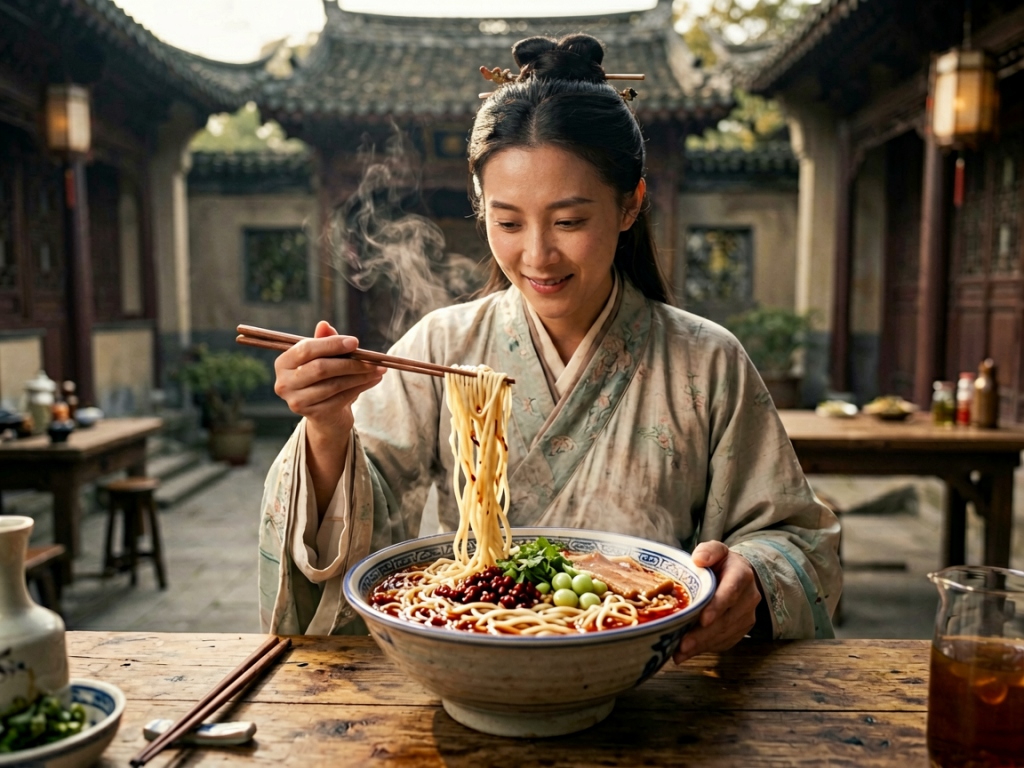
Look, I’ve lived in China for eight years now. I’ve survived on instant noodles in Beijing hostels, feasted on Michelin-starized dim sum in Guangzhou, and argued with taxi drivers in dialects I don’t understand. But nothing prepared me for the sheer visual assault of a bowl of Biangbiang noodles.
I was in Xi’an, that ancient city that smells like cumin, chili oil, and history. I walked into a tiny hole-in-the-wall spot near the City Wall. The place was packed. Men in white hats were shouting orders. The air was thick with steam and the sound of dough being slapped against the counter like a drumbeat.
Then I saw it. On the menu, there was a character that looked like a hieroglyph from another planet. It had more strokes than any word I’d ever seen. My host friend, Lao Li, just grinned and said, “You can’t write this. Nobody can. Not really.”
I thought he was joking. He wasn’t. That character is Biang. And the story behind it is wilder than the noodle itself.
It Starts with a Slap
To understand the character, you have to understand the sound. The name “Biangbiang” comes from the noise the noodles make when they are being made. The chef takes a long strip of dough and slaps it against the wooden counter. *Biang. Biang.* It’s rhythmic. It’s loud. It’s annoying if you’re trying to nap, but perfect if you’re hungry.
These aren’t your delicate, thin ramen noodles. These are wide, thick ribbons of wheat. They are chewy, hearty, and designed to hold onto a mountain of toppings. When they hit the boiling water, they look like thick white ropes. When they come out, they are glossy and strong.
I watched the chef work. He didn’t use a machine. He used his hands, his strength, and a lot of elbow grease. He stretched the dough until it was thin, then folded it over itself. The layers created the unique texture. It’s tough to bite through, which is exactly the point. You have to work for your food here.
The Character That Breaks Your Brain
Now, let’s talk about the ink. The character for Biang is a nightmare. It has fifty-eight strokes. Fifty-eight. Try writing “hello” in Chinese. Now try writing that fifty-eight-stroke monster. It’s not just long; it’s a puzzle.
The character is made up of other smaller characters. It’s a linguistic LEGO set. You have “heart” (xin) in the middle. You have “mouth” (kou). You have “horse” (ma). You have “long” (chang). And you have “moon” (yue). It’s a mess of symbols glued together.
Lao Li explained it to me over a glass of cold beer. “It’s not in the dictionary,” he said. “It’s a folk character. It was made up by the cooks to be funny and hard to write. That’s why you can’t find it on your phone keyboard.”
I tried to type it. My phone just gave me a box with a question mark. It was frustrating. I felt like an outsider looking in. But then Lao Li laughed and said, “That’s the point. It’s not meant to be easy. It’s meant to be memorable.”
He showed me a mnemonic device, a rhyme that helps locals remember how to write it. It goes something like this: “A square on top, a horse inside. A long line below, a moon to the side. A heart in the middle, a mouth to the right. If you can write it, you win the fight.”
I tried to write it on a napkin. I messed up the horse. I put the moon in the wrong place. I ended up with a blob of ink that looked like a spider. Lao Li laughed so hard he snorted. “Better luck next time,” he said.
Why Does This Matter?
You might be wondering why a five-stroke character doesn’t matter. It’s just a noodle, right? Right? But in China, food is culture. It’s history. It’s identity.
Xi’an is one of the oldest capitals in China. It was the starting point of the Silk Road. People from all over the world came here. They brought their spices, their stories, and their food. The Biangbiang noodle is a result of that mixing. It’s spicy, it’s savory, it’s heavy. It’s Shaanxi food.
Shaanxi people are known for being straightforward and bold. They don’t do subtle. They don’t do “just a little bit of chili.” They do “put the whole bottle in.” The wide noodles reflect that personality. They are big and bold.
The character itself is a joke. It’s a piece of folk art. It’s something the common people created to add flavor to their daily lives. It’s not official. It’s not sanctioned by the government. It’s just… there. And that’s why I love it.
I read somewhere that there are other complex characters in Chinese. Some have hundreds of strokes. But they are usually ancient, archaic, and rarely used. Biang is different. It’s alive. It’s used every day in restaurants across the province. It’s spoken, shouted, and written on menus.
The Taste of Chaos
Finally, my noodles arrived. They were piled high on a large plate. On top, there was a mountain of dried chili peppers. There was cumin powder. There was garlic. There was vinegar.
The chef poured hot oil over the chilies. The sizzle was deafening. The smell hit me like a wall. It was smoky, spicy, and aromatic. It made my mouth water instantly.
I mixed it all together. The noodles turned a deep, fiery red. I took a bite. The texture was incredible. It was chewy but not rubbery. It had a slight snap. The flavor was complex. The chili was hot but not burning. The cumin added an earthy note. The vinegar cut through the grease. The garlic was pungent and sharp.
It was heavy. It was filling. It was perfect. I ate until I was stuffed. I couldn’t move. I sat there, sweating, drinking more beer, feeling alive.
This is why people come to China. Not just for the history, not just for the views. But for this moment. The connection between the food, the culture, and the people.
Can You Write It?
So, can you write the Biang character? Probably not. Not on the first try. Not even on the tenth try. It’s a beast. But that’s okay.
You don’t need to write it to enjoy the noodles. You don’t need to speak the dialect to love the city. You just need to show up. Be willing to get messy. Be willing to laugh at your mistakes.
I still have that napkin with my terrible attempt at the character. I keep it in my wallet. It’s a reminder. A reminder that some things are meant to be hard. That some things are meant to be shared. That some things are just too big for a dictionary.
Next time you’re in Xi’an, go find a small restaurant. Order the Biangbiang noodles. Ask the chef to write the character on the menu. Watch him struggle. Watch him laugh. Then eat. Eat like your life depends on it.
It’s a unique experience. It’s a story in a bowl. And it’s one you won’t forget. Trust me.