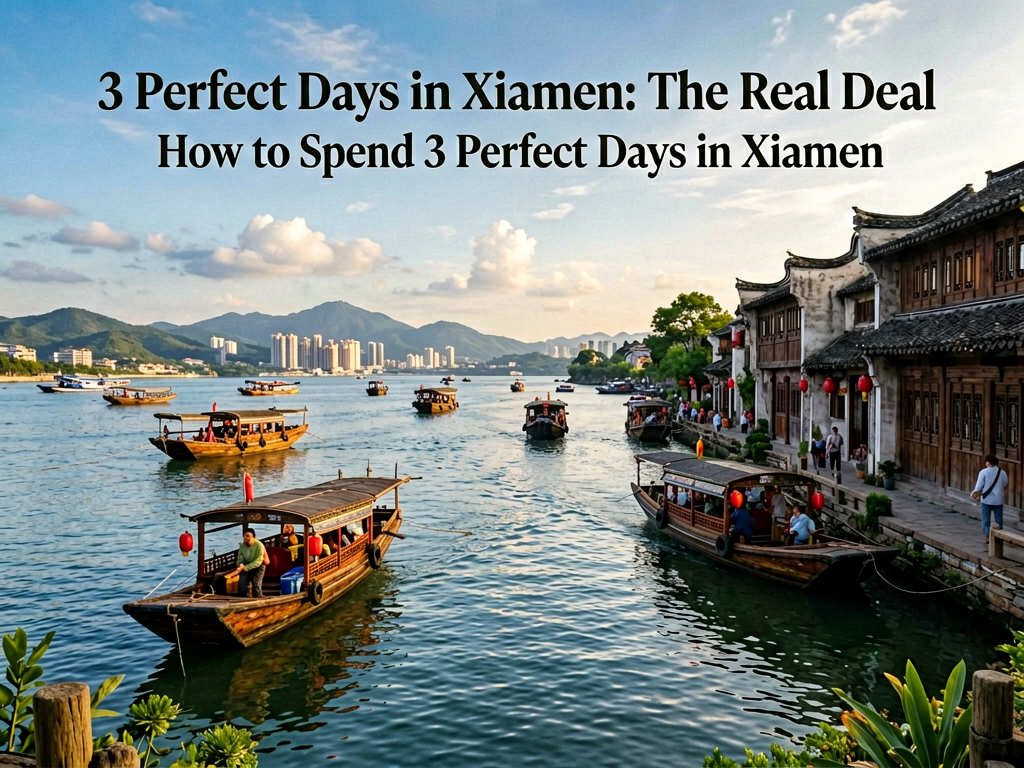
I remember standing on the balcony of a tiny guesthouse in Gulangyu Island. The morning mist was lifting off the water, revealing the jagged silhouette of Gulangyu’s rooftops. It smelled like salt, old wood, and frying dough sticks. I took a deep breath and thought, “This is it. This is the vibe.”
If you’ve been to Shanghai or Beijing, Xiamen feels like a different planet. It’s slower. It’s greener. It’s got that lazy, coastal charm that makes you want to stay put and do absolutely nothing. I’ve lived in China for eight years, and I can tell you this: Xiamen is one of the few places where the pace of life actually slows down to a human speed.
But here’s the thing. Three days isn’t a lot of time. It’s enough to scratch the surface, though. If you rush, you’ll miss the point. If you linger, you’ll fall in love. I’m going to walk you through exactly how I spent my best three days there. No generic itineraries. Just what actually worked for me.
Day One: Getting Lost in Gulangyu
You can’t talk about Xiamen without talking about Gulangyu Island. It’s a car-free zone tucked right across the harbor from the main city. It’s UNESCO-listed, sure, but don’t let that scare you off. It’s not a museum. It’s a living, breathing neighborhood with history.
I started my trip by taking the ferry from Xiamen Island to the island. You need to book tickets in advance. Seriously. Do it on WeChat before you even land in China. The ride takes about twenty minutes, and the view of the Xiamen skyline is worth the hassle alone.
Once you step off the boat at the Sanqiutian Pier, you’re hit with a wall of green. The island is famous for its banyan trees and colonial-era architecture. I didn’t bother with a map. I just started walking. That’s the best way to see it anyway.
I wandered up toward Sunlight Rock. It’s the highest point on the island, and honestly, the hike was a bit of a workout. But when I reached the top, the view was worth every sweaty step. You can see the entire city of Xiamen spread out below you, and the ocean stretching out to the horizon. It’s peaceful up there. Almost spiritual.
Down in the old town, things got more interesting. I stumbled into a small courtyard house that had been converted into a tea shop. The owner, an older man with kind eyes, invited me in. We sat on bamboo chairs and drank Tieguanyin tea. He didn’t speak much English, and I barely spoke any Chinese. We just sat there, sipping tea and watching the sun go down. It was one of those moments that reminds you why travel is important.
Don’t try to see everything. The island is small, but it’s dense with history. Pick a few streets, get lost, and see what you find. I ended up in a quiet alley filled with vintage vinyl records and indie bookstores. It felt like stepping back in time.
For dinner, I went to a local restaurant near the pier. I ordered braised abalone with pork belly. It was rich, savory, and tender. The abalone had a nice chew to it, and the pork melted in my mouth. It cost me about 80 RMB. A steal for that kind of flavor.
Stay the night on the island. The morning air there is different. Quieter. You’ll wake up to the sound of waves and birds, not traffic. It’s a reset button for your soul.
Day Two: The University Vibe and Sea Breezes
Back on Xiamen Island, the energy shifts. It’s younger. It’s academic. It’s about the sea.
I spent my second morning at Xiamen University. It’s often cited as one of the most beautiful campuses in China. The architecture is a mix of Chinese and Western styles, with red brick buildings and green roofs. It’s incredibly photogenic.
I walked along the edge of the campus, right by the sea. The Longtou Road area is packed with cafes and small shops. I grabbed a coffee at a place called M Stand. It’s a Chinese chain, but their coffee is genuinely good. I sat outside and watched students rush to class. It felt nostalgic, like being back in college, but with better weather.
Afterward, I took the BRT (Bus Rapid Transit) to the Zhongshan Road area. It’s a pedestrian street, and while it’s touristy, it’s worth it for the architecture. The buildings here are “Qilou” style–arcade buildings that protect pedestrians from sun and rain. They’re charming, even if they’re crowded.
I got hungry, so I headed to a night market nearby. Xiamen is a food city, and you can’t leave without trying the street food. I tried satay noodles. It’s a local specialty. The broth is made from peanut butter, chicken stock, and spices. It’s creamy, nutty, and slightly spicy. I ate it from a plastic stool on the side of the road, just like the locals.
Then there was the seafood. I found a small stall selling grilled squid. It was simple–just squid, salt, and chili powder–but it was incredible. I also tried a dessert called “ice jelly,” which is a sweet, cooling treat that’s perfect for the humid Xiamen heat.
After dinner, I walked along the Huandao Road. It’s a long coastal road that’s perfect for a stroll or a bike ride. The lights from the city reflect off the water. It’s romantic, sure, but it’s also just really nice to be outside. I rented a bike and pedaled along the shore. The wind was cool, and the city lights were twinkling. I felt completely at ease.
One thing I love about Xiamen is how walkable it is. You don’t need a car. You don’t even need a metro for the main sights. Just put on comfortable shoes and walk. You’ll see things you’d miss if you were in a taxi.
Day Three: Culture, Tea, and Final Thoughts
My last day was a bit slower. I wanted to soak it all in before I left.
I started at the Nanputuo Temple. It’s a Buddhist temple located at the foot of a mountain, right in the middle of the city. It’s bustling with monks and tourists, but there’s a sense of peace there. I bought some incense and watched people pray. It’s a stark contrast to the busy streets just blocks away.
The temple has a great view of the city, and there’s a small museum on the grounds. I spent an hour just wandering around the gardens. The plants are lush, and the stone paths are worn smooth by centuries of feet. It’s a place to reflect.
After the temple, I went to a tea plantation on the outskirts of the city. Xiamen is famous for its tea, especially Tieguanyin. I visited a small family-run farm where I learned about the tea-making process. The owner showed me how to hold the leaves, how to smell the aroma, and how to taste the liquor.
We sat in a traditional tea room and drank several types of tea. The difference between a cheap bagged tea and a high-quality loose leaf is night and day. The high-quality tea had layers of flavor–floral, fruity, and earthy. It was an educational experience, but more importantly, it was a sensory one.
I bought a small tin of tea to take home. It’s a small thing, but it reminds me of the trip every time I make a cup. It’s a tangible memory.
For my final meal, I went to a restaurant that serves “Xiamen style” breakfast, even though it was dinner. I ordered rice noodles with minced meat and oysters. It’s a local comfort food. The oysters were fresh and briny, and the rice noodles were slippery and smooth. It was a perfect end to the trip.
I walked back to my hotel through the night markets one last time. The energy was electric. Vendors were shouting, people were eating, and the air was thick with the smell of grilled meat and sweet syrup. I felt a pang of sadness. I didn’t want to leave.
Why Xiamen Works
So, why do I love Xiamen? It’s not just the scenery. It’s the attitude. The people here are relaxed. They’re not in a rush. They’re happy to share their food, their tea, and their stories.
It’s a city that balances modernity with tradition. You have high-rise condos next to old temples. You have Starbucks next to tiny tea houses. It’s a mix that works. It feels authentic, not staged.
Three days isn’t enough to know a city like Xiamen. But it’s enough to get a feel for it. Enough to fall in love with the pace. Enough to want to come back.
If you’re planning a trip to China, don’t skip Xiamen. It’s not on the typical itinerary, but it should be. It’s a hidden gem, not in the cliché sense, but in the real sense. It’s a place that rewards the curious traveler.
Just remember to pack comfortable shoes. And leave room in your stomach for the food. You’ll need it.
I hope you get to experience Xiamen for yourself. It’s a place that stays with you. A place that reminds you that life doesn’t have to be so fast. Sometimes, it’s okay to just sit, drink tea, and watch the waves.
That’s the Xiamen way. And honestly? I’m here for it.