The City That Eats Its Own Shadows
I still remember the first time I looked out my apartment window in Jiangbei. It was 2 AM, and the air was thick enough to chew. The humidity hit me like a wet towel. Below, the city wasn’t dark. It was a swirling river of red and gold light.
Cars crawled along the elevated highways like fireflies in a jar. The fog rolled in off the Yangtze River, swallowing the skyscrapers whole. I thought to myself, “This place is insane.” And it still is.
Chongqing doesn’t do “quiet.” It doesn’t do “subtle.” When the sun goes down, the city wakes up with a roar. It’s a place where the night isn’t just a time of day; it’s a personality trait.
If you think you know what nightlife is, you probably haven’t been to Chongqing. This isn’t about sipping cocktails in a dimly lit lounge. This is about sweating through your shirt while eating beef tripe in a plastic stool. It’s about neon lights reflecting in puddles of spicy oil.
Trust me, once you experience it, you won’t want to go back to the gentle, predictable nights of Shanghai or Beijing. Here, the night is loud, hot, and incredibly alive.
Hot Pot Isn’t Just Dinner, It’s a Ritual
Let’s get the obvious part out of the way. You can’t talk about Chongqing at night without talking about hot pot. But don’t go in there expecting a polite dinner party.
I’ve eaten hot pot in Beijing, and I’ve eaten it in Chengdu. But Chongqing’s version? It’s a different beast. It’s aggressive. It’s bold. It’s the spiritual equivalent of a punk rock concert.
I remember sitting in a tiny, windowless basement restaurant in Yuzhong District. The air conditioner was broken. The ceiling fans were just spinning hot air around. There were maybe twenty tables, and they were all packed.
We ordered the “九宫格” (Jiu Gong Ge) pot. That’s the grid layout. It’s traditional, and it’s perfect for groups. The broth was a deep, angry red. It wasn’t just spicy; it was numbing. The Sichuan peppercorns hit your tongue like a static shock.
You dip the raw beef into the boiling liquid for ten seconds. Just ten. You pull it out, shake off the oil, and eat it. The flavor explodes. It’s savory, spicy, and numbing all at once.
People here don’t whisper during hot pot. They shout over the bubbling broth. They argue about how long to cook the duck intestines. They share drinks of beer that taste like liquid bread.
I’m no expert on Chinese culinary history, but I can tell you this: the social dynamic changes when the pot boils. Strangers become friends. The heat forces you to slow down and talk. You can’t rush a meal like this.
And the price? It’s ridiculous. For about 100 RMB per person, you can eat until you can’t move. You get endless plates of meat, vegetables, and tofu. In New York, that’s a snack. Here, it’s a lifestyle.
Walking the Streets That Don’t Exist
Chongqing is built on mountains. Or rather, it’s built *on* mountains and *above* them. The geography here is so complex that GPS often gives up.
I’ve had maps tell me to walk through a building. Literally. I stood on the sidewalk, looked at my phone, and walked through the lobby of an office building, down an escalator, and ended up on a street level that was twenty stories below where I started.
That’s the magic of the city at night. You never know what you’re going to find.
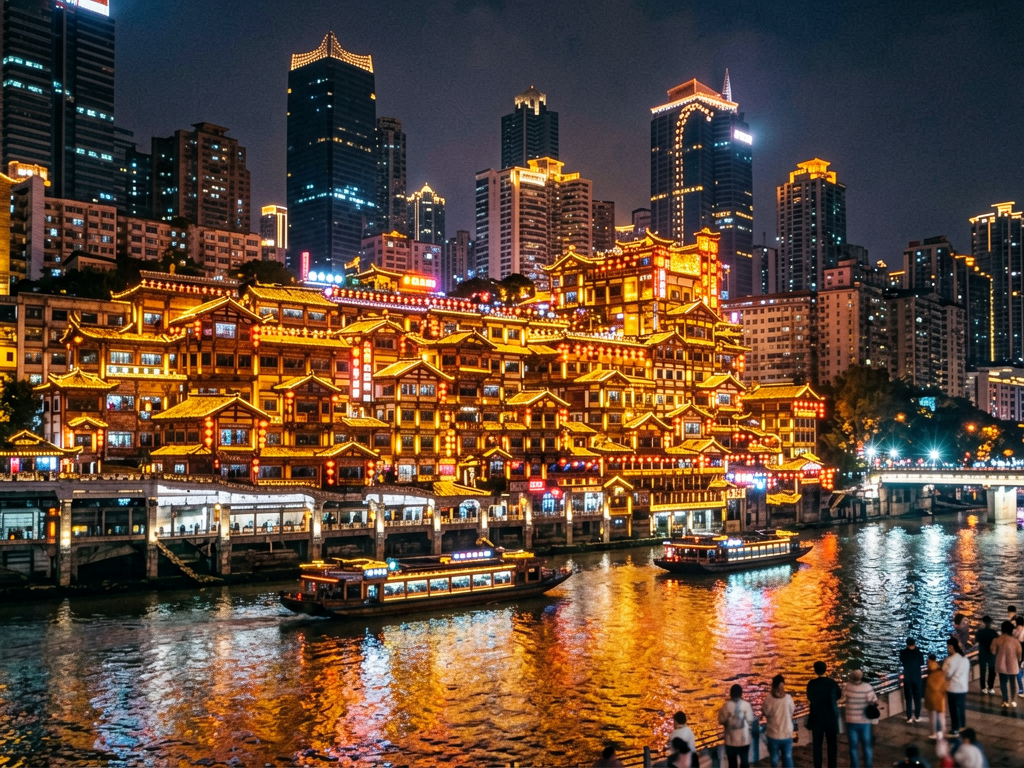
Take Hongya Cave. It’s a tourist trap, sure. But it’s a beautiful one. At night, it lights up like a scene from a Studio Ghibli movie. Traditional stilt houses cling to the cliffside. Below, the Jialing River flows dark and silent.
I went there around 10 PM. The crowds were thick. Tourists with selfie sticks jostled for position. But if you step back, just a few feet into a side alley, the noise fades. You can hear the water. You can see the lights reflecting off the ripples.
It’s a reminder that Chongqing is a city of layers. You are never just on one level. You are always above, below, or between.
I also love wandering through the older neighborhoods in Nan’an District. The streets are narrow and winding. Old women sit on folding chairs outside their doors, fanning themselves and watching the world go by.
The air smells of fried dough and damp stone. You’ll hear Mahjong tiles clacking in the distance. It’s a slower, quieter side of the night. It feels timeless.
It’s easier than you’d expect to get lost here. But getting lost is part of the fun. You’ll stumble upon a street food stall selling skewered chicken hearts. Or a small bar playing jazz. You’ll find your way back eventually.
From Skyline Bars to Street Corner Noodles
If you want to see the city from a distance, head up to the top of Nanping Mountain. It’s across the river in Nan’an District. The night bus ride takes about twenty minutes.
The view from the observation deck is spectacular. The Yuzhong peninsula looks like a glowing island in the middle of a dark sea. The bridges are lit up in different colors. It’s romantic, in a chaotic way.
But honestly? The best views aren’t always from the top. Sometimes, they’re from the bottom.
I spent a late evening in a small noodle shop in Shapingba. It was 11 PM. The shop was empty except for a few workers finishing their shifts. I ordered a bowl of Chongqing Xiaomian.
The noodles were thin and springy. The sauce was a complex mix of chili oil, vinegar, and garlic. It was simple, but it was perfect. The heat of the chili warmed me up from the inside out.
This is the side of Chongqing that tourists often miss. It’s not about the landmarks. It’s about the rhythm of the night. The way the city breathes.
There are high-end rooftop bars in the Raffles Chongqing complex, of course. You can drink expensive whiskey and look down at the grid of lights. But I prefer the street corners.
I’ve sat on plastic stools, drinking beer from glass bottles, watching the locals laugh and argue. I’ve eaten skewers with people who didn’t speak a word of English. We communicated through smiles and shared food.
That’s the real Chongqing. It’s unpretentious. It’s welcoming, even if it looks intimidating.
Surviving the Heat and the Spice
Now, a word of warning. Chongqing is one of the “Four Furnaces” of China. The summer nights are hot and humid. It’s not just warm; it’s oppressive.
If you’re visiting in July or August, you need to be prepared. The heat combines with the spicy food to create a unique kind of exhaustion. You’ll sweat. A lot.
But that’s part of the charm. There’s something primal about eating something so spicy in such heat. It clears your sinuses. It wakes you up.
Drink plenty of water. Or better yet, drink soy milk. The sweetness of the soy milk cuts through the spice. It’s a classic pairing for a reason.
And don’t be shy about asking for help. If the spice is too much, just say “bu yao la” (no spice). But I’d recommend trying a little bit first. You might surprise yourself.
The city is also very walkable, but the hills are steep. Wear comfortable shoes. If you’re staying in the city center, you’ll likely find yourself climbing stairs for no apparent reason.
I once climbed ten flights of stairs just to find a bathroom. But I ended up finding a great view of the river. So, it wasn’t all bad.
Why This City Stays in Your Head
I’ve lived in China for eight years. I’ve traveled to nearly every province. But Chongqing is different. It stays with you.
It’s not just the food or the views. It’s the energy. There’s a resilience here. A toughness. The people are direct, honest, and warm. They don’t play games.
When you leave Chongqing, you feel like you’ve been shaken awake. The city demands your attention. It doesn’t let you sit on the sidelines.
I think about it often. I think about the smell of the hot pot. The sound of the rain on the tin roofs. The way the fog rolls in at dusk.
It’s a city that refuses to sleep. And honestly, neither do I anymore.
If you’re planning a trip, don’t just check it off your list. Stay for a week. Eat the street food. Get lost in the alleys. Try to speak some dialect, even if you fail.
Let the city get under your skin. Let the spice burn a little.
You’ll come back different. Or at least, you’ll have a lot of stories to tell. And in Chongqing, stories are the most valuable currency of all.
So, are you ready? The night is young, and the pot is boiling.