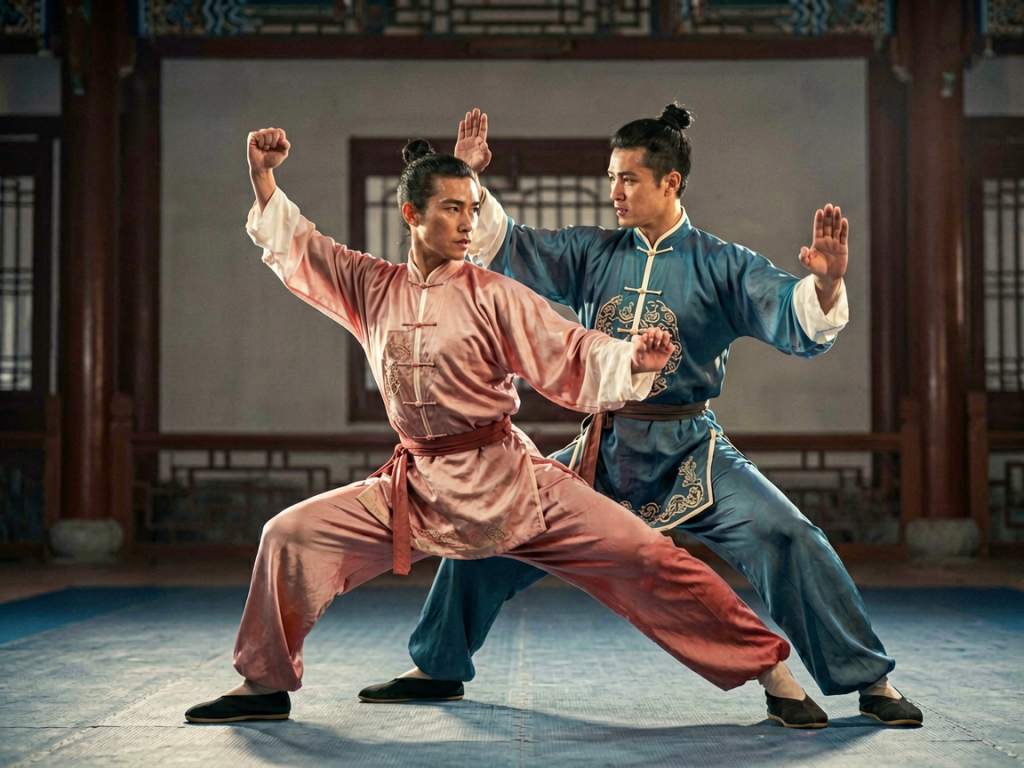
Look, I used to be one of those confused foreigners who threw the terms “kung fu” and “wushu” around interchangeably. I’d tell my bar friends in Beijing that I was practicing wushu when I was actually doing traditional Shaolin forms. Or maybe I was doing kung fu when I should have said wushu. It didn’t matter much then because nobody really cared about the distinction. They just liked that I was sweating and looking serious.
But after eight years of living in China, watching countless matches, and sweating through my own gi in dusty dojos, the difference became glaringly obvious. It’s not just semantics. It’s a clash of philosophies, histories, and physical goals. If you’re trying to understand Chinese culture, you can’t really separate it from its martial arts. They are two sides of the same coin, but they shine in completely different directions.
Here’s the thing. When you walk into a stadium in Shanghai for a national competition, you’re seeing something that looks like gymnastics meets dance. When you visit a small village temple in Henan, you’re seeing something that looks like survival. One is designed to win points. The other is designed to end a fight. Or perhaps, to end yourself.
Let’s break down why this distinction matters, not just for martial artists, but for anyone trying to grasp the soul of modern China.
The Sport of Wushu: Performance and Precision
Wushu is what you see on television. It’s flashy, it’s athletic, and it’s incredibly impressive. But it’s also modern. The term literally translates to “martial art,” but in contemporary usage, it refers specifically to the standardized sport developed in the 1950s by the Chinese government.
I remember watching a national wushu championship in Beijing a few years back. The air conditioning was blasting, the crowd was polite, and the athletes were moving with a grace that defied physics. They were doing backflips, twisting in the air, and landing on one foot. It was beautiful. But I couldn’t help but feel a strange detachment.
These athletes aren’t learning how to fight. They’re learning how to perform. Every move is standardized. If you want to do a “Crane Spreads Its Wings,” you do it exactly the way the judges expect you to. Deviate from the form, and you lose points. It’s like figure skating, but with punches and kicks.
The focus is on difficulty, flexibility, and aesthetic appeal. You’re trying to impress a panel of judges with your range of motion and your composure. It’s a test of discipline and physical perfection. To be fair, the athletes are incredibly strong. Their legs are like steel cables. But if you put them in a street fight tomorrow, they might not know what to do.
I tried a beginner’s wushu class in Guangzhou last year. The instructor was a former national team member. He was strict, yes, but he kept emphasizing “style points.” We practiced jumping turns for an hour. Just jumping turns. My lungs burned, my legs shook, but I wasn’t learning how to block a punch. I was learning how to look cool doing it. And honestly? It was fun. It got me in shape. It connected me to the modern Chinese appreciation for athleticism.
The Heart of Kung Fu: Tradition and Function
Then there’s Kung Fu. Or as the Chinese say, “Wu Shu” (without the ‘u’ sound change, roughly translating to martial skill). This is the old stuff. The real stuff. It’s not a single system. It’s a collection of hundreds of styles, each with its own history, philosophy, and techniques.
I spent a month in Shaolin Temple in Henan, studying traditional kung fu. The difference from wushu was night and day. The gym wasn’t a shiny stadium with air conditioning. It was a dirt courtyard in the winter wind. The floor was hard. The training was repetitive, boring, and painful.
We didn’t do backflips. We did horse stances. Just standing still. For hours. My quads were on fire. I wanted to quit. I wanted to go back to my hotel and eat hotpot. But the master kept saying, “Foundation is everything.” In kung fu, you can’t build a house on sand. You can’t learn to fight if you can’t stand your ground.
Kung fu is about function. It’s about efficiency. Every movement has a purpose. A punch isn’t just a punch; it’s a strike to the solar plexus or a palm strike to the chin. A block isn’t just a shield; it’s a setup for a counter-attack. It’s messy. It’s gritty. It’s not always pretty.
I watched a demonstration of Eagle Claw kung fu. The movements were sharp, almost jerky. They grabbed wrists, twisted joints, and struck pressure points. It looked violent. It looked practical. It reminded me that these techniques were developed over centuries, refined in actual battles and street brawls. There was no judge to give me points for my aesthetic appeal. There was only survival.
Why the Confusion Exists
If the differences are so clear, why is everyone so confused? Part of it is Bruce Lee. The man changed the world’s perception of Chinese martial arts. He brought kung fu to Hollywood, and suddenly, “kung fu” became a catch-all term for anything Asian and punchy.
Then there’s the media. Movies like *Crouching Tiger, Hidden Dragon* blend the two. They show characters flying through the air (wushu aesthetics) using traditional techniques (kung fu concepts). It’s art, not reality. But it shaped how the world sees China.
domestically, the Chinese government promoted wushu as a way to unify the country’s diverse martial traditions under one banner. It made sense for competition. You can’t have judges evaluating “spirit” or “intent.” You need measurable criteria. Distance. Speed. Form. So, wushu was born.
But kung fu remained in the shadows. It stayed in the villages, in the temples, in the private lineages passed from master to student. It became secret. Mysterious. Which, of course, only made it more alluring to outsiders like me.
The Cultural Weight Behind the Movements
Understanding the difference between kung fu and wushu is really about understanding two different ways of being Chinese. Wushu represents the modern, globalized China. It’s confident, standardized, and eager to show off on the world stage. It’s about progress and precision.
Kung fu represents the traditional, spiritual China. It’s rooted in Buddhism, Taoism, and Confucianism. It’s about harmony, balance, and inner strength. When I practiced Tai Chi in the park in Chengdu, watching old men move like they were underwater, I wasn’t just watching exercise. I was watching centuries of philosophy in motion.
There’s a concept in kung fu called “Jing.” It’s often translated as “essence” or “refined energy.” It’s the idea that true power comes from within, not from muscle. You can’t buy jing. You can’t learn it from a textbook. You have to cultivate it through years of discipline. Wushu doesn’t really care about jing. It cares about points.
I’ll be honest, I struggled with this at first. I wanted the magic of kung fu. I wanted to hit things hard. But wushu taught me discipline. Kung fu taught me patience. Both are valuable. But they serve different masters.
Which One Should You Choose?
If you’re reading this, you’re probably thinking about trying martial arts. Maybe you want to get fit. Maybe you want to defend yourself. Maybe you just want to understand China better.
If you want to get fit, look amazing, and enjoy a sense of community, try wushu. It’s accessible. You can find gyms in most major Chinese cities. The instructors are often friendly and eager to teach foreigners. It’s a great way to make friends and improve your flexibility. Just don’t expect to become a fighter.
If you want to understand the soul of Chinese culture, try traditional kung fu. It’s harder to find. You might need to travel to specific schools or temples. The training is grueling. The instructors can be strict. But the payoff is huge. You’ll learn more than just how to punch. You’ll learn about history, philosophy, and resilience.
I tried to do both. I’d do wushu in the morning to wake up my body, and kung fu in the evening to quiet my mind. It worked. My body got stronger. My mind got clearer. It was the perfect balance.
But here’s the truth. You don’t need to choose one to love China. You can watch a wushu match and be amazed. You can watch a kung fu master and be moved. Both are expressions of the Chinese spirit. One looks outward. One looks inward.
Next time you see a Chinese martial artist on TV, ask yourself: Is this for the crowd? Or is this for the self? The answer will tell you everything you need to know about the difference between kung fu and wushu. And maybe, just maybe, it will tell you something about yourself, too.
I’m no expert. I’m just a guy who liked to train. But I’ve learned that the best martial arts aren’t about winning. They’re about becoming. Whether you’re flipping through the air or standing still in the snow, you’re part of a long, rich tradition. And that’s worth respecting.
So, what do you think? Have you ever tried martial arts in China? Did you prefer the sport or the tradition? Or are you just here for the hotpot? I’d love to hear your story. Leave a comment below. Let’s talk.