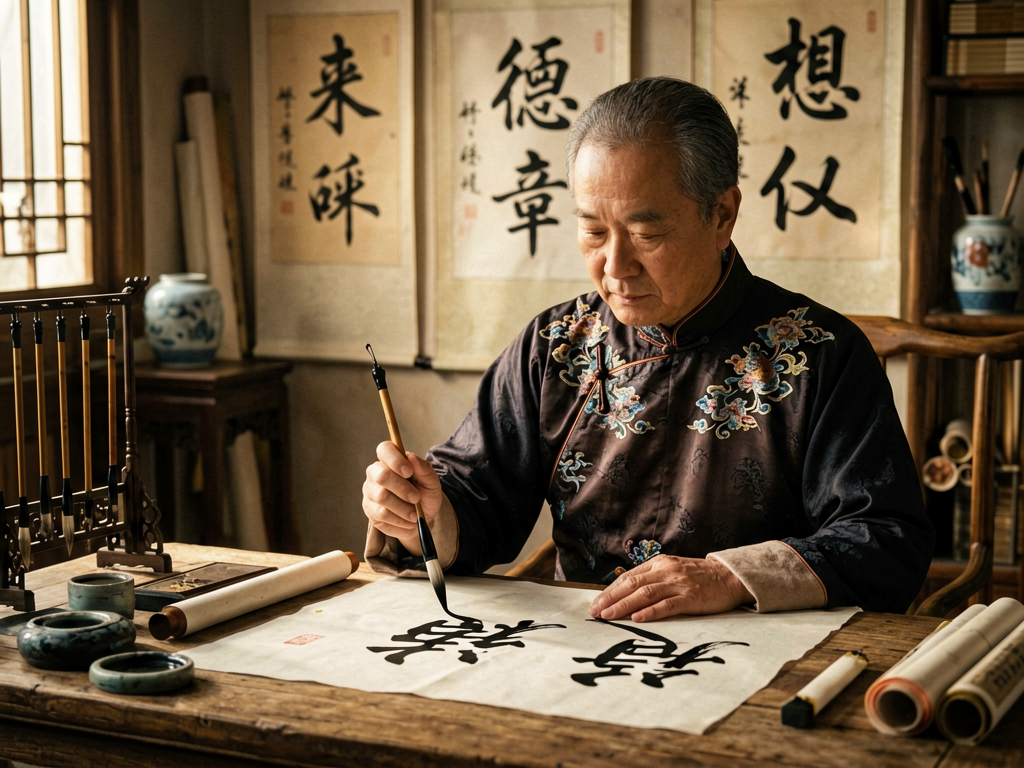
I’ll be honest. When I first picked up a brush in Chengdu, I thought it was going to be the most frustrating thing I’d ever tried. I’d spent years thinking of writing as a tool for speed. If you had to stop and think about every letter, you were slow. In English, we value the quick scribble, the efficient email, the tweet that hits the character limit. We don’t have time for five minutes of contemplation before we write a sentence.
But in China, specifically when you sit down to do calligraphy, speed is the enemy. You can’t rush. The ink is wet. The paper is absorbent. Once the brush touches the rice paper, there’s no undo button. There’s no Ctrl+Z. You have to commit to the stroke, and you have to do it with intention. It completely broke my brain at first. I was so used to treating words as disposable containers for information that the weight of the ink felt absurdly heavy.
That was five years ago. Now, I can’t imagine my life without it. And it’s not just about making pretty pictures on the wall. It’s about how the act of writing Chinese characters physically changes the way you process information, manage stress, and view the world. Here’s what I’ve learned after years of staring at black ink on white paper.
The Illusion of Speed vs. The Reality of Flow
Here’s the thing about modern life. We’re obsessed with efficiency. We want to get from point A to point B as fast as possible. Calligraphy forces you to slow down, but not in a forced, meditative yoga way. It’s a practical necessity. If you move too fast, the ink bleeds. The lines become muddy blobs. You lose the structure.
I remember sitting in a small studio in Shanghai with my teacher, Master Li. He watched me struggle with a simple character, *xin* (heart). I was rushing through the strokes, trying to get it over with. He stopped me and said, “You are fighting the paper. The paper is not your enemy. It is your partner.”
That phrase stuck with me. When you rush, you’re fighting the material. You’re trying to impose your will on the ink. But when you slow down, you enter a state of flow. It’s similar to what musicians talk about when they’re in the zone. You’re not thinking about the next note. You’re just playing. In calligraphy, you’re not thinking about the next stroke. You’re feeling the pressure of the brush, the angle of the wrist, the moisture of the ink.
This shift in perspective is huge. It teaches you that doing something slowly isn’t the same as doing it poorly. In fact, it’s often the opposite. When I take my time with a complex task at work now, I find I make fewer mistakes. I’m not rushing to finish. I’m engaging with the material. It’s a subtle shift, but it changes everything.
Decoding the Brain: Visual Memory and Structure
Let’s talk about the mechanics of it. Chinese characters aren’t just random lines. They’re constructed with specific rules. There’s a top part, a bottom part, a left radical, a right radical. They have to balance each other out. If one part is too heavy, the character collapses. If one part is too light, it looks weak.
When you learn to write these characters, you’re training your brain to see structure in chaos. You start to notice patterns everywhere. It’s like learning to see the skeleton of a building instead of just the paint on the walls. I noticed this happening in my daily life. I’d look at a messy desk or a disorganized schedule, and my brain would automatically try to find the “radicals” of the problem. What’s the core issue? What’s the supporting structure? How do I balance it?
It’s a form of visual problem-solving. Unlike English, where we write linearly, character by character, Chinese characters are spatial. You have to fit a lot of information into a square. You have to decide what gets emphasis. Which stroke goes first? Which one goes last? Where does the space go?
I tried explaining this to a friend back in the US who was learning Chinese. He was frustrated because he kept forgetting the order of the strokes. I told him to stop memorizing. I told him to imagine the character as a person. The first stroke is the head. The last stroke is the feet. The middle strokes are the body. If the head is too big for the body, it looks ridiculous. If the feet are too small, it falls over. Suddenly, he wasn’t memorizing rules. He was visualizing a structure. And once you visualize it, you remember it.
This spatial awareness is a cognitive workout. It engages different parts of the brain than reading or writing in an alphabetic language. You’re using your visual cortex, your motor skills, and your memory all at once. It’s like doing a puzzle with your hand. And unlike a puzzle, the reward is immediate. You see the result of your focus right there on the paper.
The Discipline of Mistakes
I’m no expert, but I can tell you this: calligraphy is humbling. You can practice for months and still make mistakes. A slight tremor in your hand, a drop of dust on the paper, a change in the humidity. These things matter. In English, if you miss a comma, nobody cares. In Chinese calligraphy, if you miss a stroke, the character is ruined.
This teaches you a level of accountability that’s rare in our digital age. When you type, you can delete and rewrite. You can send a draft and then send a correction. You can hide behind your edits. But with calligraphy, your mistakes are permanent. They’re part of the piece.
At first, this was terrifying. I hated wasting the expensive Xuan paper. It’s not cheap, and it’s fragile. But Master Li told me something that changed my relationship with error. He said, “The mistake is not a failure. It’s a teacher. Look at it. Why did it happen? Was your wrist too stiff? Was the ink too wet? Learn from it.”
This mindset is powerful. It shifts your focus from perfection to progress. You’re not trying to be perfect. You’re trying to be better than you were yesterday. And that’s a much healthier way to live. I used to be terrified of making mistakes at work. I’d stay up all night worrying about a typo. Now, I see mistakes as data points. They tell me where I need to focus my energy. They’re not judgments on my worth. They’re just part of the process.
There’s also a physical component to this discipline. Calligraphy requires a specific posture. You sit up straight. Your shoulders are relaxed. Your wrist is loose. Your breathing is steady. If you’re tense, your hand shakes. If your hand shakes, the lines are jagged. It’s a direct feedback loop between your mind and your body.
I’ve noticed that when I’m stressed or anxious, my calligraphy suffers. The lines become erratic. The characters look rushed and angry. But when I’m calm, the lines are smooth and balanced. It’s like a mirror for my internal state. I can’t lie to the brush. It knows exactly how I’m feeling. And that’s a valuable tool for self-awareness.
Connection to History and Philosophy
When you write Chinese characters, you’re connecting with thousands of years of history. Every stroke you make has been made by millions of people before you. You’re using the same tools, the same principles, the same logic. It’s a tangible link to the past.
I remember holding a replica of a famous poem from the Tang Dynasty. The ink was faded, but the structure was intact. I could feel the energy of the poet in the strokes. It wasn’t just words on a page. It was a moment in time, frozen in ink. And when I picked up my own brush, I felt that same connection. I wasn’t just writing words. I was participating in a tradition.
This sense of continuity is grounding. In a world that feels increasingly fragmented and fast-paced, it’s comforting to know that some things remain constant. The brush, the ink, the paper. The principles of balance and harmony. These things don’t change. They’re timeless.
There’s also a philosophical depth to it. Chinese calligraphy is closely tied to Taoism and Confucianism. The Taoist idea of *wu wei* (effortless action) is central to good calligraphy. You don’t force the brush. You guide it. You flow with the material. You don’t fight the resistance. You work with it.
Confucianism emphasizes self-cultivation and discipline. Calligraphy is a form of self-cultivation. It requires patience, focus, and integrity. It’s not just about the art. It’s about the person making the art. The quality of the writing reflects the quality of the mind. A chaotic mind produces chaotic writing. A clear mind produces clear writing.
This idea of *shu dao* (the way of calligraphy) resonates with me. It’s not just a hobby. It’s a practice. It’s a way of being in the world. And that’s why I keep coming back to it. It’s not about becoming a master calligrapher. It’s about becoming a better version of myself.
Why You Should Try It (Even If You Can’t Draw)
I know what you’re thinking. “I can’t draw. I’m not artistic. Why should I bother?”
Because it’s not about art. It’s about attention. It’s about slowing down enough to notice what’s happening in your head. In a world full of distractions, that’s a superpower.
You don’t need expensive equipment. A basic brush, some ink, and some paper will do. You can buy a set for under $20. You don’t need a studio. You don’t need a teacher, although having one helps. You just need a quiet corner and twenty minutes of your time.
Start with simple characters. *Yi* (one), *Er* (two), *San* (three). They’re just lines. But even those simple lines require control. You have to learn how to hold the brush. You have to learn how to apply pressure. You have to learn how to lift the brush. It’s deceptively simple.
I was skeptical at first. I thought it was just an old-fashioned hobby for retired people. But I was wrong. It’s for anyone who wants to feel more present. More focused. More in control. It’s a reminder that we’re not just brains in jars. We’re bodies. And our bodies know things our brains don’t.
So, give it a shot. Buy a brush. Make a mess. Ruin some paper. Laugh at your mistakes. And then try again. You might be surprised at what you find. Not just in the ink, but in yourself.
Trust me. It’s worth it.