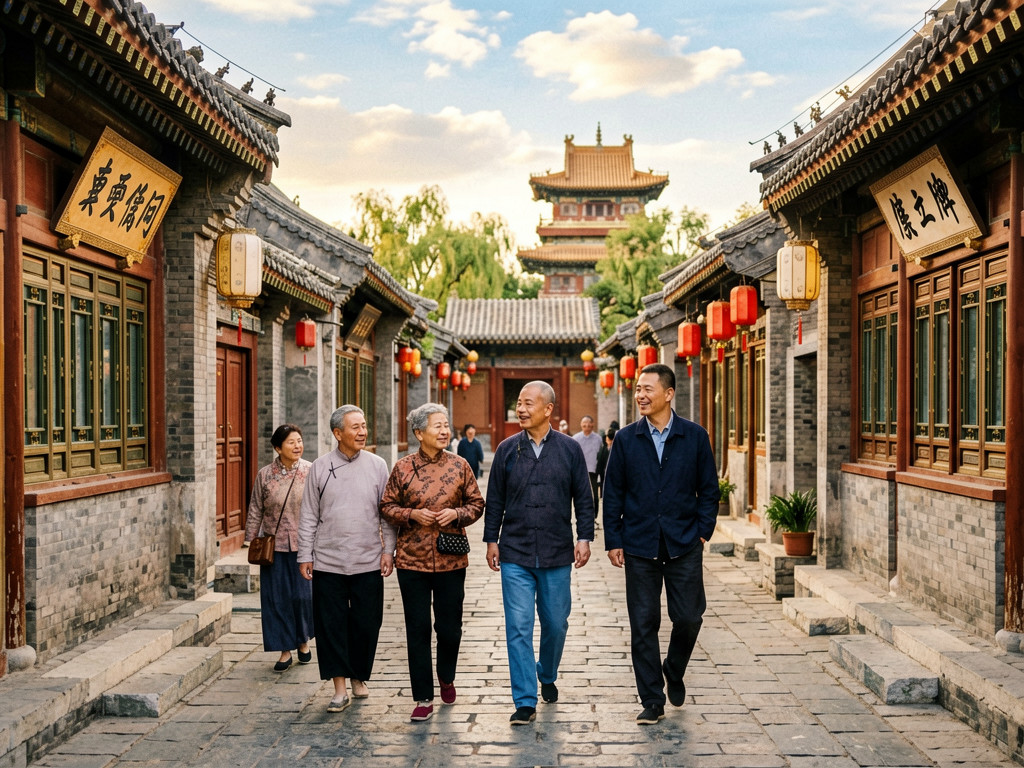
Here’s the thing about Beijing. Everyone goes for the Forbidden City. They go for the Great Wall. They spend their days staring at imperial red walls and wondering how they got so much money back in 1420. It’s impressive, sure. But it’s also cold. And crowded. And frankly, a bit impersonal.
If you want to know what China actually feels like, you need to leave the tourist traps behind. You need to walk into the labyrinth. You need to find a hutong.
I’ve lived in this city for eight years. I’ve seen the skyline change from low-rise apartments to glass towers that scrape the sky. But the old neighborhoods? They hang on. They stubbornly refuse to be erased by progress. And I love them for it.
Walking through a hutong isn’t just about sightseeing. It’s about feeling the pulse of the city. It’s about hearing neighbors argue over grocery prices, smelling garlic scallion noodles frying in a wok, and watching grandmas play mahjong on plastic stools. It’s messy. It’s loud. It’s real.
So, let’s get lost together. I’m going to take you on a walking tour of the best hutongs in central Beijing. We’ll skip the overpriced tea houses and go where the locals actually hang out.
Starting in Nanluoguxiang’s Shadow
Most tourists start at Nanluoguxiang. Look, I get it. It’s convenient. It’s near the Lama Temple. But honestly? It’s a nightmare. It’s a street lined with cheap trinkets, overpriced bubble tea, and crowds so thick you can’t breathe.
I’m not saying don’t go. But don’t make it your destination. Use it as a jumping-off point. Turn left as soon as you hit the end of the main drag. Slip into the side streets.
That’s where the magic happens. The main street is for influencers. The alleys are for life.
I remember my first real hutong experience. I was twenty-four, lost, and hungry. I ducked into an alley off Nanluoguxiang to escape a sudden summer downpour. I ended up in a tiny courtyard where an old man was feeding pigeons. He didn’t speak a word of English. I didn’t speak a word of Mandarin. But he offered me a steamed bun. It was warm, slightly sweet, and made of the best dough I’ve ever tasted.
That’s the vibe we’re chasing. Not the curated Instagram shot. The accidental kindness of a stranger who just wants to share his breakfast.
Guangfu Temple and the Quiet Alleys
Let’s move west. Head towards Guangfu Temple. This area is quieter. The trees are older. The shadows are deeper.
One of my favorite spots here is a small tea house tucked away in a renovated courtyard. It’s not fancy. The chairs are wooden and hard. The tea is served in simple glass cups. But the atmosphere? Unbeatable.
I’ve spent countless afternoons here just watching the world go by. You’ll see young couples walking hand-in-hand. You’ll see grandfathers practicing Tai Chi in the square. You’ll see kids on bicycles ringing their bells as they weave through the narrow path.
It’s a rhythm you can’t find anywhere else. The pace is slower. The air smells different. It smells like history and damp earth and frying oil.
Don’t be afraid to wander. There are no signs. There are no maps. You just follow your nose. If you smell incense, follow it. If you smell cooking, follow that too. You’ll end up somewhere interesting, I promise.
One time, I followed the smell of cumin and lamb. It led me to a hole-in-the-wall BBQ spot. No menu. Just a guy yelling orders to a grill master. I pointed at a skewer that looked juicy. He handed it to me. It was spicy, smoky, and absolutely perfect. I didn’t know what I was eating, but I knew I wanted more.
The Art of Siheyuan Living
You can’t talk about hutongs without talking about siheyuan. That’s the traditional courtyard house. Four buildings facing a central yard. It’s an architectural masterpiece designed for family harmony.
But these days, many siheyuan are shared housing. Ten families might share one courtyard. One bathroom. One kitchen. It’s cramped. It’s chaotic.
And yet, it fosters a sense of community that’s vanishing in modern apartments. In a high-rise, you might not know your neighbor’s name in five years. In a hutong, you know everyone’s business.
I’ve had conversations with neighbors while hanging laundry. I’ve been invited to birthday parties for children I’ve never met. It’s intrusive sometimes. But it’s also warm. It’s human.
When you walk through these alleys, try to spot the courtyard doors. Look for the stone lions. Look for the red couplets pasted on the frames. These are the markers of old Beijing.
Some of these houses are now high-end boutiques or private clubs. They’ve been restored to pristine condition. They’re beautiful, sure. But they feel sterile. There’s no life inside.
I prefer the lived-in look. The peeling paint. The bicycles chained to the gates. The clotheslines strung across the alley. That’s the Beijing I love. Not the museum version. The living, breathing version.
Eating Your Way Through the Alley
Now, let’s talk food. You can’t survive on steamed buns alone. Beijing has some of the best street food in the world. And the hutongs are full of it.
Start with jianbing. It’s a savory crepe. You’ll see carts everywhere. The vendor cracks an egg onto the batter. Spreads a sauce. Adds a crispy cracker. Rolls it up. It’s cheap. It’s filling. It’s breakfast of champions.
Then, look for douzhi. It’s fermented mung bean milk. It smells terrible. It tastes even worse. But it’s a rite of passage. I tried it once. I regretted it immediately. But hey, I did it. That’s what you do when you’re in Beijing.
For lunch, seek out zhajiangmian. Fried sauce noodles. Thick wheat noodles topped with a rich, salty soybean paste and diced vegetables. It’s comfort food. It’s heavy. It’s delicious.
I have a favorite stall near Beihai Park. The owner is a stern woman with sharp eyes. She doesn’t smile much. But her noodles are legendary. I’ve waited in line for forty minutes just to eat them. And I’d do it again tomorrow.
Don’t ignore the snacks either. Candied hawthorn on a stick. It’s sour, sweet, and crunchy. A classic Beijing treat. Perfect for walking while you snack.
When to Go and How to Prep
Timing matters. Spring and autumn are best. The weather is mild. The trees are beautiful. Spring has blossoms. Autumn has golden ginkgo leaves.
Summer is brutal. It’s hot. It’s humid. You’ll sweat through your shirt before you’ve walked two blocks. Winter is cold. Very cold. But there’s a certain charm to walking through snowy alleys. It’s quiet. It’s peaceful.
Wear comfortable shoes. The ground is uneven. There are cobblestones. There are cracks. There are dogs. You need good traction.
Carry cash. Some of these small stalls don’t take WeChat or Alipay. Or if they do, the signal might be spotty. Having a few yuan in your pocket saves awkward moments.
And respect the locals. These are their homes. Don’t knock on doors. Don’t take photos of people without asking. Keep your voice down. If you’re loud, you’re a nuisance. If you’re quiet, you’re a guest.
Learn a few phrases. “Ni hao” is basic. “Xie xie” is polite. Even if you mess up the tones, people will appreciate the effort. It breaks the ice. It shows you’re trying.
Why This Matters
We live in a world of homogenization. Coffee shops look the same in New York as they do in Shanghai. Hotels are identical. Fashion is global.
The hutongs resist this. They are stubbornly local. They hold onto traditions that might otherwise disappear. They remind us that life can be slower. That community still exists. That history is not just in books, but in the bricks and mortar of our streets.
When you walk through a hutong, you’re not just seeing a place. You’re seeing a way of life. It’s changing. It’s evolving. But it’s still there.
I’ve seen developers tear down blocks of hutongs to build malls. It’s heartbreaking. But I’ve also seen communities fight to preserve their neighborhoods. They organize. They speak up. They care.
That resilience inspires me. It makes me want to stay. To keep exploring. To keep learning.
So, next time you’re in Beijing, skip the tour bus. Put on your walking shoes. Turn off your GPS. And just walk.
You might get lost. You might miss your train. You might end up in a courtyard you never planned to visit. But that’s the point. The best memories aren’t planned. They’re stumbled upon.
I’ll be honest. I’m never truly satisfied with my first hutong tour. There’s always another alley. Another courtyard. Another neighbor with a story. There’s always more to see.
That’s why I keep coming back. That’s why you should too. The old city is alive. It’s waiting for you to walk its streets. Are you ready?
Trust me. You won’t regret it. Just bring an empty stomach and an open mind. The rest will take care of itself.