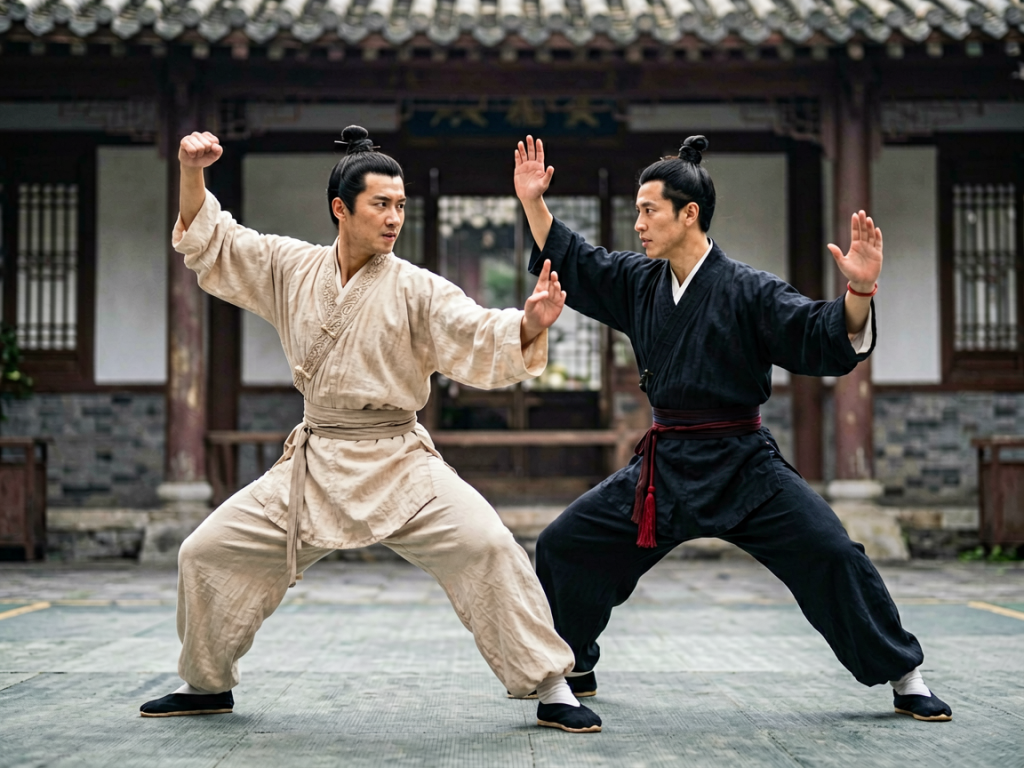
Here’s the thing. I spent three years living in a small village near Dengfeng, just a stone’s throw from the old Shaolin Temple. I woke up at 5:30 a.m. every single day for four years. My legs shook. My back screamed. I drank more bitter herbal tea than I care to admit.
Then I took a high-speed train south to Mount Wudang. The air there was thick with mist and the smell of pine. The monks there moved like water. It was a completely different vibe from the hard, thudding kicks of Henan.
If you’ve ever watched a movie, you probably think you know the difference. One is hard, one is soft. One is Buddhist, one is Taoist. But if you actually step into a training hall, the reality is a lot messier. And honestly, a lot more interesting.
I’m not here to give you a textbook definition. Textbooks are boring. I’m here to tell you what it actually feels like to stand on the ground and try not to break your own fingers. So, let’s talk about the real differences between Shaolin and Wudang.
The Hard Truth About Shaolin
Let’s start with the elephant in the room. Or rather, the iron wooden post in the room. When you think of Shaolin, you think of iron. You think of bones that feel like stone. I remember watching a senior disciple hit a sandbag filled with steel balls. The bag didn’t move. His fist did, though. It looked like he was punching through solid rock.
Shaolin kung fu is rooted in Chan Buddhism. The philosophy is about discipline. It’s about purifying the mind through physical suffering. That’s why the training is so brutal. You’re not just learning to fight. You’re learning to control your own body when it wants to quit.
I tried the basic horse stance in Shaolin. It’s where you squat low, back straight, arms out. Simple, right? Wrong. After ten minutes, my legs felt like they were on fire. After twenty minutes, I was trembling so hard I thought I’d fall over. The monk watching me just smiled and said, “Good. That means it’s working.”
That’s the Shaolin way. It’s external. It’s about building power from the ground up. The forms are dynamic. They’re full of jumps, kicks, and strikes that look incredible in a performance. If you watch a Shaolin troupe in Beijing, you’ll see people doing flips that defy physics. It’s flashy, sure. But that flash has a purpose.
The techniques are designed for the battlefield. Or at least, that’s what they claim. The movements are direct. Block, strike, kick, repeat. There’s no wasted motion. Every punch is intended to end the fight. It’s efficient. It’s aggressive. It’s everything you’d expect from a martial art born in a military temple.
But don’t let the hardness fool you. Shaolin is also about balance. The monks talk a lot about yin and yang. Even in their hardest styles, there’s a softness. It’s just hidden under layers of muscle and callous.
Flowing Like Water: The Wudang Approach
Now, let’s head to Wudang. If Shaolin is a hammer, Wudang is a river. I visited the Golden Hall on top of Mount Wudang during the winter. The wind was howling. The temperature was below freezing. Yet, the practitioners were moving slowly, gracefully, in white robes that fluttered in the gale.
Wudang kung fu is tied to Taoism. The philosophy is about harmony with nature. It’s about going with the flow rather than fighting against it. When you train here, you aren’t trying to break the bag. You’re trying to move *with* the wind.
I tried Tai Chi there. Yeah, I know. Everyone thinks Tai Chi is for old people in parks. But the real Wudang Tai Chi is intense. It’s slow, but it’s powerful. Imagine trying to push a heavy boulder that keeps moving away from you. That’s what it feels like.
The instructor told me, “Your force is direct. Mine is circular. You hit me, you hit air. I hit you, you hit me.” It sounds like a riddle. It’s actually physics. It’s about redirection. It’s about using your opponent’s energy against them.
The movements are circular. They’re fluid. There’s very little jumping. No high kicks. It’s all about structure and alignment. You’re learning to root yourself to the earth. When someone pushes you, you don’t resist. You yield. And in that yielding, you find an opening.
I remember watching a master practice Bagua Zhang. He was walking in circles. Just walking in circles. But every time he turned, his hand moved. It was like he was holding a giant ball. Or maybe a steering wheel. The coordination required is insane. I tried it for five minutes and got dizzy. He did it for an hour.
Wudang isn’t just about softness. It’s about internal power. It’s about generating force from the dantian, or center. It’s not about muscle mass. It’s about breath and intent. To be fair, it’s much harder to learn than it looks. Watching it is easy. Doing it is a nightmare.
Philosophy in Motion
The biggest difference isn’t just physical. It’s mental. Shaolin teaches you to conquer yourself. Wudang teaches you to accept yourself. Or maybe to accept the universe. The lines get blurry, but the starting point is different.
At Shaolin, you’re fighting your limits. You’re pushing past pain. You’re building armor. At Wudang, you’re dissolving your ego. You’re learning to be like water. One is about building up. The other is about letting go.
I asked a Shaolin monk once why they train so hard. He said, “To become strong enough to protect the weak.” I asked a Wudang practitioner the same question. He said, “To become weak enough to understand the strong.” See the difference?
It’s not about which one is better. It’s about what you need. If you’re angry, Shaolin might help you channel that energy. If you’re anxious, Wudang might help you find calm. Both are valid paths. Both are ancient. Both are real.
People often ask me which one I prefer. I’m no expert. I’ve only scratched the surface of both. But I’ll be honest. I miss the smell of incense in the Shaolin halls. I miss the silence of the Wudang mountains. I don’t want to pick a winner. That’s missing the point.
Modern Life and Ancient Roots
Here’s the tricky part. Most people in China don’t train in either of these for self-defense anymore. They do it for health. For culture. For tourism. I’ve seen tourists in Shaolin paying 500 yuan for a one-hour class. They come away with a photo and a sore back.
Real training takes years. Decades, even. The commercial side of kung fu is huge. You’ll find schools teaching “Shaolin Kung Fu” that look nothing like the real thing. They’re gymnastics classes with costumes. It’s not bad. It’s just not the traditional art.
Wudang has its own commercial side. You’ll find shops selling amulets and swords to visitors. The mountains are crowded with tour buses. But if you wake up early enough, you can still find the old masters practicing in the mist. They don’t care about the tourists. They care about the practice.
I tried to find a teacher who could teach me both. It’s rare. Most masters specialize. A Shaolin master won’t teach you Wudang moves. A Wudang master won’t teach you Shaolin forms. It’s about lineage. It’s about respect for the tradition.
So, if you’re thinking of training, do your research. Don’t just pick a style because it looks cool in a movie. Think about your own body. Your own mind. Are you a hammer or a river? Or maybe you’re something in between.
My Final Take
I’ll be honest. I started out thinking Shaolin was cooler. The jumps. The weapons. The history. It’s iconic. But after spending time with both, I’ve changed my mind. Or maybe I’ve just expanded my mind.
Wudang’s emphasis on internal energy and health has stayed with me. It’s helped me deal with stress. It’s helped me stand taller. It’s subtle, but it’s powerful. But I still respect the hardness of Shaolin. I respect the discipline. I respect the fire.
The real difference isn’t in the styles. It’s in the student. You bring your own intent to the mat. If you bring anger, you’ll learn aggression. If you bring fear, you’ll learn defense. If you bring respect, you’ll learn art.
So, don’t get hung up on the debate. Shaolin vs Wudang is a false dichotomy. They’re two sides of the same coin. They’re both expressions of Chinese culture. They’re both tests of human potential.
Just go. Try one. Try the other. Feel the difference. Let your body tell you what it needs. And for the love of everything holy, wear comfortable shoes. Trust me on that one.