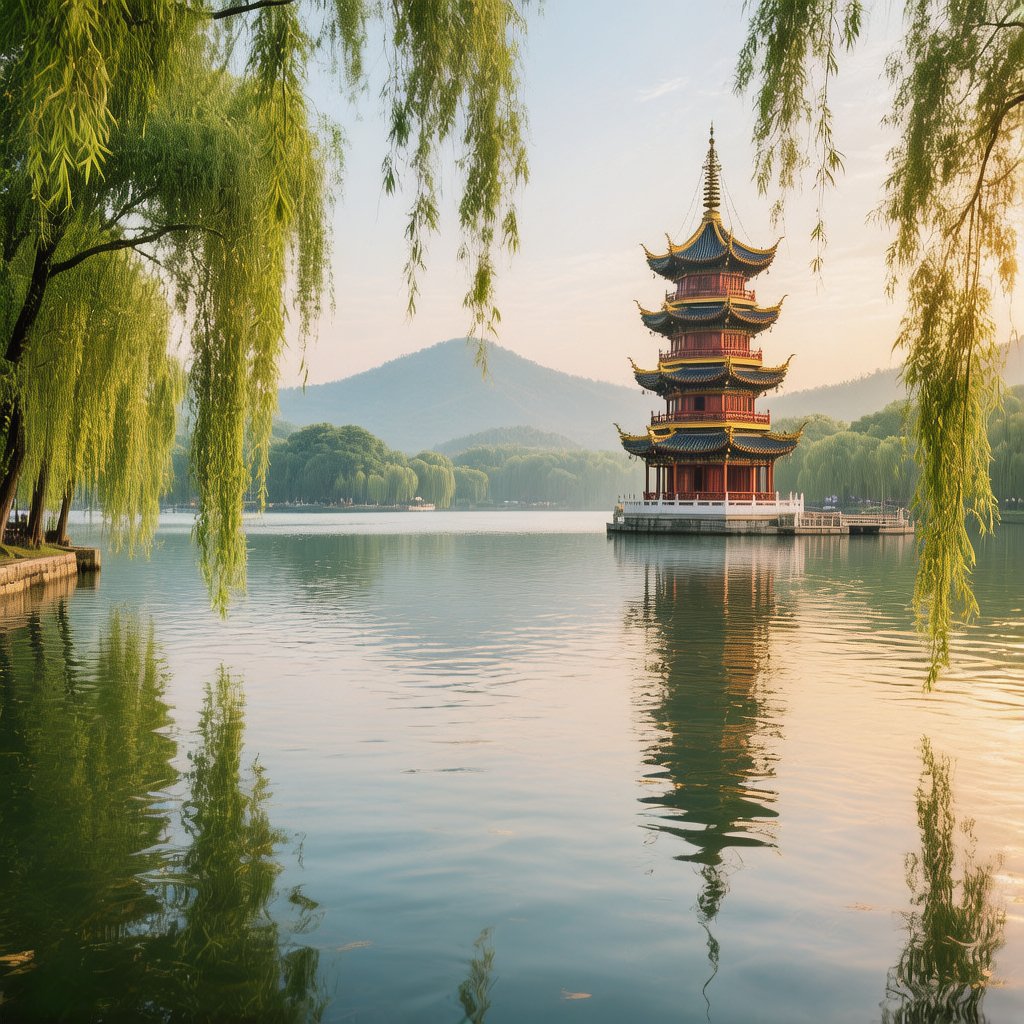
For over a thousand years, West Lake has been China’s ultimate muse — a landscape so beautiful that poets, painters, and emperors have tried to capture its essence in every medium imaginable. Located in the heart of Hangzhou, Zhejiang Province, this UNESCO World Heritage Site is not merely a lake but a living canvas where nature and human artistry have conspired to create one of the most enchanting destinations on Earth. The lake’s shores are lined with pagodas, temples, gardens, and causeways that represent the pinnacle of classical Chinese landscape design, each element placed with the precision of a brushstroke on a silk painting.
A Lake Born of Legend and Geology
West Lake’s origins are as poetic as its scenery. Geologically, the lake was once a shallow bay of the Qiantang River that gradually became landlocked through silt deposition, creating a freshwater lake surrounded by hills on three sides. Chinese legend offers a more romantic explanation: the lake was formed from a pearl dropped by the Phoenix and the Dragon, celestial beings who were carrying the jewel to heaven. When they stumbled, the pearl fell to earth and became West Lake, with the surrounding hills forming from the creatures’ wings as they landed to retrieve it.
The lake covers approximately 6.39 square kilometers and is divided into five distinct sections by three causeways: Su Causeway, Bai Causeway, and Yanggong Causeway. These artificial land bridges serve both practical and aesthetic purposes, allowing pedestrians and cyclists to cross the lake while creating the visual divisions that make each section feel like a separate world. The causeways are lined with willow trees and peach blossoms, creating a spectacular corridor of pink and green during spring that has inspired countless paintings and poems.
The Ten Classic Scenes of West Lake
Since the Southern Song Dynasty, West Lake has been defined by its “Ten Classic Scenes,” a curated list of the most beautiful views that has guided visitors for centuries. Each scene captures a specific aspect of the lake’s beauty at a particular time or season, and experiencing all ten remains a goal for dedicated travelers.
Dawn on the Su Causeway in Spring is perhaps the most famous of the ten scenes. The 2.8-kilometer causeway, built by the Song Dynasty poet-governor Su Dongpo, comes alive in early spring when the peach blossoms bloom alongside the weeping willows. Walking the causeway at dawn, when the morning mist still clings to the water and the first light paints the hills in soft gold, is an experience that feels like stepping into a Song Dynasty scroll painting.
Leifeng Pagoda in Evening Glow captures the magical moment when the setting sun silhouettes the five-story pagoda against the western sky. The original pagoda, built in 977 AD, collapsed in 1924 and was reconstructed in 2002. The new structure faithfully replicates the original’s elegant proportions while incorporating modern engineering. The view from the top at sunset, with the entire lake spread below like a mirror of fire, is one of China’s most photographed scenes.
The other classic scenes include Listening to Orioles Singing in the Willows, where bird song mingles with rustling leaves at Willow Wave Park; Viewing Fish at Flower Harbor, a garden where thousands of red carp create living tapestries in the water; Lingering Snow on the Broken Bridge, a winter scene where snow melts unevenly on the famous arched bridge; and Three Pools Mirroring the Moon, where three stone pagodas in the southern lake create ethereal reflections during the Mid-Autumn Festival.
Walking and Cycling the Lake
The complete circuit of West Lake measures approximately 15 kilometers, a distance that can be covered on foot in about four hours or by bicycle in two. The walk is flat, well-paved, and consistently beautiful, making it one of China’s most pleasant urban walks. Bicycle rentals are available at numerous stations around the lake, and the dedicated cycling paths make pedaling safe and enjoyable.
For a more immersive experience, consider breaking the circuit into sections and exploring each in depth. The northern shore, with the Broken Bridge and Baochu Pagoda, is best in the early morning when the light is soft and the crowds are thin. The western shore, dominated by the Su Causeway and Maojiabu scenic area, offers the most natural scenery with lotus ponds, bamboo groves, and tea plantations extending into the hills. The southern shore features the Leifeng Pagoda and Jingci Temple, while the eastern shore is the most urban, with the city’s modern skyline providing a dramatic contrast to the classical landscape.
Tea Culture: The Soul of Hangzhou
West Lake and Longjing tea are inseparable in the Chinese cultural imagination. The hills west of the lake produce China’s most celebrated green tea, and the tea plantations that climb the slopes of Longjing Village and Meijiawu are an essential part of the West Lake experience. A visit to these terraced gardens, where tea bushes form geometric patterns on the hillside, provides insight into a craft that has been perfected over centuries.
Spring is the most exciting time to visit the tea villages, as this is when the precious pre-Qingming tea is harvested. The first tender leaves, picked before the Qingming Festival in early April, produce the most delicate and expensive tea in China. Watching skilled tea pickers move through the rows with practiced efficiency, their fingers deftly plucking only the finest two-leaf bud sets, is mesmerizing. Most tea farms welcome visitors for tastings, and the experience of drinking freshly roasted Longjing tea while overlooking the very hills where it was grown is transcendent.
Temporalles of the Lake: Spirituality and Architecture
West Lake’s shores and surrounding hills are home to some of China’s most important Buddhist temples. Lingyin Temple, founded in 326 AD, is one of the largest and wealthiest Buddhist monasteries in China. Its Grand Hall houses a 24.8-meter-tall camphor wood Buddha statue, and the temple’s setting in a forested valley creates an atmosphere of profound tranquility. The Feilai Feng grottoes adjacent to the temple contain over 300 stone Buddhist carvings dating from the 10th to the 14th centuries, their weathered faces gazing serenely from the cliff faces.
Jingci Temple, on the southern shore of the lake, is equally significant and considerably less visited. Founded during the Five Dynasties period, the temple is famous for its ancient bell, which rings out across the lake each evening in a tradition known as “Evening Bell at Nanping Hill” — another of the Ten Classic Scenes. The temple’s vegetarian restaurant serves some of the finest Buddhist cuisine in Hangzhou, and a meal here followed by a meditative walk through the temple gardens is a perfect antidote to the crowds at the more popular attractions.
The Cuisine of Hangzhou
Hangzhou’s cuisine is one of the eight great culinary traditions of China, characterized by its refinement, subtlety, and emphasis on fresh, seasonal ingredients. The restaurants around West Lake serve dishes that have been perfected over centuries, many of them with literary associations that connect dining to the lake’s cultural heritage.
West Lake Vinegar Fish is the city’s most iconic dish, featuring a whole grass carp from the lake served in a sweet-and-sour sauce that balances richness with acidity. Dongpo Pork, named after the same poet-governor who built the Su Causeway, is a slow-braised pork belly that achieves a melting tenderness through hours of patient cooking. Beggar’s Chicken, wrapped in lotus leaves and clay before baking, delivers an extraordinarily fragrant result as the clay shell is cracked open at the table. Longjing Shrimp pairs the local tea with fresh lake shrimp for a dish that is uniquely Hangzhou.
Seasonal Guide to West Lake
West Lake rewards visitors in every season, but the experience varies dramatically. Spring (March to May) is the most popular time, when the cherry blossoms, peach flowers, and tulips create a kaleidoscope of color around the lake. The weather is mild and the gardens are at their most exuberant, but crowds can be intense, particularly during the Qingming Festival holiday.
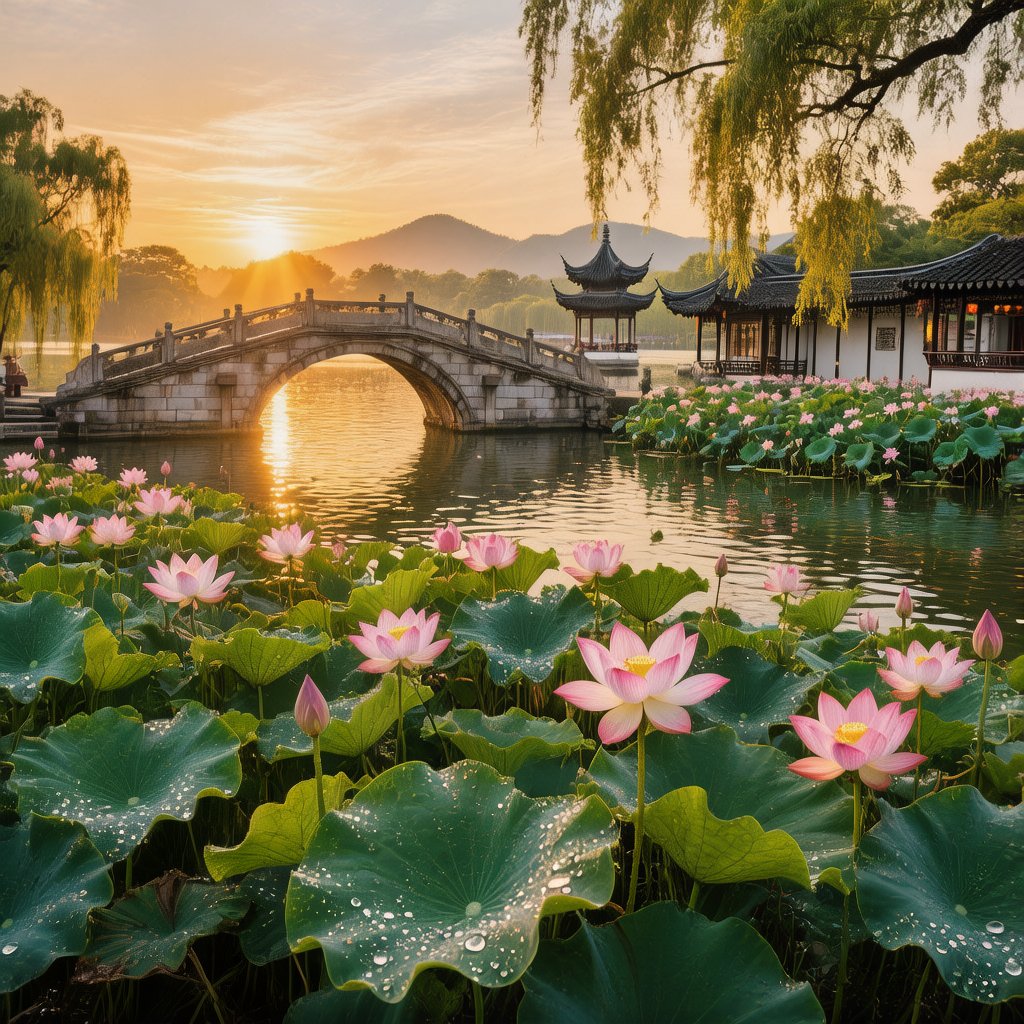
Summer (June to August) brings the lotus season, when thousands of lotus flowers bloom in the lake’s shallows, creating vast carpets of pink and green. The heat can be oppressive, but early morning and evening walks along the lake are delightful, and the sight of the lotus flowers closing at dusk is a uniquely poetic experience.
Autumn (September to November) offers the most comfortable weather and the stunning osmanthus season, when the sweet fragrance of golden osmanthus flowers permeates the entire city. The autumn foliage around the lake creates rich tapestries of amber and crimson, and the Mid-Autumn Festival celebrations, with their lantern displays and mooncake traditions, are unforgettable.
Winter (December to February) transforms the lake into a scene of minimalist beauty. The bare willow branches create delicate calligraphic lines against the grey sky, and if you are fortunate enough to witness snow on the lake, you will experience the fabled “Lingering Snow on the Broken Bridge” — a view that Chinese artists have tried to capture for a thousand years.
Practical Information for Visitors
West Lake is free to visit and accessible 24 hours a day. The surrounding parks and gardens charge modest admission fees, typically between 10 and 50 yuan. The Hangzhou Public Bicycle system offers convenient rentals with stations throughout the lake area, and the first hour is free. The metro system connects the lake to Hangzhou’s high-speed railway station, making day trips from Shanghai possible in under an hour.
For the best experience, plan at least two days to explore the lake and its surroundings at a leisurely pace. Stay in one of the hotels or guesthouses near the lake, wake before dawn to catch the morning mist, and allow yourself to be drawn into the same contemplative rhythm that has captivated visitors for over a millennium. West Lake is not a destination to rush through — it is a place to linger, to observe, and to let the poetry of the landscape seep into your soul.