
Chinese martial arts embody philosophical principles that extend far beyond combat techniques, offering profound insights into human nature, personal development, and harmonious living. Understanding these philosophical foundations enriches martial arts practice and provides valuable guidance for navigating life’s challenges with wisdom and grace. The integration of philosophy and physical practice distinguishes Chinese martial arts from mere fighting systems, elevating them to paths of personal transformation that have been followed for centuries by scholars, warriors, and spiritual seekers alike.
The philosophical foundations of Chinese martial arts draw from three major traditions that have shaped Chinese culture: Taoism, Confucianism, and Buddhism. Each tradition contributes unique perspectives that together create a comprehensive framework for understanding the relationship between physical training, mental development, and spiritual growth. Taoism contributes the concepts of naturalness, spontaneity, and harmony with the universe. Confucianism emphasizes moral cultivation, social responsibility, and proper relationships. Buddhism, particularly Chan Zen Buddhism, contributes mindfulness, present-moment awareness, and the transcendence of dualistic thinking.
Yin and Yang in Martial Arts
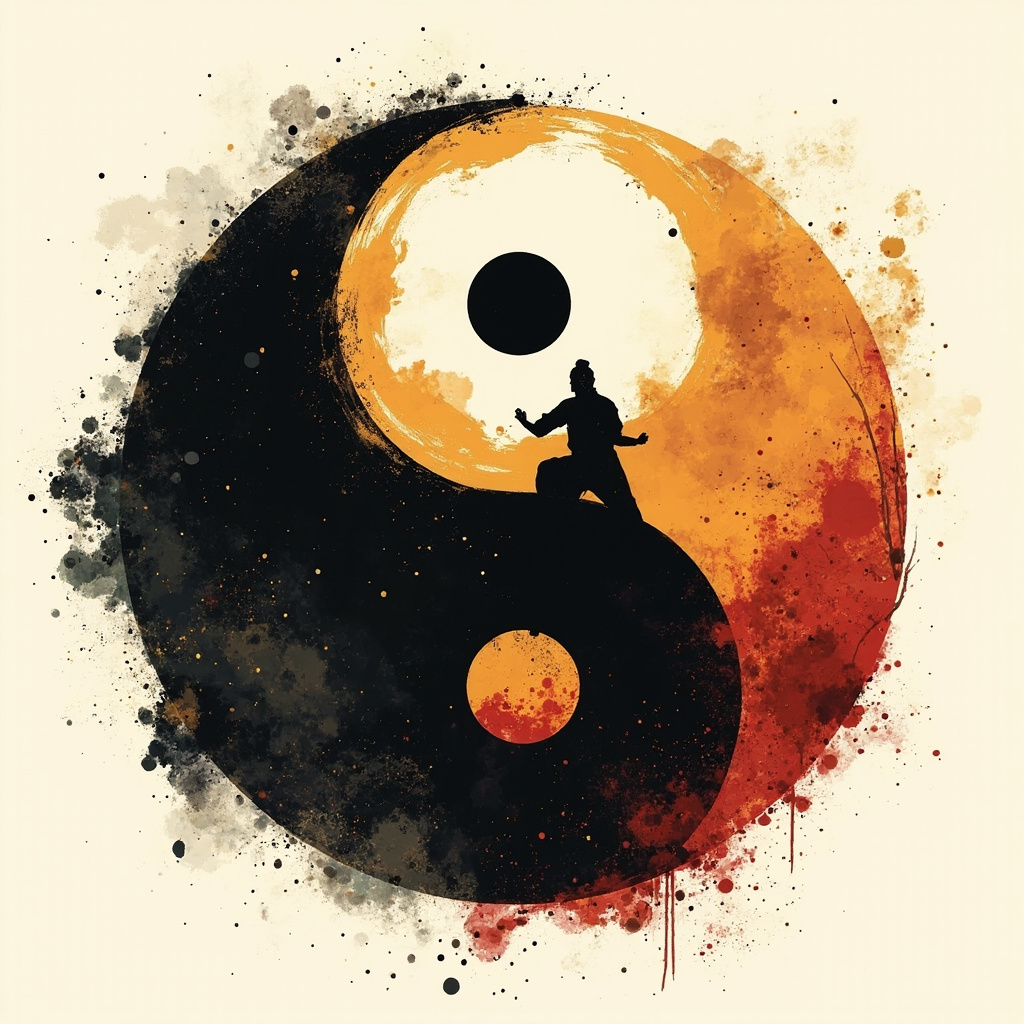
The concept of Yin and Yang, originating from Taoist philosophy, provides the fundamental framework for understanding Chinese martial arts strategy and technique. Yin represents softness, yielding, darkness, and receptivity, while Yang represents hardness, aggression, lightness, and activity. True martial mastery lies not in choosing one over the other but in understanding how these complementary forces interact and transform into each other. A hard block that meets an incoming attack with equal force may result in injury to both parties, while a soft redirect that yields to the attack’s momentum can neutralize it with minimal effort. Circular movements that flow from one technique to the next exemplify the interaction of Yin and Yang, with each movement containing the seed of its opposite within itself. Advanced practitioners learn to transition seamlessly between soft and hard, yielding and attacking, defense and offense, adapting their approach moment by moment to the changing circumstances of combat. The Tai Chi symbol itself, with its interlocking teardrop shapes, represents the interdependence and constant transformation of these complementary forces in all aspects of life and combat.
Daoism and Natural Movement
Daoist philosophy, particularly the concept of Wu Wei or effortless action, profoundly influences Chinese martial arts theory and practice. Wu Wei describes a state of spontaneous, natural action that arises when the practitioner is fully present and responsive to the situation rather than imposing preconceived plans or techniques. In martial terms, this means responding to an opponent’s attack with exactly the right technique at exactly the right moment, without hesitation or calculation. The famous water metaphor from Daoist philosophy encourages martial artists to be like water, adapting to any container, flowing around obstacles, and wearing down the hardest substances through persistent, gentle action. Practitioners cultivate this quality through thousands of repetitions of basic techniques until the movements become spontaneous and natural, requiring no conscious thought to execute. The paradox of Wu Wei is that it requires immense effort and discipline to achieve, as the spontaneity of effortless action only arises from dedicated practice that makes correct responses automatic.
Respect, Discipline, and Moral Cultivation
Confucian values of respect, discipline, and moral cultivation are central to traditional Chinese martial arts training. Students are taught to respect their teachers, training partners, and opponents, recognizing that everyone they encounter provides opportunities for learning and growth. The teacher-student relationship in Chinese martial arts is modeled on the Confucian ideal of the teacher as a moral exemplar who guides students in both technical skill and character development. Etiquette and ritual, including bowing before entering and leaving the training space, maintain the formal structure that supports respectful interaction and focused practice. The concept of wu de, or martial virtue, emphasizes that martial skill without moral character is dangerous and incomplete, teaching students to use their abilities only for protection and justice. Many traditional schools require students to sign pledges promising not to misuse their training or to initiate violence unnecessarily, reinforcing the ethical dimension of martial practice.
Meditation and Mindfulness in Practice
Meditation has been an integral part of Chinese martial arts since the Shaolin Temple’s founding, with Chan Buddhism contributing techniques for developing focused awareness and mental clarity. Traditional training begins and ends with meditation periods that prepare the mind for practice and integrate the lessons learned. Moving meditation, as practiced in Tai Chi and internal martial arts, combines physical movement with meditative awareness, developing the ability to maintain calm focus even during intense physical activity. Mindfulness practice cultivates the ability to observe thoughts, emotions, and physical sensations without being controlled by them, a skill that is invaluable during combat and equally valuable in daily life. Breathing meditation, in which the practitioner focuses attention on the breath while performing techniques, develops the connection between breath, movement, and awareness that is essential for efficient energy use and power generation.
The Martial Artist’s Path of Self-Cultivation
Chinese martial arts are traditionally viewed as a lifelong path of self-cultivation rather than a finite skill to be acquired. This perspective encourages practitioners to approach training with patience, humility, and long-term commitment rather than seeking quick results or superficial achievements. The path involves continuous refinement of technique, deepening of understanding, and integration of martial principles into all aspects of life. Advanced practitioners often report that their martial arts training transforms how they approach relationships, work, and everyday challenges, applying principles of balance, timing, and appropriate response to situations far beyond the training hall. The ultimate goal of traditional martial arts training is not victory over others but mastery of oneself, developing the wisdom and self-control to respond appropriately to any situation life presents.
Conclusion
Chinese martial arts offer paths to physical mastery and personal growth that distinguish them from mere combat systems. The philosophy that accompanies the physical training provides depth and meaning that sustains practitioners throughout their lives. Understanding the philosophical foundations of martial arts transforms practice from exercise into a comprehensive path of personal development.
The Five Animal Styles and Their Philosophy
Chinese martial arts have developed distinctive styles based on observations of animal movements and behaviors, each embodying different strategic principles and physical qualities. The Tiger style represents raw power and aggressive forward movement, teaching practitioners to develop strong bones and direct attacking techniques. The Crane style embodies grace and precision, emphasizing balance, evasion, and precise striking with minimal force. The Leopard style combines speed and power, training explosive acceleration and rapid combinations that overwhelm opponents. The Snake style cultivates internal energy and fluidity, using circular movements and precise targeting of vulnerable points. The Dragon style is the most comprehensive, representing the synthesis of all other animal qualities and teaching practitioners to be unpredictable and adaptable. Studying these animal styles provides a framework for understanding different martial strategies and developing a well-rounded skill set that can adapt to any combat situation.
Qi Cultivation and Internal Energy
The concept of qi or vital energy is central to Chinese martial arts philosophy, though its understanding varies among practitioners and traditions. Qi is understood as the vital energy that flows through the body along pathways called meridians, and martial arts training aims to cultivate, store, and direct this energy for health and combat purposes. Internal martial arts like Tai Chi and Bagua Zhang place special emphasis on qi development through specific breathing exercises, visualization, and slow, focused movements. External martial arts like Shaolin also incorporate qi cultivation as an integral part of advanced training, recognizing that physical strength alone is insufficient for high-level practice. The practical manifestations of qi cultivation include improved endurance, faster recovery from exertion, enhanced body awareness, and the ability to generate power with minimal muscular tension. While the scientific basis of qi remains debated, the training methods associated with qi cultivation produce verifiable benefits in health, coordination, and martial skill.
Applying Martial Philosophy to Daily Life
The philosophical principles learned through martial arts training have practical applications in everyday life that extend far beyond combat. The principle of yielding to overcome, central to Tai Chi philosophy, applies to interpersonal conflicts where sometimes stepping back and allowing situations to develop naturally produces better outcomes than forceful confrontation. The discipline of consistent practice develops character traits of patience, perseverance, and self-awareness that benefit all areas of life. The mindfulness cultivated through martial arts training improves focus and performance in professional and academic pursuits. The respect for others learned through martial arts etiquette translates into better relationships with colleagues, family, and friends. Many advanced practitioners report that their martial arts training transforms how they approach challenges, relationships, and personal growth, applying principles of balance, timing, and appropriate action far beyond the training hall.