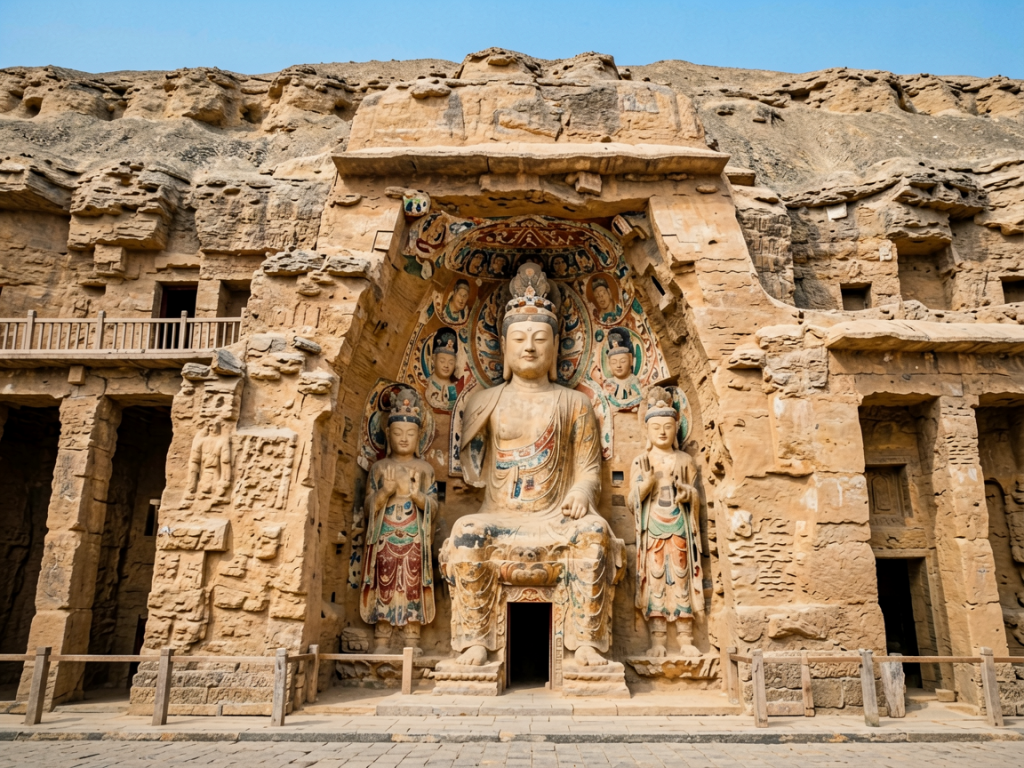
I’ll be honest. When I first booked a ticket to Dunhuang, I wasn’t expecting to cry. I’m a tough customer. I’ve seen the Great Wall when it’s crowded with tour groups and eaten spicy hotpot until my stomach hurt. But standing in Cave 96, staring up at that 33-meter-tall Maitreya Buddha, I felt small in a way that had nothing to do with size and everything to do with time.
Dunhuang isn’t just a dot on the map of China’s Gansu province. It’s the place where the desert meets the mountains, where the Silk Road actually made sense. And right there, carved into the red sandstone cliffs, are the Mogao Caves. They’re not just caves. They’re a library of faith, art, and commerce that spans sixteen centuries.
The oasis that funded the angels
You probably think of monks living in seclusion, surviving on alms and rainwater. That’s partly true. But here’s the thing about Dunhuang: it was a toll booth. If you wanted to cross the Hexi Corridor without getting robbed or dying of thirst, you stopped here. You bought water. You paid taxes. And you often donated that money straight to the cave builders.
I spent an afternoon with a local historian named Li Wei, who grew up in the shadow of the crescent lake. He laughed when I asked if the monks were poor. “Poor? No,” he said. “The donors were rich merchants from Chang’an, Samarkand, and even Baghdad. They wanted merit. They wanted their names on the wall.” And they got it.
Every mural, every statue, every scroll was paid for by someone who wanted to be remembered. You see names like “Lady Wang” or “Merchant Zhang” scrawled in the corners of paintings. They weren’t anonymous artists working in secret. They were contractors. They were entrepreneurs of the spiritual economy.
This changes how you look at the art. It’s not just divine inspiration. It’s a transaction. A merchant pays for a beautiful bodhisattva, and in return, he gets blessings for his caravan’s safe passage through the dangerous Taklamakan Desert. Sound interesting? It’s basically the original crowdfunding campaign, but with higher stakes and better aesthetics.
1,600 years of paint in a dust bowl
The scale is hard to grasp until you’re there. There are 735 caves. There are 45,000 square meters of murals. To put that in perspective, that’s enough to cover ten football fields. And they’re all hand-painted on mud and straw walls in the middle of a desert that tries its hardest to erase them.
I visited in late October. The wind was howling outside, kicking up yellow sand that settled on the visitor center windows. Inside, the air was cool and dry. It’s a perfect preservation environment, if you ignore the fact that humans are trying to break it down by breathing.
The colors haven’t faded because of lack of oxygen. They’re faded because of oxidation and light. That’s why you can’t go inside most caves anymore. You get thirty seconds to look at Cave 158, the reclining Buddha, through a dimly lit window. The rest? You watch a high-res video projection.
I know. It sucks. I wanted to walk into Cave 257, famous for the “Nine-Colored Deer” story. Instead, I sat in a dark room watching a screen. But then I looked at the faces in the video. The blues were made from lapis lazuli imported from Afghanistan. The greens from malachite. The pinks from realgar. These pigments survived because the caves were sealed tight, buried under sand for centuries.
Think about the logistics. Getting that stone out of Afghanistan, across the Himalayas, and through the Gobi? That took months. That cost a fortune. And they smashed it up to paint a deer story on a cliff face. Why? Because beauty was the point. Devotion was the payment. And trade was the engine.
The library cave that disappeared
Here’s the part that always makes my blood boil. Cave 17, the Library Cave. In 1900, a Daoist priest named Wang Yuanlu was cleaning out sand from a corridor when his pickaxe hit hollow space. He broke through a wall and found a room packed with tens of thousands of manuscripts, textiles, and paintings dating back to the 4th century.
It was a time capsule. Everything from Buddhist sutras to tax records, marriage contracts, medical texts, and poetry. It was the internet of the ancient world, stored on paper.
Wang didn’t know what he had. He thought it was trash. So, when explorers arrived–Aurel Stein from Britain, Paul Pelliot from France, others from Japan and Russia–they bought the books for pennies. Stein paid him $250 worth of silver and goods for over nine thousand volumes. Pelliot picked the best philosophical texts for a mere $500.
I remember reading about this for the first time. I couldn’t sleep. Where are those books now? Some are in the British Library. Some are in Paris. Some are in Tokyo. They’re scattered across the globe, separated from the very wall they came from.
But here’s the twist. Wang wasn’t entirely to blame. He was a poor priest in a remote town. He had no idea of their value. He later tried to send them to Beijing for safekeeping, but the officials ignored him. By the time anyone cared, the treasure was gone. It’s a tragedy of bureaucracy, colonialism, and timing.
I visited the museum in Dunhuang after the caves. They have replicas. They have photos. But holding a piece of history from 1,200 years ago? You can’t do that. You just have to trust that the spirit of those writers is still somewhere between the silk and the sand.
Why you need to go (and how to survive it)
Look, Dunhuang is far. Really far. From Xi’an, it’s a four-hour flight. From Lanzhou, it’s six hours by train. Most people skip it because it feels like a hassle. Don’t.
The city itself is small and walkable. The Crescent Lake is right next to the Mingsha Mountain (Singing Sand Dunes). You can hike up the dunes at sunset. It’s free, mostly. The sand sings when you slide down it. I slid down three times. I looked ridiculous, but I felt alive.
Eating there is underrated. You think it’s just lamb? Sure, try the roasted lamb leg. But also get the huimian, a chewy white noodle dish with cucumber and chili oil. It’s cheap. It’s refreshing. It cuts through the dry heat of the desert. I ate it every day. My wallet loved it.
Booking tickets for the Mogao Caves is tricky. You need to reserve weeks in advance. There’s a limited number of visitors per day to protect the caves. I tried to walk up on the day of, and the line was around the block. Just book online. It’s worth the headache.
And bring cash. Not for the tickets, but for the little shops near the visitor center. You’ll see jade carvings, silk scarves, and replica murals. Buy a scarf. It’s lighter than carrying a book of sutras, and you’ll stay cooler in the summer.
The silence of the Gobi
I left Dunhuang with sand in my boots and a strange quietness in my head. Modern life is loud. We’re always notified, always connected, always moving. But in those caves, time stopped.
The painters worked in silence. The monks prayed in silence. The merchants counted coins in silence. There was no noise pollution. Just the wind outside and the brush inside.
I stood in front of a Bodhisattva from the Tang Dynasty, painted around 700 AD. Her eyes followed me. Not in a creepy way. In a knowing way. She had seen empires rise and fall. She had seen the Silk Road dry up. She had seen her own cave buried under sand.
She remained.
That’s the lesson of Dunhuang. It’s not just about Buddhism. It’s about resilience. It’s about how people find meaning in the harshest places on Earth. They didn’t have electricity. They didn’t have AC. They had faith, trade, and a whole lot of patience.
If you go, don’t just rush through the caves. Take time to sit by the Crescent Lake. Watch the camels walk by. Think about the merchants who once did the exact same thing, worrying about bandits and water levels.
We’ve forgotten how to wait. How to sit still. How to appreciate the slow burn of history. Dunhuang forces you to slow down. The heat does that too, but the culture does it better.
I’m not saying you’ll change your life. But you might just realize how small you are. And that’s a good feeling. It takes the pressure off. You’re not that important. The murals are. The desert is. The history is.
Come see it. Book the ticket. Pack the sunscreen. And leave your phone in the hotel room for an hour. You’ll thank me later. Trust me.