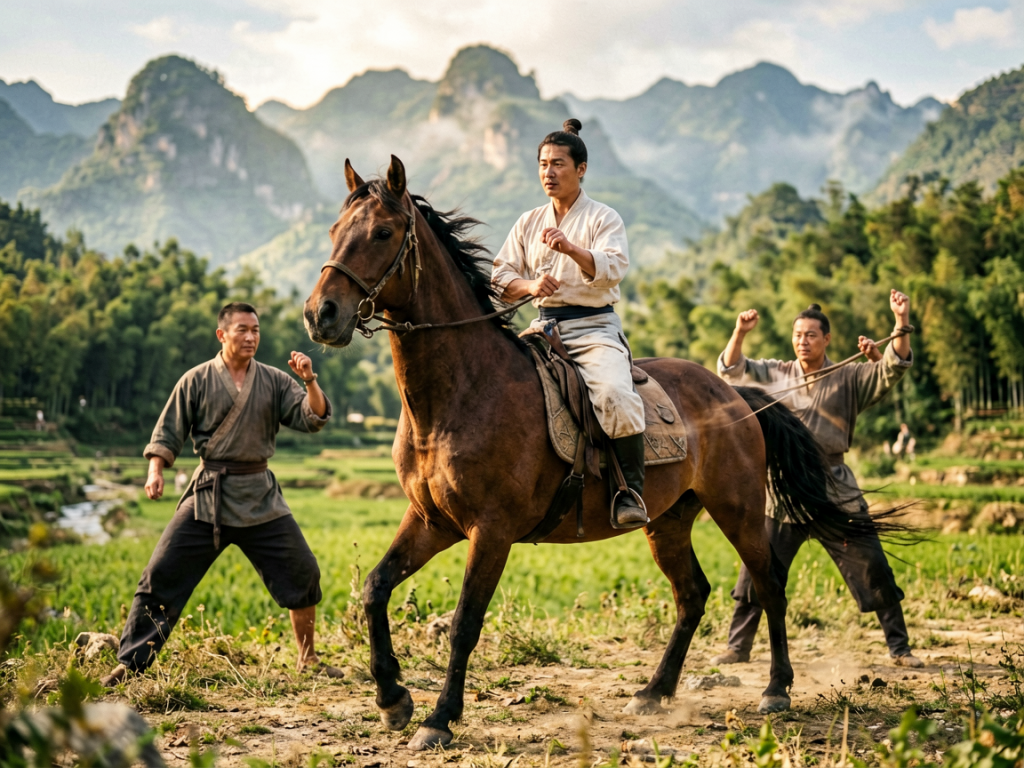
I Showed Up Expecting Bruce Lee Moves
I still remember the smell of my first kung fu class in Guangzhou. It smelled like old rubber mats, sweat, and damp concrete. I was twenty-four, fit from running marathons, and completely arrogant. I had watched enough Shaw Brothers movies to think I knew what martial arts looked like.
I wanted to fly. I wanted to spin. I wanted to break bricks with my pinky finger. Instead, the master, a stoic man named Uncle Lin, pointed to the corner of the room. He didn’t say a word. He just pointed.
I walked over, assuming I was supposed to shadowbox. Uncle Lin shook his head and dropped into a squat. His thighs were parallel to the floor. His back was straight. He looked like a statue carved from granite. That was it.
He held the pose for ten seconds before speaking. “Hold,” he said. “Until I say stop.” I laughed. I thought it was a joke. It wasn’t. It was the beginning of a six-week lesson in doing absolutely nothing.
The Agony of the Horse Stance
You might be wondering what a horse stance actually is. In Chinese, it’s called Mabu. It’s the foundational posture of almost every Southern Chinese martial art. You spread your feet wider than your shoulders, knees bent, toes pointing slightly inward or forward, and butt low.
It looks simple. It feels like hell. The first minute is fine. You’re thinking, “This is easy. I’ve got this.” By minute three, your quads start shaking. By minute five, your lower back screams. By minute ten, you’re questioning every life choice that led you to a sweaty gym in southern China.
I lasted forty-five seconds before my legs buckled. Uncle Lin didn’t yell. He didn’t hit me. He just sighed, adjusted my hips with two fingers, and made me stand up. Then he made me sit again.
For the next month, that was our entire routine. Warm up for ten minutes. Hold the stance. Repeat. No punches. No kicks. No forms. Just holding. I remember staring at the peeling paint on the wall, counting breaths, trying to convince my nervous system that standing still was a valid sport.
It felt pointless. I’m no expert, but I’ve seen people punch through wood in competitions. How does holding a squat help me hit harder? That was the question haunting me every day. I thought I was wasting my time. I thought I was being punished.
Building the Foundation Before the House
Here’s the thing about structure. If you try to build a second-story bedroom on a foundation of sand, it collapses. Martial arts aren’t an exception to physics. They obey it strictly. Uncle Lin eventually explained this while we drank tea after practice. I was stiff, walking like a newborn deer, but the tea helped.
“The root must be deep before the branches grow,” he told me. He meant that without stable legs, you have no power. Power doesn’t come from your arm. It comes from the ground. You push off the earth, channel that energy through your legs, rotate your hips, and then *maybe* your fist arrives with some force.
If your legs are weak or shaky, that energy leaks out. It dissipates into your knees or your lower back. You end up throwing a punch that feels heavy but hits like a wet noodle. The horse stance forces your body to learn stability under extreme load. It teaches your muscles to fire in unison.
After two months, something shifted. I wasn’t just standing; I was sinking. My center of gravity dropped naturally. When I finally started learning simple blocks, they felt immovable. I felt like an oak tree instead of a willow branch swaying in the wind. It wasn’t magic. It was biomechanics.
We’ve all seen videos of masters getting pushed and not moving an inch. People think it’s supernatural strength. It’s not. It’s structural alignment built on thousands of hours of standing still. It’s boring, yes. But it works.
Patience as a Martial Art
There’s another layer to this that I didn’t appreciate until I was much older. It’s mental. The horse stance is a meditation in motion. You can’t think about your email, your rent, or that rude comment your boss made. You can only think about keeping your knees aligned and your spine straight.
If your mind wanders, your body relaxes. If your body relaxes, you fall. So, the stance demands total presence. It forces you into the now. I found that practicing Mabu actually reduced my anxiety in daily life. I learned to sit with discomfort without reacting immediately.
In China, we have a concept called *chi ku*. It literally translates to “eat bitterness.” It means enduring hardship for long-term gain. Holding that squat for twenty minutes is eating bitterness. It’s a taste of the discipline required for real skill.
Modern life is obsessed with speed. We want fast results. We want quick fixes. We swipe right, we stream movies, we order food in seconds. Kung fu rejects this entirely. It says that if you rush the process, you ruin the outcome. You can’t hurry bone density. You can’t hurry tendon strength. You just have to wait.
I remember watching a junior student quit after three weeks. He wanted to spar. He wanted to feel cool. He couldn’t handle the monotony. Uncle Lin didn’t blame him. He just nodded and said, “If you cannot eat bitterness for ten minutes, how will you eat it for ten years?” It was a harsh truth, but a fair one.
From Stillness to Movement
Eventually, the punching started. But it wasn’t the wild haymakers I expected. It was tight, short, and explosive. Because my base was solid, the power transferred instantly. My punches didn’t just move my arm; they moved my whole body. I felt heavier, grounded, and dangerous in a way I never felt in the gym.
I tried sparring with someone who knew more striking but less grounding. He moved fast. I stayed still. He swung, I blocked. The impact stopped dead against my arms because my legs were rooted. I didn’t swing back wildly. I stepped in, anchored myself, and tapped him lightly on the chest. He fell over backward.
That moment blew me away. It wasn’t about who was stronger. It was about who was more connected to the earth. The horse stance had given me a leverage point that he didn’t have. I realized then that traditional training isn’t outdated. It’s efficient. It strips away the unnecessary fluff.
We spent the rest of my year in Guangzhou refining this connection. I learned forms, yes. I learned breathing exercises, too. But every single technique began and ended with the horse stance. It was the alphabet of our language. You wouldn’t write a novel without knowing letters, would you?
Why This Matters Today
I still go to the gym back home in Ohio. I lift weights. I run. But sometimes, when I’m stressed or feeling scattered, I drop into a squat. Just for a minute. It centers me. It reminds me that strength isn’t about appearance. It’s about foundation.
Traditional kung fu feels archaic to many Westerners. We see it as entertainment or history. But the principles inside it are incredibly practical. They teach resilience. They teach humility. They teach that you can’t cheat the process.
If you ever visit China and find yourself in a dusty park or a small school in the alleyways, watch closely. Don’t look for the flashy flips. Look for the old men holding static poses. Look for the kids shaking in their stances. That’s where the real work happens. That’s where the magic is brewed.
Uncle Lin retired two years ago. He goes to the temple now. I haven’t seen him since, but I keep his advice in my head. When I face a tough problem, I don’t rush to solve it. I drop my stance. I breathe. I hold. And then, when the time is right, I strike.
So, next time you see a martial artist holding a pose for what seems like an eternity, don’t check your watch. Don’t get bored. Respect the silence. Respect the shake. They are building something that lasts. And frankly, it’s better than most quick-fix workouts out there.
Trust me, once you understand the power of the root, everything else becomes clearer. Even if your legs hurt like crazy.