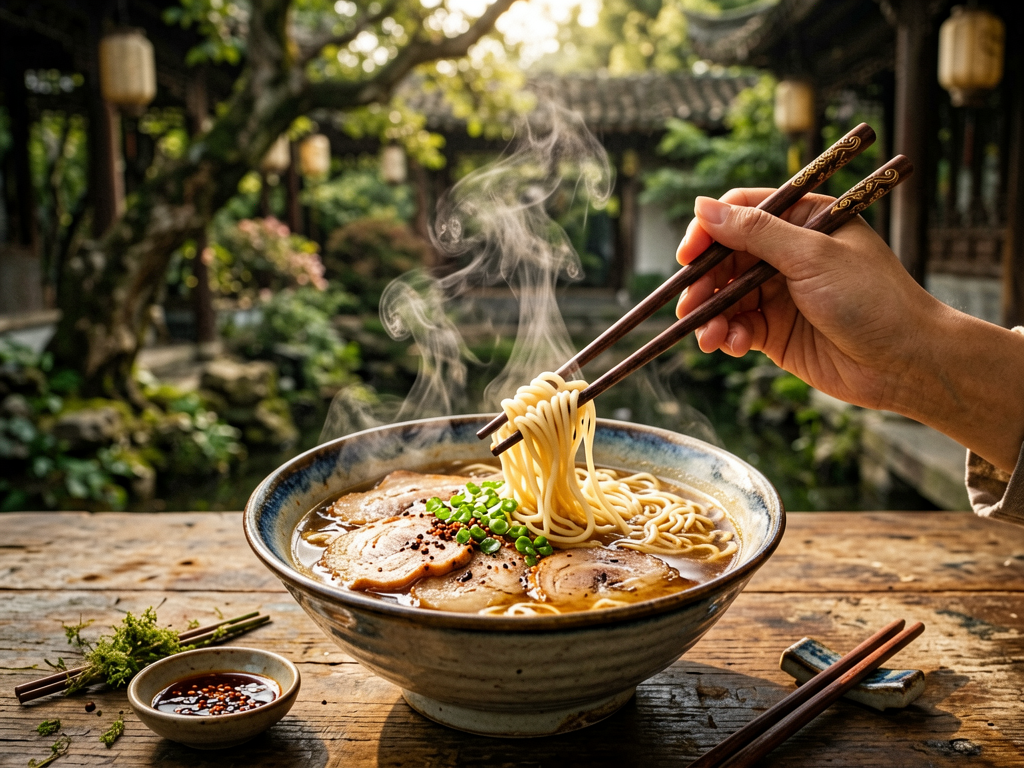
I remember the first time I tried to drink hot and sour soup with chopsticks in a small noodle shop in Chengdu. I was sweating. The bowl was too heavy, the broth too hot, and my hands were shaking like I was defusing a bomb. The old man at the next table just laughed, picked up his bowl, and tipped it straight to his lips. He didn’t even pause. I felt like an absolute amateur.
That was eight years ago. I’ve been living in China since then, eating my way through every province from the snowy north to the humid south. I’ve mastered the art of picking up slippery eel balls and delicate dumplings. But soup? Soup is still my nemesis.
Here’s the thing: you are trying to use a fork to drink a milkshake. It’s not just hard; it’s mechanically stupid. We’ve been conditioned by Western table manners to believe that utensils are for picking, not pouring. But in China, the chopstick is a tool for extraction, not consumption of liquids. If you want to eat like a local, you have to stop thinking like a tourist.
The Iron Age That Changed Everything
To understand why you’re struggling, you have to look back over 2,000 years. Most people think chopsticks are just a quirky Eastern alternative to the knife and fork. They’re wrong. They’re actually a technological solution to a specific environmental problem.
In ancient China, fuel was scarce. Wood was valuable. So, when people started cooking, they didn’t just throw a whole chicken in the pot. They cut the meat into tiny, bite-sized pieces before or during cooking. This saved massive amounts of fuel. Imagine cooking a whole roast in a fireplace versus chopping it up and stir-frying it in a wok. The difference in wood usage is huge.
This is where the knife disappears. In the West, the knife stayed at the table because we cut our meat there. In China, the cutting was done in the kitchen. By the time the food reached your table, it was already small enough to pick up. You didn’t need a knife to cut it. You just needed something to grab it.
That something became the chopstick. The earliest versions were likely made of bone or bamboo, but by the Han Dynasty, bronze and later iron chopsticks became common among the elite. They were longer than the ones we use today because the tables were lower, almost like floor-level dining in some traditions. But the principle remained the same: grab, lift, eat.
I once asked a historian in Beijing why the Chinese diet evolved this way. He told me it wasn’t just about fuel. It was about harmony. In Chinese philosophy, the kitchen is a place of transformation. The fire changes the raw into the cooked. The table is a place of consumption. Mixing the two–cutting and eating at the same time–was seen as disruptive to the flow of the meal. It’s a bit of a stretch, but it makes sense when you consider how meditative a Chinese dinner can feel.
The Geometry of the Grip
Let’s get technical for a second. I know, I know, you just want to eat your noodles. But if you want to stop looking clumsy, you need to understand the physics. Most Westerners hold chopsticks wrong. We hold them like a pencil. This is fatal.
When you hold them like a pencil, you’re using three fingers to control two sticks. This creates a lot of friction and not enough precision. The correct way is static and dynamic. One stick stays still, pinned by your ring finger and the base of your thumb. The other stick moves, controlled by your index and middle fingers.
Think of it as a seesaw. The bottom stick is the anchor. The top stick is the lever. This gives you a much stronger grip. It also means you’re not straining your hand. I spent weeks practicing this with my wife, who is from Shanghai. She’d watch me struggle, then gently reposition my fingers. “Stop fighting the stick,” she’d say. “Let it rest.” It sounds silly, but it’s true. Relax your hand, and the chopsticks work for you.
There’s a specific type of chopstick that helps with this: the one with a ridged or grooved top. In high-end restaurants, you’ll see these often. The ridges provide friction, so you don’t slip. In cheaper places, the chopsticks are smooth bamboo or wood. That’s why you slip. It’s not your fault. It’s the tool.
I bought a pair of titanium chopsticks in Chengdu last year. They cost about 50 yuan. They’re light, durable, and have a slight texture near the tip. They changed my life. I picked up more dumplings in one week than in the previous three months. If you’re serious about eating Chinese food, invest in a good pair. Don’t use the flimsy disposable ones unless you have to.
Why Soup is a Different Beast
Back to the soup. This is where most foreigners fail. We see a bowl of liquid with stuff in it, and our brain says, “Pick out the stuff, drink the liquid.” But Chinese soup culture doesn’t work that way.
First, there are two types of soup. There’s the “drinking soup” and the “eating soup.” Drinking soup is clear, thin, and meant to be sipped directly from the bowl. You don’t use chopsticks for this. You lift the bowl. Yes, lift the bowl. It’s rude to leave a bowl on the table for drinking soup. It looks lazy.
Eating soup is different. These are thick, stew-like dishes with chunks of meat, vegetables, and tofu. Here, chopsticks come into play. But you don’t try to scoop. You pick. You pick out the solid ingredients. Then, if there’s broth left, you either drink it from the bowl or use a spoon.
And here’s the kicker: in many Chinese meals, the spoon is mandatory. You will almost always be given a ceramic spoon alongside your chopsticks. The chopsticks are for the solids. The spoon is for the broth. Using chopsticks to drink broth is like using a fork to eat a smoothie. It’s possible, but you’re going to make a mess and look ridiculous.
I learned this the hard way in a Cantonese restaurant. I ordered a clay pot soup. It was delicious. I tried to use my chopsticks to swirl the broth towards my mouth. My friend slapped my hand. “Use the spoon,” he said. “The chopsticks are for the chicken.” I felt embarrassed, but once I switched, the experience became so much better. I could enjoy the flavor of the broth without worrying about spilling it on my shirt.
The Cultural Taboos You Must Know
Using chopsticks is not just about mechanics. It’s about etiquette. Break the rules, and you’ll offend the host. I’ve seen tourists get shushed in quiet restaurants for doing things that seem harmless to us.
Never, ever stick your chopsticks vertically into a bowl of rice. This resembles incense sticks burned at funerals. It’s a huge bad luck symbol. It’s also just weird. If you need to rest your chopsticks, lay them horizontally across the top of your bowl or on the provided rest. If there’s no rest, lay them on the table.
Don’t tap your bowl with them. In the past, beggars would tap their bowls to get attention. Doing this at a dinner table implies you’re a beggar. It’s insulting to the host. I did this once in a village in Guizhou. The host looked confused, then smiled nervously. I felt like an idiot. Don’t be like me.
Another big no-no: pointing with chopsticks. It’s rude. Just put them down. And don’t spear your food. Chopsticks are for grasping, not piercing. If you’re eating something slippery, like a mushroom or a piece of fish, use the spoon. There’s no shame in using both tools. In fact, using both is often expected.
Embracing the Mess
At the end of the day, chopsticks are about connection. They bring you closer to your food. You feel the texture, the temperature, the weight of each bite. It’s a more tactile experience than using a fork.
I love watching people struggle with chopsticks. It’s part of the journey. I remember my first month in China. I dropped a thousand pieces of food. I spilled soup everywhere. I looked like a disaster. But I kept trying. And slowly, it got easier. Now, I can pick up a single peanut from a bowl without thinking. It’s a small skill, but it feels like a superpower.
So, the next time you’re in China and you’re faced with a bowl of soup, don’t try to be clever. Don’t try to drink it with chopsticks. Lift the bowl. Sip the broth. Use the spoon for the solids. Respect the tools. Respect the culture.
It’s not about being perfect. It’s about being present. When you eat with chopsticks, you slow down. You pay attention. You engage with the meal. And honestly, that’s the best part of eating in China. It’s not just about filling your stomach. It’s about enjoying the moment. Trust me, your host will appreciate it more than your perfect technique.