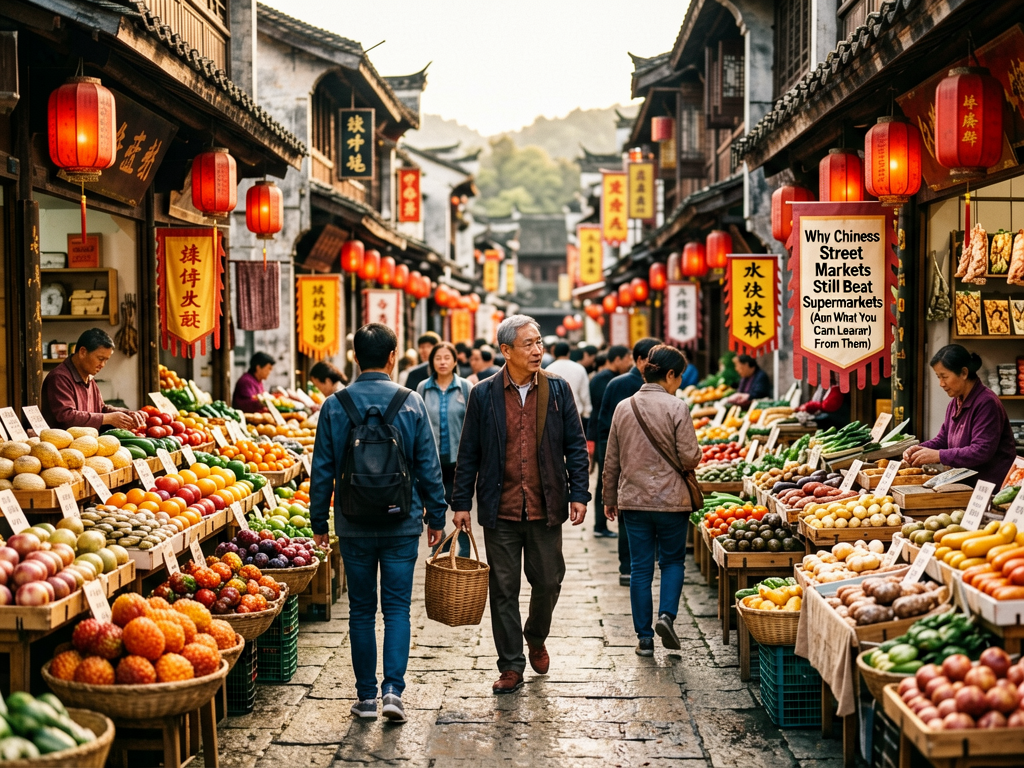
Here’s the thing about supermarkets. They’re clean. They’re air-conditioned. They have those little plastic bags that tie themselves with a satisfying snap. But honestly? They’re boring. I’ve shopped in Carrefours, Walmarts, and the fancy Ole’ stores in Shanghai, and while the tomatoes are uniform and the apples shine under LED lights, something vital is missing. It’s the soul. It’s the chaos. It’s the life.
I lived in China for eight years, and if I had to pick one place that defined my understanding of the culture, it wouldn’t be the Forbidden City or the Great Wall. It would be the morning wet market near my apartment in Chengdu. That’s where the real China happens. That’s where you learn how people eat, how they talk, and how they value each other.
If you’re visiting China or living here, trust me, skip the supermarket for a day. Head out to the street market. It’s louder, messier, and infinitely more rewarding. You’ll get fresher food, better prices, and a story or two you’ll actually remember.
The Sensory Overload Is The Point
Walking into a modern supermarket is like walking into a museum. You stick to the aisles. You don’t touch the produce unless you’re checking the price. You leave without saying a word to anyone. It’s efficient, sure. But it’s sterile.
Now, step into a traditional street market in the early morning. The air hits you first. It’s a thick mix of raw meat, earthy root vegetables, spicy chili oil, and fresh basil. It’s overwhelming at first if you’re not used to it. I remember my first time in a Guangzhou wet market, I almost turned around. The smell of blood and fish was strong. But then I stayed. And I loved it.
Sound interesting? It’s not just noise and smell. It’s energy. You hear vendors shouting prices. You hear customers haggling over the cost of two extra green onions. You hear the clatter of bamboo baskets being stacked. It’s a symphony of commerce that hasn’t changed much in centuries. In a supermarket, the silence feels unnatural. Here, the noise feels like community.
I’ll be honest, I used to worry about hygiene. It’s a valid concern. But here’s what I learned. These vendors have been selling to the same neighbors for twenty years. If their food was bad, word would spread faster than wildfire. They take pride in their stall. You can see it in how they arrange the greens, how they sharpen their knives, how they smile at their regulars. There’s a personal accountability there that a faceless corporation can’t match.
Freshness You Can Actually Taste
Let’s talk about food. This is the biggest win for street markets. In a supermarket, the lettuce might have been harvested three days ago, shipped across the country, and stored in cold storage. It looks pretty in the plastic wrap, but taste it? It’s waterlogged and flavorless.
At the market, the vegetables are often pulled from the ground that morning. I remember buying bok choy from an old auntie in Beijing. She didn’t even wash it properly; there was still dirt on the roots. She told me it was from a farm in the suburbs, picked at 4 AM. I cooked it that night. It was crisp, sweet, and intensely green. It tasted like actual plants, not like products.
The same goes for meat. Supermarkets sell meat that’s been packaged, labeled, and dated. At the market, you watch them cut it. I’ve bought pork belly from butchers who knew exactly how I liked it sliced. They’d ask, “Stir-fry or braised?” before they even put the knife to the board. That kind of service doesn’t exist in a self-checkout lane.
And seafood? Forget it. Supermarket fish is dead, usually frozen, and often lacks that briny, oceanic pop. At a morning market, you pick the fish you want, and they gut and clean it for you right there. The whole process takes five minutes. By dinner, the fish is steamed with ginger and scallions. It’s impossible to get that kind of freshness in an aisle.
Surprised? It shouldn’t be. If you want food that tastes like food, you go where the food hasn’t been waiting in line. Street markets move fast. Goods turn over daily. That means less time in storage and more time on your plate.
The Art of the Deal
One of the most frustrating things for Westerners in China is the haggling culture in markets. In a supermarket, the price is the price. You scan it, you pay it, you leave. Simple. But in a street market, the price is a starting point. It’s an invitation to talk.
I’m no expert in negotiation, but I’ve learned that haggling isn’t about being cheap. It’s about engagement. When I first started buying fruit in Hangzhou, I was terrified to ask for a discount. I’d just pay the listed price. My Chinese friend laughed and told me I was being too polite. “It’s part of the dance,” she said.
So I tried it. I bought a bag of strawberries. I pointed at one bruised berry and asked for a small reduction. The vendor laughed, shook his head, and said, “Okay, okay, for you, take it.” He gave me a few more strawberries on top. It felt like a small victory. It felt like a human interaction.
This dynamic changes how you view value. In a supermarket, you’re a consumer. In a market, you’re a participant. You build relationships. Over time, vendors recognize you. They’ll hold your favorite mushrooms for you. They’ll warn you when the rain is coming and the fish might be muddy. They’ll give you tips on how to cook a strange vegetable you’re holding.
To be fair, not everyone likes haggling. It can feel aggressive if you’re not used to it. But look, it’s low stakes. You’re buying vegetables, not a car. The price differences are usually small. But the social benefit is huge. It breaks down barriers. It makes you part of the local rhythm.
I could be wrong, but I think we’ve lost something with the convenience of fixed prices. We’ve lost the chance to connect with the people who provide for us. Street markets force that connection. And honestly, I’d trade a few extra minutes of haggling for that connection any day.
Seasonality and Surprise
Supermarkets are designed to offer consistency. You want strawberries in January? They’ll have them, likely imported or greenhouse-grown. It’s predictable. But it’s also artificial. Street markets run on the seasons. They run on what’s available right now, in this region.
This seasonality forces you to eat differently. I remember walking through a market in Wuhan during late summer. The stalls were piled high with lotus root and water chestnuts. I didn’t know what to do with them. I asked a vendor. She suggested a cold salad with vinegar and chili. I bought some, went home, and made it. It was crunchy, tangy, and perfect for the heat. I wouldn’t have found that in a supermarket, where everything is standardized.
There’s also the element of surprise. You might go in for eggs and come out with a bag of wild herbs you’ve never seen before. Or a type of mushroom that smells like the forest. I’ve discovered ingredients that have become staples in my kitchen, all because I was willing to wander away from the main aisle.
It’s easier to stick to what you know in a supermarket. The layout guides you. The labels tell you everything. But in a market, you have to explore. You have to ask. You have to be curious. And that curiosity pays off. You end up with a diet that’s more varied, more local, and more interesting.
I love the unpredictability of it. One week it’s bamboo shoots. The next, it’s river snails. You never quite know what you’ll find. And that keeps food exciting. It keeps cooking creative. It stops you from falling into the same grocery routine week after week.
The Community Hub
Finally, let’s talk about the social fabric. In many Chinese cities, the street market is the living room of the neighborhood. It’s where people meet. It’s where news is shared. It’s where the older generation spends their morning exercise and socializing.
I’ve seen grandmothers meeting their grandmothers to discuss the price of pork. I’ve seen young couples buying ingredients for their first dinner together. I’ve seen tourists mixing with locals, pointing at things, asking questions, and laughing. It’s a melting pot of daily life.
Supermarkets are transactional. You go in, you get what you need, you get out. There’s no reason to linger. But in a market, you linger. You watch the interactions. You see the respect elders show to vendors. You see the patience of young parents teaching kids about different vegetables. You see the pride of the workers.
It’s a microcosm of society. And it’s beautiful. I’ve spent hours just sitting at a small plastic stool outside a stall, drinking tea, and watching the world go by. It’s cheaper than a coffee shop. It’s more authentic than a museum. And it’s infinitely more human.
So, next time you’re in China, or anywhere you can find a traditional market, go there. Leave the bright lights and the air-conditioning behind. Go into the noise. Go into the smell. Go into the chaos. You’ll come back with a full stomach, a lighter wallet, and a deeper understanding of the culture that feeds you.
It’s not just about buying food. It’s about participating in life. And that’s something no supermarket can ever offer.