I’ll be honest, when I first arrived in Lanzhou eight years ago, I had no idea what I was walking into. I thought it was just another city with good food. I was wrong. It was a religious experience served in a bowl.
You don’t just eat Lanzhou beef noodles in Lanzhou. You survive on them. You dream about them. You wake up at 6 a.m. because your stomach is screaming for that specific combination of broth, meat, and chewy noodles.
It’s not just breakfast. It’s the heartbeat of Gansu province. And it’s maintained a standard so strict that it hasn’t really changed in over a century. That’s crazy, right?
Let’s talk about why this bowl of noodles is more than just food. It’s a cultural institution.
The Five Essentials Are Non-Negotiable
If you go to a shop in Lanzhou and order noodles, the boss will ask you how you want your noodles done. This isn’t a small detail. It’s the difference between a good meal and the best meal of your life.
There’s a saying that every authentic bowl must meet five criteria. If one is missing, you’re drinking water with some garnishes, not eating beef noodles.
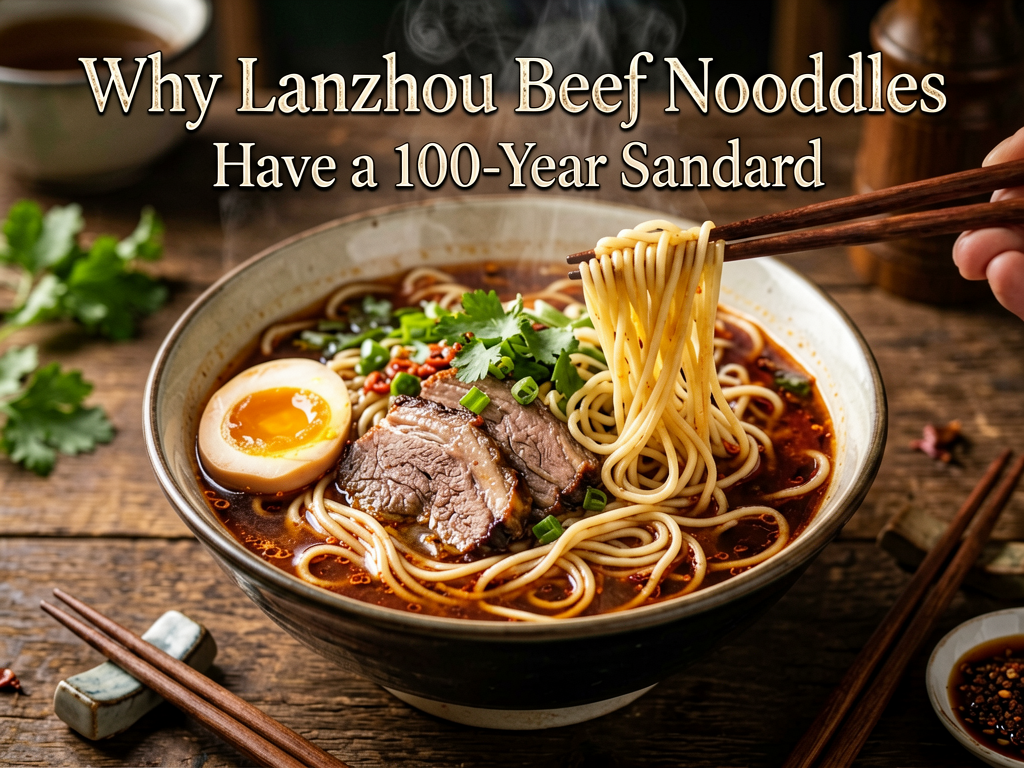
First, the broth. It has to be clear. Not cloudy. Clear. It’s made from beef bones and spices simmered for hours. The meat is boiled separately and added later. This keeps the soup pristine.
Second, the noodles. They must be white, smooth, and strong. The chef pulls them by hand. It’s a performance. You watch them stretch and fold until the dough becomes a long, thin ribbon.
Third, the chili oil. This is where the magic happens. It’s not just spicy; it’s aromatic. The oil is red, bright, and fragrant. It adds warmth without overwhelming the palate.
Fourth, the radish. White radish slices. They’re boiled until tender. They add a subtle sweetness that cuts through the richness of the beef.
And fifth, the cilantro and garlic sprouts. Green specks against the white noodles and red oil. It’s visual harmony. It’s taste harmony.
If any of these five elements are off, the bowl is considered incomplete. Locals will tell you this. Tourists usually don’t notice until they’ve had too many bad bowls.
The Art of the Pull
I spent an afternoon watching a master chef named Master Wang in a tiny shop near the Yellow River. He didn’t say much. He just worked.
He took a ball of dough, slapped it on the counter, and started pulling. It looked like magic. One pull, two pulls, three pulls. The noodles multiplied. Within seconds, he had dozens of strands in his hand.
He asked me what width I wanted. I said “thin.” He laughed. “Thin” is a suggestion. “Extra thin” is a request. “Super thin” is a challenge.
I chose “extra thin.” He nodded, slapped the dough again, and produced noodles so fine they looked like threads. He dropped them into the boiling water. Twenty seconds. That’s all it takes.
The texture is unique. It’s not like Italian pasta or Japanese ramen. It has a chewiness that’s satisfying but not tough. It holds the broth perfectly.
I watched him make three bowls in the time it took me to blink. Speed is part of the standard. You don’t wait twenty minutes for lunch in Lanzhou. You eat, you go, you work.
It’s efficient. It’s delicious. It’s practical.
The Red Oil That Changes Everything
Let’s talk about the chili oil. This is the secret weapon. Without it, the noodles are just boiled pasta in soup.
The oil is made from chili peppers, Sichuan peppercorns, and a blend of spices. The mixture is heated and poured over the chilies. The heat releases the aroma without burning the peppers.
I remember the first time I added chili oil to my bowl. I was hesitant. I’m not a huge spice fan. But the aroma was irresistible. I poured a spoonful in.
The color changed instantly. The clear broth turned a vibrant red. The smell filled the small shop. My neighbor, an older man eating his lunch, nodded in approval.
I took a bite. The heat wasn’t aggressive. It was a slow burn. It woke up my taste buds. The beef tasted richer. The noodles tasted brighter.
It’s not just about heat. It’s about flavor layering. The chili oil adds a depth that you can’t get from salt or soy sauce alone.
Locals add a lot of it. I started adding more too. Now I can’t imagine my noodles without that red gloss on top. It’s the signature of Lanzhou.
A Century of Consistency
How has this standard lasted for a hundred years? It’s not just tradition. It’s economics.
In Lanzhou, noodle shops are everywhere. There’s a shop on every corner. Competition is fierce. If your noodles are bad, you don’t last a week.
Customers know what they want. They’re not easily impressed by gimmicks. They want consistency. They want the same taste every morning.
This pressure ensures quality. Chefs have to maintain the standard. If they slack off, their regulars will leave. Word travels fast in a small community.
It’s a self-regulating system. The customers are the quality control. They’re the ones who enforce the rules of the five essentials.
I’ve eaten at fancy restaurants in Shanghai and Beijing. Some of them try to replicate Lanzhou noodles. But they often miss the mark. The broth is too heavy. The noodles are too soft. The chili oil is too sweet.
Nothing beats the real thing. Nothing beats the simplicity of a street-side bowl in Lanzhou.
The Social Ritual
Eating Lanzhou beef noodles is a social activity. It’s not a quiet, solitary meal. It’s loud. It’s busy. It’s communal.
I’ve seen businessmen in suits eating noodles out of paper bowls on the street. I’ve seen students sharing a large bowl because they’re both too broke to order two. I’ve seen tourists looking confused but happy.
Everyone is equal in the noodle shop. You don’t need reservations. You don’t need a dress code. You just need hunger.
I remember sitting next to a truck driver who had just arrived from Xinjiang. He ordered three bowls. He ate two of them in ten minutes. He thanked the chef in dialect I didn’t understand but felt in my heart.
It’s a moment of connection. Food brings people together. In Lanzhou, noodles are the glue.
It’s raw and real. It’s not polished for Instagram. It’s made for the people who live there.
Why You Should Try It
If you’re planning a trip to China, Lanzhou should be on your list. Forget the Forbidden City for a day. Go to the north and eat noodles.
You’ll understand why the locals are so proud. You’ll understand why the standard hasn’t changed. It’s perfect.
Don’t be afraid to ask for extra chili. Don’t be afraid to try the “super thin” noodles. Embrace the chaos.
I’m no expert on Chinese history, but I know good food when I see it. Lanzhou beef noodles are the gold standard.
They’re simple. They’re affordable. They’re unforgettable.
One bowl won’t satisfy you. You’ll want more. That’s the trap. Once you taste the real thing, everything else feels like a compromise.
I’ve traveled across China for eight years. I’ve eaten dim sum in Guangzhou, hot pot in Chongqing, and dumplings in Xi’an. But Lanzhou beef noodles hold a special place in my heart.
It’s the taste of honesty. It’s the taste of hard work. It’s the taste of home.
So next time you’re in Lanzhou, don’t look for the fancy restaurant. Look for the crowd. Follow the smell of chili oil. Sit down. Order a bowl. And let the standard wash over you.
You won’t regret it. Trust me.