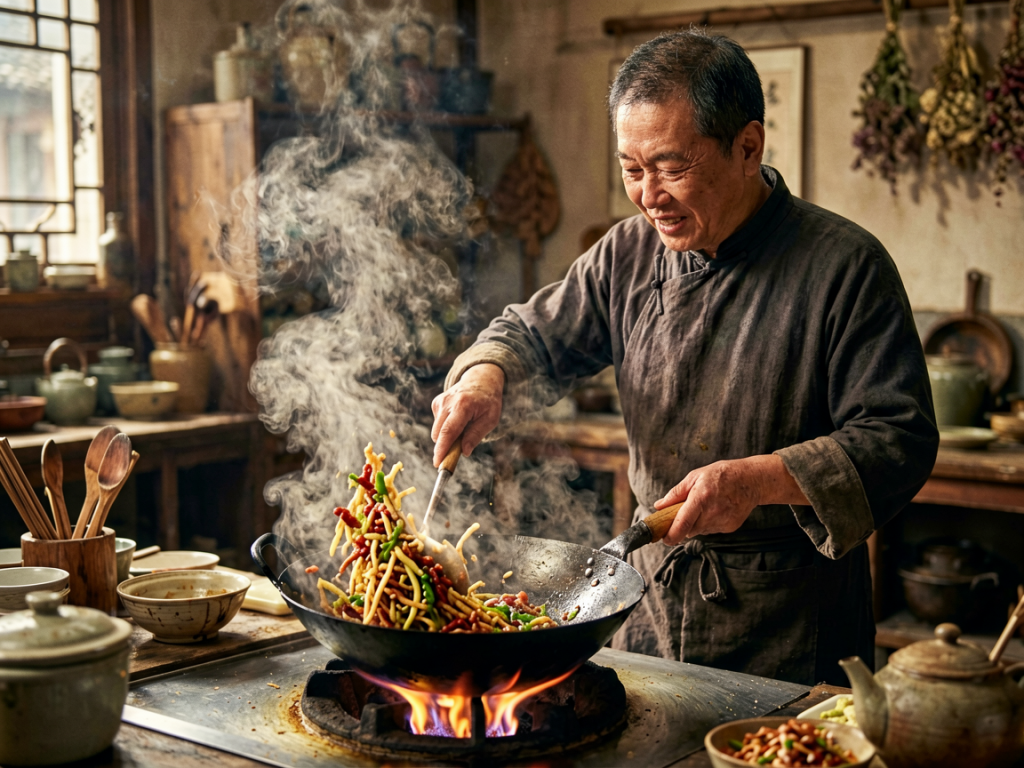
Look, I’ll be honest with you. The first time I ordered stir-fried beef with black pepper in a Guangzhou street stall, I thought someone had slipped something magical into the pan. The meat tasted charred but incredibly tender. The onions carried a deep, smoky sweetness that just refused to leave my mouth. I kept asking the owner what secret sauce he was using.
He just laughed and pointed at the massive gas burner underneath his iron skillet. That’s when I finally learned about wok hei. It translates roughly to “breath of the wok,” but honestly, that phrase barely scratches the surface. It’s the entire reason your Tuesday night stir-fry tastes fine while the restaurant version tastes like it was cooked in a blaze of glory. Sound interesting?
What exactly is wok hei anyway?
I spent about three years living in southern China before I ever put all the pieces together. I’d watch street vendors toss rice, vegetables, and noodles over open flames so hot they looked like miniature dragons. The food would fly through the air, catch fire for a split second, and land back in the pan already tasting completely transformed. I couldn’t figure out how they made ordinary ingredients taste so extraordinary.
Turns out, it’s not magic. It’s just extreme heat, precise timing, and a whole lot of repetition. When you sear ingredients over a roaring flame, the surface sugars and proteins hit temperatures that trigger rapid caramelization. That’s the Maillard reaction doing its heavy lifting. But wok hei adds another crucial layer to the mix.
The oil vaporizes instantly, mixes with microscopic carbon particles from the flame, and coats everything in a faintly smoky aura. It’s literally the breath of the wok infusing itself into every single bite. You can’t really buy this effect in a bottle. I tried, trust me. There are bottles of “wok hei sauce” floating around online, but they’re just soy and sugar masquerading as culinary genius. Real wok hei comes from the violent interaction between intense heat, raw ingredients, and your cooking surface.
The science behind the smoke
Let’s talk heat for a second. Most standard American stovetops max out around five thousand BTUs. A commercial Chinese kitchen rig can push past twenty thousand. That’s a massive gap. When I first moved to Xiamen, I bought a decent nonstick pan and tried to replicate a classic garlic bok choy dish. The greens just steamed in their own juices. They were edible, sure, but utterly boring compared to the crisp-tender perfection I’d been eating at local night markets.
The problem isn’t just the temperature rating. It’s how fast you actually move the food. In a proper stir-fry, ingredients spend maybe thirty seconds in contact with the pan. You toss, you flip, you let the flame lick the edges, and you pull it off the burner before anything turns mushy. That rapid cycling creates micro-burns on the surface of the food. Those tiny charred bits are pure flavor bombs.
I could be wrong about some people thinking char equals burnt, but in wok cooking, controlled charring is the whole point. You want that slight bitterness to cut through the richness of the oil and meat. It balances the entire plate. To be fair, it takes a little getting used to if you’re coming from a Western cooking background where browning happens slowly over medium heat. Here, we’re talking flash-searing that leaves fingerprints on your soul.
My kitchen disaster in Chengdu
I remember one rainy afternoon in 2019 vividly. I’d just moved into a cramped apartment near Jinli Street. The landlord lent me an ancient carbon steel wok that looked like it had survived three dynasties. I decided to tackle mapo tofu, even though I barely knew how to hold a spatula properly. I cranked the gas stove to maximum, threw in some lard and chili paste, and immediately panicked when the whole kitchen filled with thick, acrid smoke.
Turns out, I hadn’t seasoned the wok properly. New carbon steel needs layers of polymerized oil baked onto its surface. Without that foundation, food sticks, smoke fills your lungs, and you end up cursing in broken Mandarin. My neighbor knocked on the door asking if I was trying to summon a fire truck. I laughed until my ribs actually hurt. Lesson learned.
After that fiasco, I started watching the old ladies at the morning market cook. They’d heat the wok until it smoked, pour in cold oil, swirl it around, dump it out, and repeat the process twice. Then they’d fry some ginger and garlic to anchor the seasoning. It seemed ridiculous at first. Why waste good oil? But within weeks, my stir-fries stopped sticking completely.
The food slid around like it was oiled, and suddenly I was getting hints of that elusive smoky depth. It wasn’t quite restaurant level yet, but it was close enough to keep me going. I’m no expert, but I’ve noticed that prepping takes longer than cooking. If you want that restaurant finish, you’d better spend an hour slicing and marinating before you even turn on the stove.
How professional chefs actually pull it off
If you’ve ever stood in a loud, open-flame eatery, you know the noise. Clanging metal, shouting orders, roaring burners. The chefs don’t just cook. They conduct. Every motion is timed to the millisecond. They preheat the wok until it’s nearly glowing, add oil that shimmers before it even hits the surface, and toss ingredients with a wrist flick that looks effortless but takes years to master.
They also use tools designed specifically for this kind of violence against food. A wide, flat spatula called a ho fan or chuan does the job. It scoops, lifts, and flips in one smooth arc. Home cooks usually wrestle with thin, flimsy turning spatulas that bend under pressure. No wonder our food ends up mashed instead of tossed. Easier than you’d expect once you grab the right tool.
Another thing they do differently is ingredient prep. Restaurants don’t chop things randomly. They size everything to cook at the exact same rate. Thinly sliced beef so it sears in twelve seconds. Julienne carrots so they crisp without burning. Marinated proteins that contain a touch of cornstarch to protect the meat from direct flame contact. I’ve noticed that technique matters more than fancy equipment.
Don’t overcomplicate the seasoning either. Some home cooks think adding liquid smoke or heavy soy sauce will fix everything. It won’t. Wok hei relies on dry heat and rapid movement. Keep your sauces light. Add them toward the end so they reduce quickly rather than simmer slowly. A splash of Shaoxing wine thrown into the hot pan will evaporate in seconds, carrying that fermented grain aroma straight into the food. Trust me, it makes a huge difference.
Can you really recreate it at home?
Here’s the thing. You can’t fully replicate a twenty-thousand-BTU burner in your suburban kitchen. I tried. I bought a portable butane stove meant for camping, rigged it up next to my regular range, and attempted a dry-fried green beans recipe. The flames shot three feet high. My smoke detector screamed. The beans came out perfectly crisp and slightly blistered, but my wife threatened to evict me if I did it again.
Still, you can get closer than you think. Start with a carbon steel wok instead of nonstick. The porous surface develops a natural nonstick patina over time, and it conducts heat faster and more evenly. Preheat it properly. Let it get hot enough that a drop of water dances across the surface like mercury. Add oil only after the pan reaches that stage. Cold oil hitting a cold pan just steams. Hot oil hitting a hot wok creates instant vaporization, which is exactly what drives the breath of the wok effect.
Cook in small batches too. Crowding the pan drops the temperature instantly. I learned that the hard way during a family dinner last winter. I threw in enough shrimp and broccoli for four people, forgot about the physics of heat transfer, and ended up with boiled seafood and soggy veggies. Never again. I split the portion, cooked each half separately, and the second batch came out restaurant-quality.
Crisp edges. Smoky aroma. Perfect texture contrast. It’s better than most alternatives because it respects the heat dynamics. I love watching videos of Chinese chefs throwing noodles through open flames. It looks dangerous, sure, but it’s also deeply satisfying to watch. Food should feel alive in the pan. If you’re standing still, stirring slowly, you’re making soup, not stir-fry.
Move fast. Let the heat do the work. Accept that you’ll burn your fingers occasionally. That’s part of the craft. So yeah, your stir-fry probably still tastes a little flat compared to what you get in China. That’s normal. It’s not just about the equipment or the burner. It’s about rhythm. It’s about understanding how heat interacts with oil, protein, and vegetables in real time.
I’ve spent years chasing that smoky ghost in my own kitchen, and I still haven’t nailed it completely. But every time I finally get that characteristic char on a piece of pork belly, or watch the flames kiss the edge of a wok full of rice, I feel like I’m one step closer. It’s messy. It’s loud. It’s absolutely worth it.