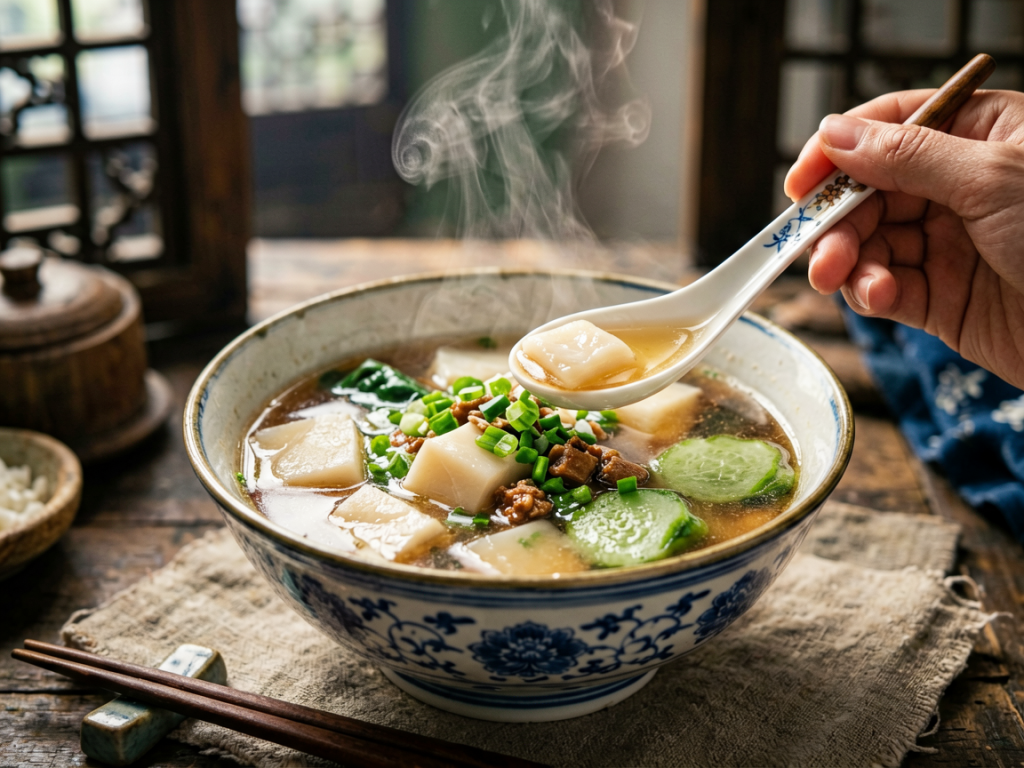
I still remember the first time I sat down for a bowl of tang shui in Guangzhou. It was August, and the humidity felt like a wet wool blanket you couldn’t take off. I ducked into a tiny shop with peeling blue tiles and a plastic stool waiting outside. The auntie behind the counter didn’t speak a word of English, but she pointed to a chalkboard menu and handed me a small ceramic bowl.
Inside was a thick, glossy soup with soft taro chunks, glutinous rice balls, and a handful of yellow osmanthus flowers floating on top. It tasted like comfort in liquid form. I was expecting something fancy, maybe some Western-style pastry or ice cream. Instead, I got a warm, sweet broth that instantly cooled my sweat-soaked shirt.
Here’s the thing. We’ve been sold a certain idea of what dessert should look like. It’s usually cold, heavy on sugar, and designed to be the grand finale of a meal. Tang shui doesn’t play by those rules. It’s not really dessert at all. It’s something else entirely.
I lived in Guangdong for eight years, and I learned pretty quickly that these sweet soups are less about satisfying a sugar craving and more about balancing your body. You drink mung bean soup when the air feels heavy and your skin breaks out. You sip ginger brown sugar tea when the damp chill gets into your bones. To be fair, I’m no expert on traditional herbal medicine, but the logic is pretty straightforward. Food fixes how you feel.
It’s not dessert, it’s medicine for your soul
Western culture treats sweets like a reward. You finish a tough week, you buy yourself a slice of cake. You celebrate a promotion, you grab some gelato. In Guangdong, sweet soups are part of the daily routine. You don’t wait for a special occasion to order a bowl. You just do it because your body needs a little adjustment.
I remember dragging my friend Jason, an expat who’d only ever known California coffee shops, to a local shop near Shamian Island. He looked at the menu and asked if we were ordering soup for dessert. I told him yes, but not in the way he meant. He took one sip of our double skin milk and suddenly understood.
The texture is everything here. It’s not about crunch or frosting or layers of chocolate. It’s about smooth, silky consistency. The milk simmers slowly until a delicate skin forms on top. You stir it gently, and it tastes like cloud fluff with a hint of floral sweetness. It’s better than most ice creams I’ve tried, and it doesn’t sit heavy in your stomach.
Sound interesting? Wait until you see what goes into these bowls. People assume they’re just boiled fruit and sugar. That couldn’t be further from the truth.
These recipes trace back centuries, but nobody really keeps the original ledgers anymore. The knowledge passes through families, then through apprentices, then through neighborhood vendors who swear by their own tweaks. I’ve watched old men add a pinch of salt to lotus seed paste to make the sweetness pop. I’ve seen young baristas swap regular sugar for rock candy to mimic the old-school finish.