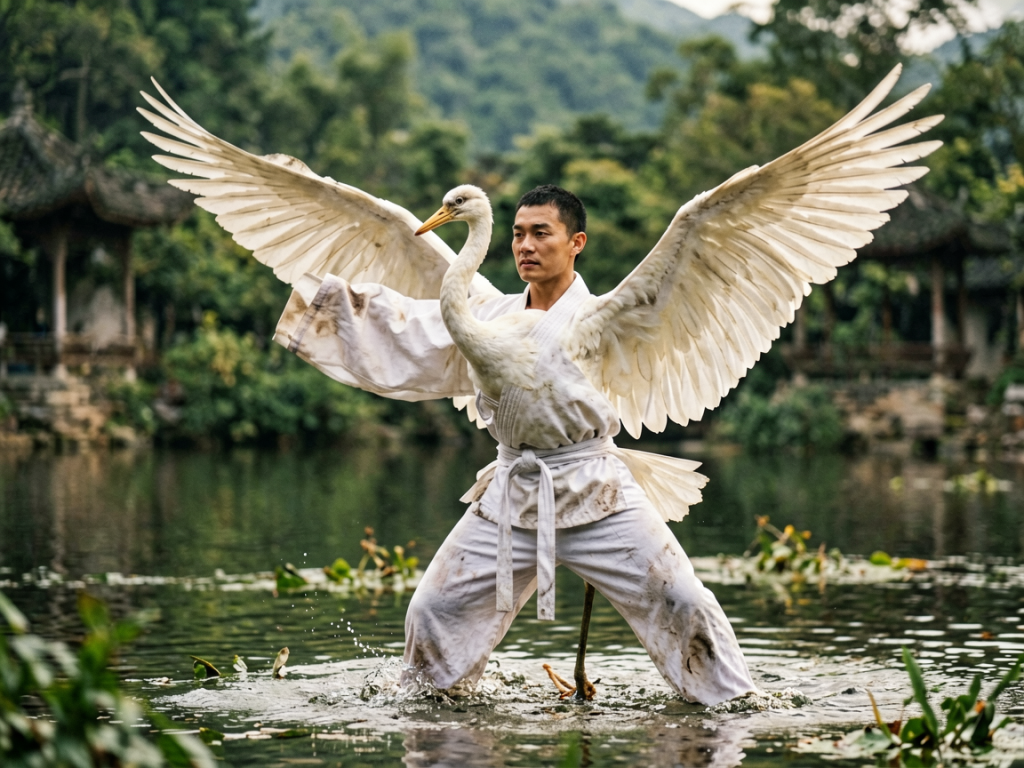
The humidity in Fuzhou doesn’t just hang in the air. It presses against your skin like a damp wool blanket. I wiped sweat from my eyes and watched the old sifu shift his weight onto one leg. His arms bent outward, wrists loose, shoulders relaxed. He looked less like a fighter and more like a bird catching an updraft. I tried to mimic him and immediately toppled forward onto my left foot. Sound interesting?
I’m not talking about a gentle tai chi form here. I was learning Fujian White Crane, and it completely rewired how I understood Asian combat history. Honestly, I never expected to find karate’s missing link in a cramped basement gym above a noodle shop. But that’s exactly where the real story lives. I’ve spent eight years wandering through Chinese provinces, eating street food, and chasing down obscure traditions. Nothing prepared me for how much this style actually shaped modern Okinawan fighting.
How a Chinese Bird Taught Okinawans to Fight
You probably learned karate through Japanese textbooks. You know the stiff stances and the loud kiai. You know the postwar dojo aesthetic that swept across America in the seventies. But strip away the polished uniforms and you’ll find Chinese roots running deep. I spent three months in Quanzhou tracking down the lineage before I even set foot in Okinawa. What I found changed everything I thought I knew.
The truth is pretty straightforward. Fujianese martial artists regularly sailed to the Ryukyu Islands for trade. They weren’t just moving silk and porcelain. They were carrying centuries of combat knowledge. Local Okinawan fighters already knew their own empty-hand system called te. When they met the northerners from mainland China, something clicked. The two styles blended quickly. What emerged wasn’t a copy. It was a practical fusion built for island life.
I remember sitting in a dusty archive in Minhou County, reading faded ledgers from the late Qing dynasty. One entry simply listed a foreign instructor teaching joint locks and acupressure strikes to visiting merchants. That’s basically the blueprint. The crane stance isn’t some mystical pose. It’s a balance trick designed for narrow stone pathways and slippery dock planks. I’ve walked those same docks myself. You quickly learn why stability matters more than brute force.
Modern practitioners often miss the mechanical purpose behind the wing-like arms. They aren’t just posing for photos. Those elbows act as levers to redirect incoming force. I tested this theory during a casual sparring session with a local fisherman who trained under a former monk. He pushed my shoulder forward, and I instinctively dropped my elbow. The push dissipated instantly. I almost laughed out loud because it felt like unlocking a hidden switch. That’s how effective the basics really are.
The Quiet Exchange Across the Water
Historians love clean narratives. They like neat timelines and documented lineages. Real cultural exchange is messier. It happens over shared cups of aged oolong. It happens during monsoon seasons when sailors are stuck in port for weeks. I drank too much of that dark tea with an Okinawan instructor named Hiroshi, and he finally opened up about his grandfather’s training. He slid a yellowed photograph across the table. It showed a broad-shouldered man practicing forms in a courtyard. The stance was unmistakable. The wrist rotations matched the white crane sequences perfectly.
He told me his grandfather trained under a Fujian refugee who fled coastal raids in the eighteenth century. That teacher brought ground sweeps, rib cracking techniques, and relentless breathing drills. Hiroshi laughed when I mentioned standard shotokan kata. He said those famous movements are just watered-down crane patterns. I could be wrong about the exact numbers, but oral histories point to dozens of these exchanges. They didn’t happen in grand academies. They happened in kitchens and boat yards.
You can trace it by looking at the footwork. Notice how both systems pivot on the ball of the foot? That’s not coincidence. It’s a direct adaptation to uneven terrain and crowded ships. I noticed the same mechanics when I visited a traditional dojo in Naha. The floorboards creaked the same way those old dock planks must have. The instructor demonstrated a simple forward step and showed how the heel drops last. It’s a friction-saving technique that preserves energy during long escapes. I never paid attention to that detail until I felt my own ankles protest during a long city walk.
Trade routes worked both ways too. Okinawan sailors sometimes stayed in Fuzhou for months to wait for favorable winds. They traded local herbs and lacquerware for Chinese rice and textiles. Martial artists naturally followed the same schedule. They taught in exchange for shelter and fresh provisions. I bought a worn copy of a handwritten manual from a street vendor near the West Lake. It contained diagrams of joint manipulations that directly mirror early goju-ryu applications. The paper smelled like dried bamboo and old ink. Holding it felt like touching a physical bridge between two cultures.
Why Japan’s Martial History Books Play It Safe
Let’s talk about national pride for a minute. Japan’s postwar martial arts boom relied heavily on branding. They needed something marketable for Western audiences. Clean uniforms, respect rituals, and a distinctly Japanese identity sold books and filled dojos. Acknowledging heavy Chinese influence didn’t fit the marketing plan. I saw this firsthand when I attended a seminar in Tokyo. The instructor politely avoided questions about Okinawan origins. He just smiled and talked about bushido values instead.
To be fair, the adaptation process was massive. Okinawan practitioners refined the techniques over generations. They stripped out some of the more brutal bone breaks and replaced them with controlled strikes. They added rigid kata structures for teaching purposes. That evolution deserves its own credit. But don’t pretend the foundation vanished overnight. I’ve compared side-by-side videos of traditional qigong drills and early karate breathing exercises. They’re practically twins.
The political landscape didn’t help either. During the occupation period, martial arts got tangled up with broader cultural policies. Some instructors deliberately obscured Chinese connections to protect their students from backlash. Others just forgot as time passed. I met a retired sensei in Kyoto who admitted he stopped teaching certain pressure points after the war. He said it kept things simple. Simple sells, but it also erases history. I wish people would stop pretending these art forms grew in a vacuum.
Even famous figures like Motobu Choki publicly acknowledged their teachers. Historical records show he studied extensively under Fujian visitors. Yet mainstream publications rarely highlight those connections anymore. They prefer cleaner origin stories. I found that frustrating when I started researching this topic. I kept hitting dead ends whenever I tried to trace specific kata backwards. The paper trail simply stops in the early twentieth century. Oral tradition fills the gaps instead. I’ve learned to trust what the elders whisper over dinner more than what the textbooks shout in classrooms.
What You Actually Feel When You Step on the Mat
Reading about lineage is one thing. Feeling it in your body is another. I’ll be honest, my first week in Fujian hurt. I thought I was tough from years of kickboxing. Then I tried holding the crane stance for forty minutes straight. My quads burned. My ankles wobbled. My mind wanted to quit repeatedly. That’s the whole point though. The style trains structural integrity before it trains aggression.
The breathing alone will wreck you. Instructors call it iron shirt conditioning, but it’s really just rhythmic diaphragm control paired with muscle tension. You inhale through the nose, lock the core, and strike on the exhale. I paired up with a local student named Lin, and we drilled basic palm strikes for hours. He kept tapping my ribs lightly. Each tap felt like a hammer blow because I wasn’t breathing right. Once I synced my breath, the impact vanished. It’s better than most alternatives I’ve tried because it builds defense without building bulk.
I remember watching a demonstration outside a teahouse in Gulangyu Island. The performers moved slowly, almost lazily. Their arms rippled like fabric in a breeze. Then one guy threw a chain punch that sounded like a whip crack. I jumped back instinctively. That’s the crane secret. It masks devastating power inside relaxed movement. I’ve never felt anything like it in mainstream sport karate. The rhythm feels alien at first. Your brain keeps expecting linear attacks. Instead, you get circular deflections and sudden linear bursts.
Sparring with practitioners of this style changes how you read distance. They don’t close lines aggressively. They let you commit first, then slip your punches while stepping to your blind spot. I took a few solid jabs during my first live drill. Each time, I’d counter, only to realize I was striking empty air. They were already moving to the next angle. It’s exhausting but deeply satisfying. You start respecting patience as a weapon. I went home that night and replayed the footage on my phone. The footwork was barely noticeable, but it dictated everything.
Food plays a role in this training too. You can’t spar effectively on an empty stomach, but you also can’t train heavy after a greasy meal. Local masters swear by congee and steamed buns before morning practice. I tried that breakfast routine and felt surprisingly light. My digestion settled quickly. I never realized how much gut health affects balance until I dropped a bow and couldn’t recover in time. Now I pack preserved plums and ginger tea in my gym bag. It’s a small change, but it keeps me sharp during long sessions.
I came to China looking for food and temple hikes. I ended up falling in love with a fighting style that refuses to stay quiet. Fujian White Crane isn’t just about punching harder or kicking higher. It’s about understanding how cultures borrow, adapt, and survive. The techniques traveled on wooden hulls and survived political purges, wars, and modern commercialization. They’re still breathing today in cramped gyms and sunlit courtyards alike.
Next time you watch a karate tournament, look past the white belts and the trophies. Watch how they move. Notice the wrist angles. Listen to the cadence of their breathing. You might just catch a ghost of a Fujianese crane taking flight. I certainly did. And I wouldn’t trade that realization for anything. If you ever get the chance to train it, drop your ego and show up. Your knees will thank you later.