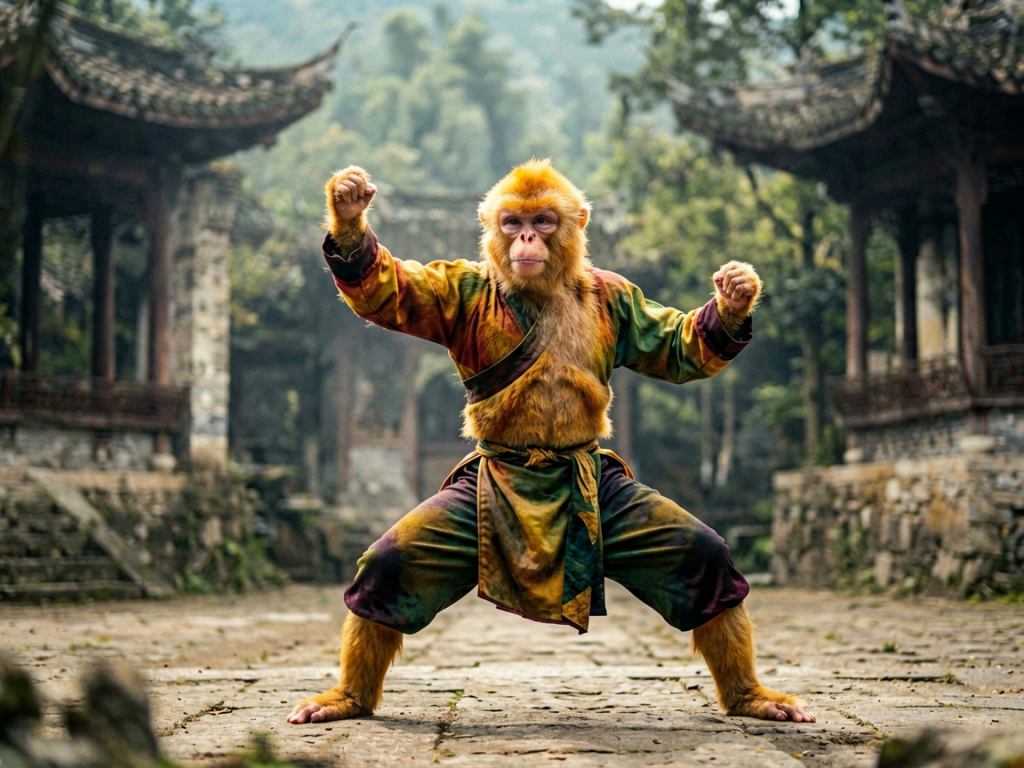
I still remember the first time I watched a proper Hou Quan demonstration. It wasn’t on some polished TV screen. It was a cracked concrete courtyard outside Dengfeng, right after a summer storm. The air smelled like wet dirt and tiger balm. An old guy named Master Chen cracked his knuckles, dropped to one knee, and started hopping around like he’d just escaped a cage.
Everyone else was laughing. Even I smirked a little. Then he snapped into a stance, slapped his own thighs hard enough to echo off the temple walls, and launched into a series of flips that defied physics. My smile vanished. You don’t laugh at Monkey Kung Fu after you’ve seen it work.
Here’s the thing. Most people think it’s just theater. They picture Sun Wukong bouncing around pagodas while orchestras play bamboo flutes. That’s Hollywood nonsense. Real Hou Quan is built for survival. It’s chaotic, unpredictable, and absolutely merciless.
I moved to China eight years ago chasing stories about culture and tea. I never expected to spend my weekends bruised and sweating in a martial arts school. But once I stepped onto that mat, I couldn’t stop. The style hooked me. And honestly, it shouldn’t surprise anyone how deep it goes.
What Actually Happens Inside a Monkey Kung Fu Class
You walk into a traditional training hall expecting formal bowing and crisp uniforms. You won’t find it here. The space usually looks like a storage room for gym equipment. Mats are thin. Walls are stained. Some guys wear faded tank tops that say brands from 2005.
We start with basic leg conditioning. Master Chen doesn’t waste time with philosophizing. He just points at a wooden post and tells us to kick it until our shins burn. Then he makes us hop on one foot while balancing a rice bowl on our head. I dropped three bowls before the bell rang.
After that comes the core repertoire. The monkey stances aren’t pretty. You crouch low, arms bent like claws, shoulders hunched forward. It feels ridiculous at first. I looked like a confused gorilla trying to hide from rain. But hold it long enough and your quads start trembling. That’s the point.
The drills mix animal mimicry with combat mechanics. We practice swinging from imaginary branches, rolling across the floor, and jabbing forward with stiff fingers. Every movement has a purpose. The hops close distance. The slaps distract opponents. The sudden drops break your balance.
By hour two, everyone’s drenched. The instructor stops us only to correct posture or remind us to keep our hips loose. I tried asking about the history mid-session. He just handed me a bottle of weak jasmine tea and pointed back at the mats. Patience, he signed with his hands. You learn by sweating.
The Brutal Truth Behind the Acrobatics
Let’s talk about why this style actually works. It isn’t designed for showboating. It’s built around evasion and sudden violence. You avoid strikes by moving in weird angles. Then you punish openings while the other guy is still turning around.
I learned this the hard way during a sparring session. My partner was six-foot-two, trained in northern boxing, and used to standing tall. He charged at me like a bull. I didn’t block. I dropped to all fours, scrambled sideways, and tapped his knee with a knuckle strike. He went down coughing.
That’s how Hou Quan operates. It rejects rigid geometry. Traditional styles line up shoulder-to-shoulder. Monkey style cuts diagonals. It uses the ground like a teammate. Rolling escapes become counterattacks. Climbing moves translate to joint locks.
The acrobatics aren’t optional flair. They’re tactical necessities. High kicks leave you exposed. Standing exchanges favor taller fighters. If you can’t control height, you change levels. You go low, you roll, you pop back up behind them. Simple in theory. Terrifying in practice.
I’ve watched seasoned sanda fighters get completely thrown off rhythm by practitioners who refuse to stand still. They chase shadows. They swing at empty air. Meanwhile, the monkey stylist is already circling back for a sweep. Sound exhausting? It is. That’s why I quit training in the summer. The humidity made everything twice as brutal.
Why This Ancient Style Still Makes Sense Today
You’d think something so old would fade into museum exhibits. Yet Hou Quan survives because it adapts. Modern martial arts often overcomplicate things. They add new terminology, separate sport from self-defense, and polish techniques until they lose their edge.
Monkey kung fu does the opposite. It embraces chaos. It teaches you to read environments instead of memorizing forms. I’ve seen students use parkour concepts naturally because the style already trains spatial awareness. Walls become platforms. Ropes become levers. Stairs become ambush points.
To be fair, it’s not for everyone. You need a decent baseline of flexibility and coordination. If you carry extra weight or struggle with joint mobility, the early months will wreck you. I gained fifteen pounds of scar tissue before month three. My knees still click when it rains.
But for those who stick with it, the payoff is real. You stop relying on brute strength. You start fighting smarter. The style forces humility. You can’t muscle through bad positioning. You either flow or you faceplant.
I’ve taken workshops in Chengdu and Qingyuan too. The Sichuan variation emphasizes joint manipulation and rapid hand changes. The Henan version focuses on footwork and deceptive lunges. Both share the same DNA. Unpredictability wins fights.
Honestly, it’s refreshing. So much modern combat sports drill linear responses. Counter this punch with that block. Retreat this step then pivot. Monkey style breaks the pattern. It trains you to respond to angles, not just force. That mental shift changes everything.
Learning Hou Quan Without Breaking Your Knees
Training this stuff requires respect for recovery. I used to push through pain like a rookie. That lasted exactly two weeks before I couldn’t squat to tie my shoes. Now I treat my body like an investment account. Small deposits, steady growth.
Warmups take longer than people expect. We do dynamic stretches, ankle rotations, and light jogging on the balls of our feet. Static stretching comes after training, never before. Cold muscles snap. Loose muscles absorb impact.
Footwork drills are non-negotiable. We practice stepping forward, backward, and laterally while maintaining a crouched frame. It feels awkward at first. Your brain wants to stand tall. You have to rewire that instinct. I spent a whole month just practicing the monkey shuffle. No flips, no strikes. Just movement.
Protect your joints with proper gear. I started wearing lightweight knee sleeves after my second class. Cheap ones from Taobao do the job. Wrist wraps help too. Falling backwards on concrete hurts more than you’d think. I bruised my tailbone doing a simple backward roll. Took three days to sit comfortably.
Find a teacher who prioritizes safety over spectacle. Too many schools turn martial arts into circus acts. They push kids into aerial tricks before they can even fall correctly. Real instruction builds foundations first. You earn the flips. You don’t skip to them.
I paid around four hundred yuan monthly for private coaching in Zhengzhou. Group classes ran closer to two hundred. Either way, you’re buying time and attention. Good instructors correct your alignment before praising your speed. That alone separates professionals from influencers.
Looking back, I never imagined Monkey Kung Fu would reshape my relationship with movement. I came to China expecting poetry and quiet temples. Instead, I found sweat, discipline, and a fighting system that laughs at conventional rules. It changed how I walk through crowds. How I handle stress. How I view obstacles.
You don’t train Hou Quan to look cool. You train it to survive unexpected moments. Life throws curveballs that standard routines can’t block. This style prepares you to adapt on the fly. Roll with the hit. Change your level. Strike where they least expect it.
If you ever get the chance, just watch a local group practice. Don’t judge by the grunting or the goofy costumes. Watch the footwork. Notice how they stay balanced while shifting direction instantly. Feel the intent behind every hop. That’s where the real power lives.
I’m still learning. I’ll probably never perform a backflip into a palm strike without wincing. But I don’t care. The style taught me more about humility than any meditation retreat ever could. Sometimes the best lessons come wrapped in chaos. And honestly, I wouldn’t trade those bruised knees for anything.