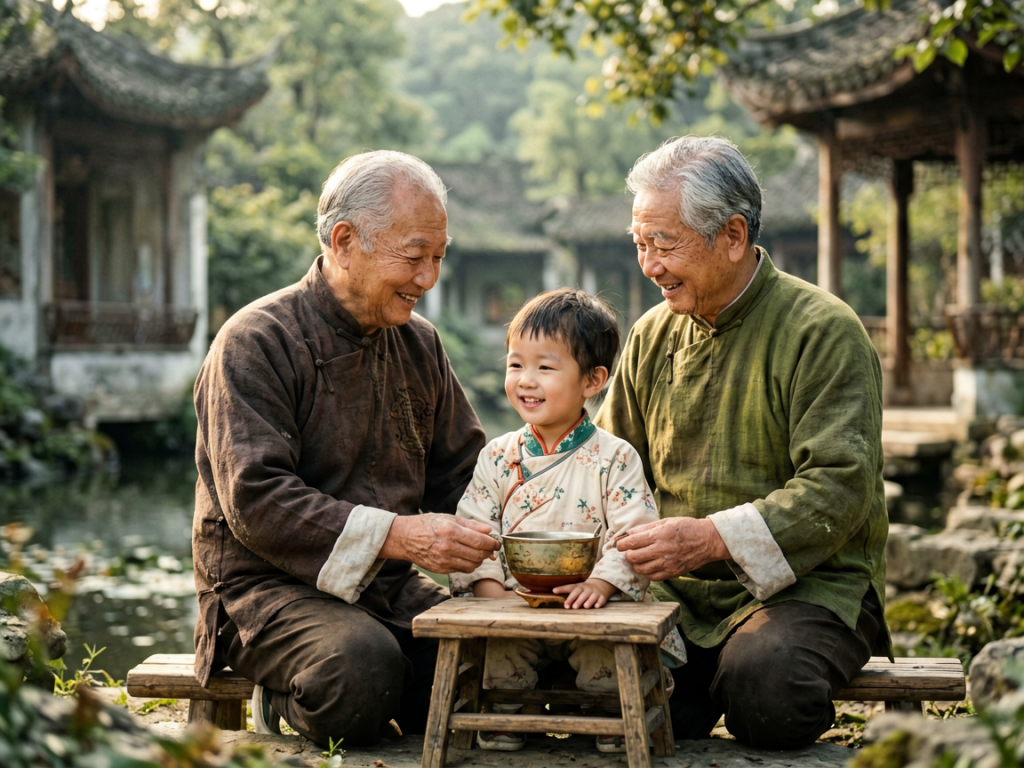
I still remember the look on my mother-in-law’s face when I handed her our three-year-old son. It wasn’t just joy. It was a tactical assessment. She squinted at his wrists, pinched the soft flesh of his cheek, and then looked at me with a mixture of pity and determination.
“Too thin,” she said immediately. “Not enough meat on the bones. We need to fix this.”
That was eight years ago. My son is now eleven. He hasn’t lost an ounce. In fact, he’s gained five since that day. And every time we visit, the cycle repeats. The plate fills up. The compliments flow in English, but the intent is universal across all of China.
If you’ve ever been to a Chinese family reunion, you know the drill. You sit down. You eat. They watch you eat. They ask if you’re full. You say yes. They bring out more food. This isn’t just hospitality. It’s a cultural mandate.
But why? Why are Chinese grandparents so obsessed with turning their grandkids into little barrels of joy? Is it just about love? Or is there something deeper happening here?
The Hungry Ghost of History
You have to understand where they came from. My wife’s parents grew up in rural Henan province in the 1960s and 70s. That was not a glamorous decade for food security.
I met my father-in-law for the first time at a small noodle shop in Beijing. He ordered three bowls of beef noodles for himself and two for us. I told him one was plenty. He laughed, a deep, rumbling sound, and pushed the extra bowl toward me.
“Back then,” he told me later over tea, “if you didn’t eat until you were sick, you wasted the chance. Now we have too much. But the feeling… the feeling stays.”
This is the core of it. For generations, being thin wasn’t a fashion statement. It was a warning sign. It meant sickness. It meant poverty. It meant your family couldn’t afford to feed you properly.
When a child is underweight, the immediate reaction isn’t concern about obesity rates or cholesterol. It’s panic. Panic that the child is sick. Panic that something is wrong. So the remedy is simple: calories. Lots of them.
To them, a chubby baby is a healthy baby. A skinny baby is a dying baby. It’s an evolutionary instinct that got hardwired into their brains during the hardest decades of modern Chinese history.
So when they see your kid picking at his rice, they don’t think, “He’s being a picky eater.” They think, “He’s going to starve unless I intervene.”
Love Looks Like Food
In many Western cultures, we express love through words, time, or gifts. In China, love is often expressed through labor. And what is the hardest labor in the kitchen? Cooking. Specifically, cooking your favorite dishes until they are exhausted from sitting.
I watched my mother-in-law spend six hours making *hongshao rou*–braised pork belly. It’s a heavy dish. Rich. Sweet. Salty. Loaded with fat.
My son doesn’t even like pork belly. He prefers plain steamed fish. But that’s not the point. The point is the effort. The point is the sacrifice of her morning.
She spends hours selecting the freshest ingredients. She waits by the stove. She tastes and adjusts. Then she carries the tray to the table, watching him like a hawk. If he takes a bite, she smiles. If he leaves a piece, she frowns.
It’s emotional sustenance. When they feed you, they are nurturing your spirit. To refuse food is to reject their care. It’s rude. It’s hurtful. It’s a slap in the face to their affection.
I remember one Thanksgiving, which is not a Chinese holiday, but we celebrated anyway. My mother-in-law made turkey, but she seasoned it like a Peking duck. Crispy skin. Sweet bean sauce. Her son-in-law (me) stared at it, confused. She patted my arm.
“Eat,” she said. “You work hard. You need strength.”
I ate every bite. It was delicious, actually. But the message was clear: I am taking care of you. I am keeping you strong. Don’t question the method.
The Skinny Shame
Let’s talk about aesthetics. For a long time, being thin in China was associated with illness. Today, that’s changing among the younger generation in big cities like Shanghai or Shenzhen. Young people go to gyms. They count macros. They want abs.
But the older generation? They haven’t bought into that trend yet. For them, thinness still carries a stigma. A thin grandson might be seen as weak. Not physically strong, but perhaps lacking vitality.
There’s a phrase I heard often in my early days here: “Yuan dun dun” (round and chubby). It’s a term of endearment. You say it about babies. You say it about pandas. You say it about luck.
Conversely, calling someone “shou” (thin) can sometimes imply “shou ruo” (weak/sickly). It’s a subtle linguistic trap. Parents hear “thin” and worry. Grandparents hear “thin” and act.
I’ve seen uncles at family gatherings weigh their nieces and nephews on scales in front of everyone. Not to judge, but to compare. “Ah, last year he was 40 jin. This year 45. Good growth.”
To us, that feels invasive. To them, it’s a report card. It’s proof that the family is thriving. The children are the harvest. If the harvest is abundant, the farm is good.
The Modern Clash
Here’s the thing. We live in a different world now. Childhood obesity is a real crisis in China. The government is even launching campaigns to reduce sugar and fat intake for kids.
But these campaigns rarely reach the grandparents. Or if they do, the grandparents dismiss them. They trust their eyes more than epidemiology studies.
I had a conversation with my father-in-law last month. We were walking in the park. My son was running around, eating a bag of chips. I gently took the bag and threw it away.
My father-in-law stopped walking. He looked at me, then at the trash, then back at me.
“Why did you do that?” he asked.
“He’s eating too much junk,” I said. “And he’s already quite healthy.”
He shook his head. “Healthy isn’t enough. He needs to be strong. Look at his arms. Still too thin. That chip has protein. Meat is better, but chip is okay. Don’t throw it away.”
I was stunned. We were having a battle of ideologies. His generation vs. my generation. Scarcity mindset vs. abundance management.
We compromised, of course. He let the chip stay in the pocket. But the tension remained. I’m trying to teach my son moderation. He’s trying to ensure my son never knows hunger again.
It’s hard to explain to them that we don’t need to stockpile calories. We need to manage them. But how do you argue with someone who believes that every empty plate is a failure of duty?
Bridging the Gap
After living here for nearly a decade, I’ve learned that this isn’t really about food. It’s about connection. It’s about legacy.
In a rapidly changing China, where traditional structures are crumbling, feeding the young is one of the few stable roles left for grandparents. They may not speak the same digital language as their grandkids. They may not understand modern education pressures. But they understand hunger. And they understand how to cure it.
So, when my mother-in-law shoves a piece of braised pork into my son’s mouth, I try to smile. I thank her. I eat it. Even if I’m stuffed.
Because in that moment, I’m not just accepting food. I’m accepting her history. I’m accepting her fears. And I’m accepting her love.
Is it annoying? Sometimes. Is it counterproductive to our health goals? Probably. But is it meaningful? Absolutely.
Next time you visit a Chinese family, don’t fight the plate. Embrace it. Ask for the recipe. Learn the technique. And enjoy the meal. Because that extra bowl of rice? That’s not just carbs. That’s culture.
And honestly? It’s pretty damn good.